


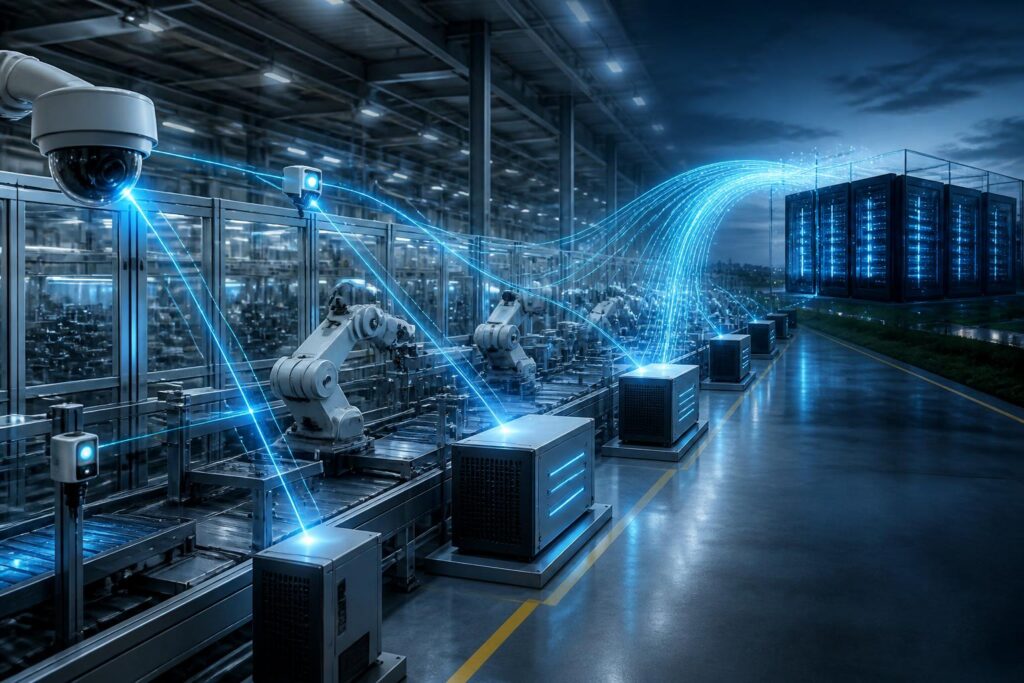
For many years, the familiar image of cloud computing has been data being sent to large server centers for storage and analysis before results are returned to users. This model remains foundational to most digital services, but the rise of cameras, sensors, industrial devices and applications that require immediate responses raises another question: does all data necessarily have to pass through a remote data center before it can be processed?
Edge computing emerged from precisely this need. Instead of moving all workloads to the cloud, this model distributes some computing and storage capabilities closer to where data is generated. That location may be an endpoint device, a controller in a factory, a server at a store, a telecommunications station or a server cluster placed near the user area. The goal is not to eliminate cloud computing, but to build an architecture in which each type of data is processed in a more appropriate location.
What problem does edge computing solve?
The most obvious value of edge computing is shortening the distance between the data source and the place where decisions are made. A camera system detecting objects on a production line, for example, may need to respond immediately when it identifies signs of an anomaly. If the entire video stream must be continuously transmitted to a remote server, transmission time, network congestion and connection failures can all affect the result. When part of the analysis is performed directly in the production area, the system only needs to send alerts or selected data to the central system.
Low latency is important not only in industry. Driver-assistance vehicles, medical devices, building control systems, automated warehouses and real-time interactive services can all benefit from the ability to process data near the device. In these cases, a few moments of waiting can reduce the quality of the experience or make a process less safe than designed.
Edge computing also helps reduce the amount of data that must travel across the network. Not every image, sound recording or sensor reading needs to be stored long term. Edge devices can filter, compress, aggregate or detect events before sending the necessary results to the central system. This approach can reduce pressure on network connections and the costs associated with storing data at scale, while also helping businesses focus more on information with operational value.
Edge does not mean being separate from the cloud
A common misunderstanding is to view edge computing as a complete replacement for the cloud. In reality, the two models often complement each other. Edge devices or servers handle tasks that require rapid responses, local operation or involve sensitive data. The cloud remains suitable for model training, long-term data analysis, centralized management, backup and coordination across multiple locations.
In a hybrid architecture, data can be processed across multiple layers. The layer closest to the device performs simple operations such as reading sensors, filtering noise or issuing initial alerts. The edge layer at the operating site can conduct deeper analysis, coordinate multiple devices and maintain operations when the connection to the central system is disrupted. The cloud layer provides a global view, compares data across areas, updates software and improves analytical models.
This division helps businesses avoid making a rigid choice between centralization and decentralization. The important question is not whether data should reside at the edge or in the cloud, but which data needs to be processed where, for how long and with what level of control. A device can make an immediate decision locally and then send a summary to the cloud for reporting or process improvement.
Fields that need near-real-time processing
In manufacturing, edge computing can connect sensors, machinery and monitoring systems into a local response layer. Data on temperature, vibration, speed or product quality is analyzed directly in the factory to detect signs of anomalies. A central system is still necessary for tracking long-term trends, but initial alerts do not necessarily have to wait for data to pass through multiple network layers.
In retail, stores can use edge servers to manage cameras, inventory devices, checkout points and local control systems. When the wide-area network is unstable, some basic functions can continue operating. Aggregated data can then be synchronized once the connection is restored. This model is especially useful for locations with many devices that do not want to depend entirely on a continuous connection.
In transportation and urban infrastructure, sensors at intersections, parking facilities or along roads can provide timely information to control systems. Processing data close to its source helps reduce the amount of video and sensor data that must be transmitted, while also allowing systems to respond to local situations. Nevertheless, citywide decisions still require a central platform for coordination and overall assessment.
In healthcare, monitoring devices can analyze certain indicators at the point of use, helping reduce waiting times and limit the transmission of unnecessary data. This is a field requiring particular caution because health data is highly sensitive, and every automated alert needs to be placed within an appropriate professional process. Edge computing can support workflows, but it does not automatically replace the responsibilities of healthcare personnel.
Privacy can be improved, but is not automatically guaranteed
Processing data locally can provide privacy benefits. An event-detection system may send only condensed results instead of transmitting entire images or audio recordings to a central server. Businesses can also establish rules to delete raw data after a certain period, retaining only the information needed for operations or auditing.
However, moving data out of a central system does not mean that the data becomes safer in every case. Edge devices are often distributed across many locations, may be situated in difficult-to-control environments and may be operated by different teams. A small server in a store, a controller in a factory or a device placed outdoors each has its own attack surface. If they are not managed tightly, the number of points that need protection increases significantly.
Therefore, security for edge computing must include device authentication, data encryption, access control, software updates and the ability to detect anomalous behavior. Businesses also need to know which devices are operating, which software versions are installed and what data is being processed at each location. A forgotten device or one that no longer receives updates can become a weakness in the entire system.
The biggest challenge lies in distributed management
Deploying a server in a data center is already difficult; managing hundreds or thousands of edge locations is even more complex. Devices may differ in configuration, environmental conditions, connection quality and business requirements. An incompatible update could disrupt operations at a location that the technical team cannot immediately reach.
Therefore, a centralized management platform is an important component of an edge architecture. This platform needs to support device registration, configuration distribution, operational status monitoring, software-version deployment and recovery when errors occur. The update process should also be capable of rolling back to a stable version if a new change causes problems. These requirements are often less prominent in technology demonstrations, but they determine sustainability once a system enters actual operation.
Data between layers also needs to be clearly designed. Businesses must determine what types of data are retained at the edge, what types are synchronized, how frequently synchronization occurs and how to handle situations in which two systems contain different information. Without consistent rules, distributed data can create multiple versions of the truth, making it difficult for employees to know which information is the most current and reliable.
Designing a practical edge system
Businesses should not begin by purchasing equipment and only then looking for applications. The first step should be to determine whether the problem requires low latency, operation during connection outages or limited data transmission. If a task is not affected by waiting time and can be processed effectively on the current platform, moving it to the edge may only make the architecture more complex.
After identifying the problem, the team needs to map the data flow from devices and processing points through central systems to end users. This map helps clarify where data is generated, where it needs to be transformed, who has access to it and what data needs to be stored long term. Only then can the business choose appropriate hardware, software and connectivity methods.
A small-scale pilot project is often safer than a simultaneous full deployment. A business can start with one production line, one store or a group of devices, and then measure response time, resource consumption, stability and operating costs. Actual results will show which tasks should remain at the edge, which should be moved to the cloud and which weaknesses need to be addressed before expansion.
Development trends in edge architecture
As hardware becomes increasingly capable, more analytical and artificial intelligence tasks can be performed directly on devices or servers near those devices. This reduces dependence on continuous connectivity, but it also increases the requirements for model management, output quality checks and consistent updates across multiple deployment points.
Another trend is the closer integration of telecommunications networks, the cloud and processing nodes located near users. The boundaries between data centers, access networks and endpoint devices are becoming more flexible. Applications can move part of their workloads between layers depending on connection conditions, processing loads and response-time requirements.
In this context, edge computing should not be viewed as a new slogan for replacing every existing model. It is a way of organizing computing capabilities that suits a world with many devices, many data sources and many real-time requirements. Its success depends on whether businesses divide tasks correctly, manage distributed points effectively and maintain security discipline.
Cloud computing will continue to play an important role, while edge computing expands processing space closer to real-world operations. When these two layers are designed as a unified system, data is not only stored but can also become a signal for taking action at the right time, in the right place and with an appropriate level of control.
