


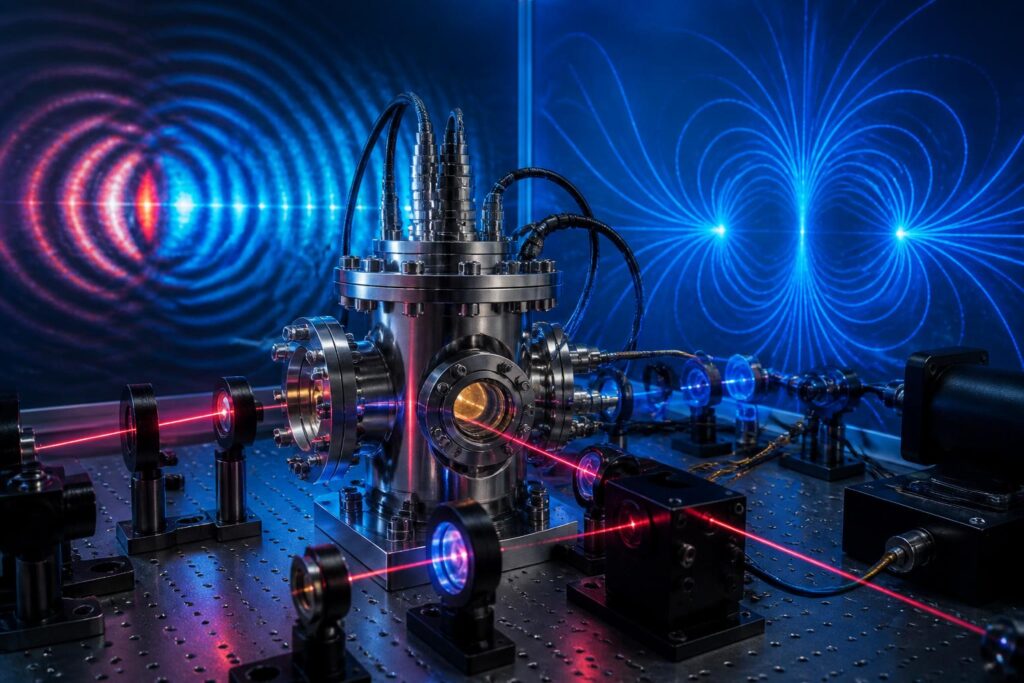
When discussing quantum technology, most attention is usually focused on quantum computers and their ability to process problems that traditional computers struggle to handle. However, another branch is also gradually moving beyond the laboratory: quantum sensors. Instead of using quantum states to perform calculations, these devices exploit the sensitivity of atoms, photons, or special material systems to their surrounding environment. From very small changes in magnetic fields, acceleration, and time to changes in gravity, quantum sensors can create new measurement methods for many fields.
Notably, quantum sensors do not necessarily have to wait until large-scale quantum computers emerge. Some principles have already been studied in devices for measuring time, magnetic fields, and motion, although commercialization remains at different stages. This makes quantum sensing a more practically oriented area of development in the short term, but it does not mean that every product labeled “quantum” is already ready to replace traditional equipment.
What Do Quantum Sensors Operate On?
In everyday life, a sensor may measure temperature through the expansion of a material, pressure through mechanical deformation, or light through the electric current generated in a photosensitive material. Quantum sensors go further by using properties that can only be fully described by quantum mechanics, such as the discrete energy levels of atoms, superposition, interference, or the spin states of particles.
A quantum system is usually prepared in a known state and then exposed to the quantity being measured. This interaction changes the phase, frequency, energy level, or spin state of the system. The readout device converts that change into a signal that can be analyzed. In essence, the sensor does not “see” gravity or a magnetic field directly; it observes how that quantity affects a carefully controlled quantum system.
The high sensitivity of this method comes from the fact that very small effects can accumulate or produce a clear interference pattern. But sensitivity is also a double-edged sword. Vibrations, temperature, electromagnetic noise, pressure, and deviations in the control process can all destabilize the quantum system. Therefore, a sensor capable of detecting weak signals under ideal conditions may not necessarily perform well in the field.
Notable Groups of Quantum Sensors
Atomic Clocks and Precision Time Measurement
Atomic clocks use the frequency of atomic energy-level transitions as a reference standard. For a long time, they have played an important role in positioning systems, telecommunications, and time synchronization. Increasingly compact generations of devices can bring this principle into more environments, rather than confining it to strictly controlled facilities.
Time serves more than simply displaying the hour. In positioning systems, differences in signal transmission time are used to infer location. In telecommunications networks and data centers, time synchronization helps devices coordinate events in the correct order. As the ability to measure time improves, applications dependent on positioning, synchronization, and signal analysis also gain room for development.
Another area of research is the use of highly stable clocks to detect very small changes in gravitational fields. According to relativity, the rate at which a clock runs is affected by its altitude within a gravitational field. In practice, turning this principle into a useful measurement tool requires devices with very high stability and calibration, as well as highly capable data-comparison methods.
Atom Interferometers and Acceleration Measurement
Atom interferometers use clouds of cold atoms controlled by pulses of light. These pulses create different quantum evolution paths, which can then be allowed to interfere with one another. The acceleration or motion of the device changes the interference phase, thereby providing information about the motion of the system.
This principle can support the development of acceleration-measurement systems and gyroscopes that do not depend entirely on external positioning signals. This is significant for vehicles operating in environments where signals are weak or interrupted. However, the devices must maintain stable conditions for the cold atoms, control the lasers, and reduce mechanical vibrations. Miniaturizing the entire system while retaining its performance is not a simple engineering challenge.
Spin-Based Magnetic Field Sensors
Magnetic fields appear in a wide range of systems, from the electrical operation of industrial equipment to biological processes in the body. Some quantum sensors exploit the spin of atoms or defects in crystals to detect changes in magnetic fields. Materials with special defect centers, such as certain diamond structures, can allow the spin state to be read using light and use that change to infer the magnetic environment.
A potential advantage of this group of sensors is their ability to operate under relatively favorable conditions compared with systems that must maintain extremely low temperatures. Small devices can be placed close to the signal source, opening up the possibility of mapping magnetic fields at the microscopic scale. In biomedicine, magnetic-field measurement principles may support research into brain or heart activity, although clinical applications always need to undergo rigorous validation, safety procedures, and approval.
Gravity Sensors and Subsurface Mapping
Gravity at one location is not exactly the same as at another. Differences may be related to the density and distribution of material beneath the surface. Quantum gravity sensors seek to measure these small variations by observing the motion of atoms or changes in the state of a quantum system.
If deployed reliably, such devices could support geological surveys, groundwater monitoring, volcano research, or examination of the structures beneath buildings and other facilities. Gravity data does not automatically indicate exactly where an object is located. It needs to be combined with geological models, topographic data, and other measurements to reduce ambiguity in interpretation. This is an example of how a good sensor is only one part of the entire data value chain.
Practical Applications Are Not Defined by Sensitivity Numbers
In discussions of quantum sensors, sensitivity is often mentioned as the central criterion. However, end users care about a broader set of requirements. A device may detect extremely small signals, but if it requires a cleanroom, a complex laser system, and a specialized operating team, it will be difficult to adapt to a construction site, a mobile vehicle, or an ordinary hospital.
For infrastructure, quantum sensors can support the monitoring of deformation, vibration, magnetic fields, or subsurface changes. Continuous measurements help detect abnormal trends before engineers need to make maintenance decisions. But to create value, the equipment must operate for long periods, maintain stability, and provide data that can be integrated with existing asset-management systems.
In navigation, quantum inertial sensors could serve as an additional layer when satellite signals are unreliable. They do not necessarily replace external positioning systems completely. A more realistic model is to combine multiple data sources, with quantum sensors helping reduce measurement drift while other sources are used for calibration and cross-checking.
In medicine and biology, the ability to measure weak magnetic signals could support research into bioelectrical activity or tissue properties. Nevertheless, the gap between a laboratory prototype and a medical device used routinely is very large. Safety, ease of sanitation, patient comfort, interpretation procedures, and legal responsibility are all just as important as the measurement principle.
Why Is Commercialization Still Difficult?
The first obstacle is environmental control. Many quantum systems require stable lasers, vacuum, magnetic shielding, temperature control, or vibration isolation. When equipment is taken outside the laboratory, these conditions become more difficult to maintain. A solution may achieve impressive results in a static environment but degrade considerably when placed on a moving vehicle or near industrial machinery.
The second obstacle is balancing performance and size. The more sensitive a system is, the more control components it generally requires. Miniaturizing a device is not merely a matter of making its parts smaller; it also requires redesigning how the quantum state is created, how signals are read, how heat is dissipated, how power is supplied, and how the system is protected from noise.
The third obstacle lies in the data. Quantum signals can often be extremely subtle and easily affected by many sources of noise. Operators need appropriate calibration, modeling, and signal-processing methods. If the signal being measured cannot be distinguished from changes caused by temperature or vibration, theoretical sensitivity will not translate into reliability in practice.
Finally, there is the economic challenge. A new sensor has a chance of being adopted only when its ownership, maintenance, and training costs are proportional to the value it creates. Businesses are not just buying hardware; they must also build procedures, connect the data to existing systems, and determine who is responsible when a measurement generates an alert.
How to Evaluate a Quantum Sensor Product
Devices should not be evaluated solely by their sensitivity claims. It is necessary to consider long-term stability, startup time, the ability to calibrate in the field, energy consumption, and performance when environmental conditions change. Another important question is what quantity the device measures under specific conditions, rather than simply asking how small a signal it can detect.
Integration capabilities should also be given top priority. In what format can the data be exported? Does the system provide information about measurement uncertainty? Can it be synchronized with traditional sensors for cross-checking? A well-deployed device must produce data that engineers and managers can understand, store, compare, and incorporate into decision-making processes.
Buyers should also distinguish between a research prototype, a device being tested in the field, and a commercial product. Each stage has a different objective. A prototype may demonstrate a principle; a field trial tests the ability to withstand real-world conditions; while a commercial product must meet requirements for manufacturing, technical support, warranties, and consistency among units.
The Outlook for a New Layer of Measurement Infrastructure
Quantum sensors may not create an immediate replacement for every measuring device currently in use. More likely, they will supplement existing systems, handling measurements that traditional sensors find difficult to perform or that require multiple supporting devices. As optical components, control electronics, and processing software continue to improve, systems that were once suitable only for laboratories may gradually appear in industrial and civilian environments.
The long-term value of this technology will depend on how it connects with specific needs. Measuring a very small signal is only the first step. The more important step is turning that signal into reliable information that helps detect risks early, control equipment more precisely, or expand the ability to observe areas that were previously difficult to access.
Therefore, quantum sensors should be viewed as a maturing measurement technology, not as a promise to replace all existing equipment. Successful projects will be those that begin with a real-world problem, clearly identify the quantity to be measured, compare it with traditional approaches, and validate it under actual operating conditions. When quantum science is combined with systems engineering, signal processing, and product design, effects at the microscopic scale finally have the opportunity to create a major impact in the macroscopic world.
