


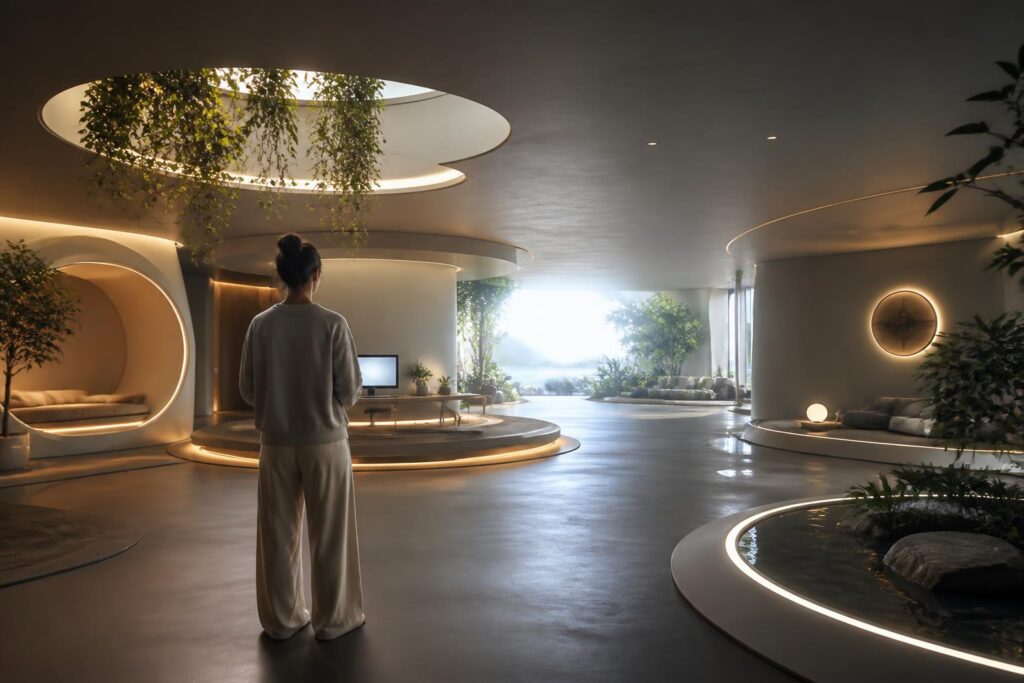
Virtual spaces are often described through highly captivating images: a limitless digital city, a meeting room where people from different places appear together, or a game world that can expand according to the imagination. However, behind those layers of images and sound lies a less-discussed question: at what rhythm will people live in those spaces? A platform may bring users into a virtual world with just a few actions, but it does not always help them know when to stay, when they need to rest, and when they should leave.
This is not merely a matter of personal habits. The way a virtual space is designed can affect users’ levels of concentration, sense of safety, quality of communication, and ability to perceive time. If every component is created to keep users online for as long as possible, the experience risks becoming a continuous stream of stimuli. Conversely, if developers regard agency and the ability to stop as parts of the product, virtual spaces can become environments that support people rather than compete with real life.
When Presence Becomes a Resource
In physical environments, people can often recognize fairly clearly the signals that indicate a meeting is about to end. The light changes, the room gradually empties, transportation arrives at its departure time, or someone stands up and gathers their belongings. These signs are not always perfect, but they help the body and mind adjust. In virtual spaces, many natural signals are replaced by notifications, icons, and programmed movements. A conversation can continue without any sense of time passing, while a new task may appear as soon as the previous one is completed.
Presence in a virtual world therefore should not be understood simply as a logged-in status. It includes attention, emotion, communicative energy, and the feeling of where one is actually located. A person may appear through an avatar but no longer have enough concentration to participate in a conversation. They may also continuously move between multiple spaces, respond to numerous invitations, and receive so many signals that they can no longer distinguish what is important.
Responsible experience design needs to regard users’ attention as a finite resource. Instead of finding every possible way to prolong a session, platforms should help users recognize the intensity of interaction and adjust it deliberately. This can begin with choices that seem small, such as allowing unnecessary movements to be turned off, reducing background sounds, setting a duration for a participation session, or reviewing pending invitations in a clear dashboard.
The Right to Leave Must Be Designed from the Start
Many digital products regard leaving a platform as a simple technical action. Users only need to close the application or remove the device, and that is all. But in a highly social virtual space, leaving also involves a sense of responsibility and a fear of missing out. Someone may want to take a break but still fear that the conversation will continue without them, that they will miss an opportunity to receive an item, or that others will interpret their departure as an unfriendly attitude.
Therefore, the right to leave should be expressed through both design and usage culture. A platform can provide an away status that does not create a sense of apology, allow users to schedule when they will return, and save important information so that they do not have to remain online continuously. In classes or meetings, the system can summarize what has taken place, clearly record decisions and tasks, rather than forcing someone to maintain their presence simply to avoid missing a detail.
It is important that options for resting should not be treated as secondary functions. If the mute-notifications button is buried under multiple layers of settings, while invitations and rewards constantly appear in prominent positions, the design is sending a very clear message about the behavior it prioritizes. A balanced experience needs to make pausing easy, normal, and free from punishment.
Virtual Spaces Need Moments of Silence
Virtual spaces are often evaluated by how lively they are. Surround sound, changing lighting, moving characters, and interactive effects help make a world more convincing. But constant liveliness can also create fatigue. When every surface is moving, every object can be interacted with, and every empty space is filled with sound, users have difficulty finding a point of rest for their eyes and minds.
Silence in design does not necessarily mean an empty room. It could be an area with few signals, a minimalist viewing mode, a period without automatic invitations, or a route that does not demand a response. These moments of silence allow users to reorient themselves, check their own state, and decide what to do next. They also create the contrast needed for important interactions to truly stand out, rather than blending into a uniform background of stimulation.
In spaces intended for work and study, silence also helps distinguish focused time from communicative time. A meeting room should not always maintain background sound and presence signals after the meeting has ended. A virtual classroom may need an area where learners can read, think, or practice independently before returning to the discussion. This arrangement acknowledges that receiving information and responding to information are two different activities that require different conditions.
The Boundary Between Role-Playing and Everyday Life
The ability to role-play is one of the most appealing aspects of virtual worlds. Users can try out a new appearance, enter a different setting, or interact in a form that does not exist in everyday life. This flexibility opens up many creative opportunities, but it also makes the boundary between a staged experience and real emotions more difficult to recognize.
A competitive situation in a game can create a feeling of tension even when participants know it is a simulated environment. An argument with another avatar can still leave an aftereffect once the session has ended. Therefore, platforms need to help users understand which mode they are in, which relationships are temporary, which actions have consequences within the system, and which actions are intended only to serve role-playing.
This does not mean that every sense of realism must be disrupted. On the contrary, transparency can make the experience more trustworthy. Users can be clearly notified when they move from a social area to a competitive area, when an interaction is recorded, or when a character is controlled by the system rather than a real person. Such signals do not reduce the appeal of the virtual world; they help users retain their ability to orient themselves within it.
Designing for Different Bodies and Different Ways of Participating
Not everyone experiences virtual spaces in the same way. Some people are sensitive to rapid movement, some are uncomfortable with dense sound, some cannot use devices for long periods, while others need to communicate through text rather than voice. If an experience is built around only one type of body, one response speed, and one mode of communication, many people will be pushed out even though they can technically access it.
Accessibility should therefore be regarded as the foundation of design, not a final additional layer. Users need the ability to adjust the field of view, movement speed, intensity of effects, interface size, and the way notifications are received. Conversations should have alternatives to voice communication. Important actions should not be indicated only through color or sound. Allowing people to choose different postures, viewpoints, and interaction rhythms also helps reduce the pressure to adapt to a single mold.
Inclusive design also has social significance. When a person can participate in a way that suits them, the group has more opportunities to hear perspectives that might otherwise be overlooked. A good virtual space does not force everyone to demonstrate their presence in the same way. Presence can take the form of speaking directly, sending text, sharing objects, observing, or contributing after the meeting session has ended.
From Time Metrics to Experience Quality
Many platforms tend to measure success by the number of return visits, time spent using the service, or the number of interactions. These metrics are easy to measure, but they do not fully describe the value users receive. A long session is not necessarily more effective than a short one. Someone who sends a great deal of feedback is not necessarily participating more deeply than someone who speaks only once but offers a useful opinion.
For virtual spaces, additional questions about quality need to be asked. Did users accomplish their goals? Did they understand what happened? Can they leave the experience without feeling trapped or pressured? Can the group maintain respect when disagreements arise? These questions are difficult to reduce to a single number, but they reflect the value of the product more clearly.
Developers should also be cautious with reward mechanisms. Rewards can encourage exploration and learning, but if they are distributed in a way that makes users afraid of missing out, they turn a voluntary choice into an implicit obligation. A healthy system should allow users to return without feeling that they have lost everything simply because they took a break for a while. A sustainable rhythm of participation matters more than maintaining an unbroken streak of presence.
The Role of Users in Shaping Spaces
Good design cannot come only from the development team. People who use virtual spaces every day are an important source of information about situations that the initial plan may have overlooked. They know when notifications become too frequent, which behaviors create a sense of pressure, which areas make it difficult for newcomers to fit in, and which rules are being applied inconsistently.
Listening to users should not stop at a generic feedback form. Platforms can organize testing sessions with different groups, make public how feedback is categorized, and explain why a change has been implemented or cannot yet be implemented. When users can see the path their feedback takes, they have greater confidence that they are participating in the building process rather than merely supplying data to a closed system.
Communities also need to establish their own norms concerning time and presence. A working group might agree on contact-free hours, how to signal that someone is concentrating, and how to hand over work when a member is absent. An entertainment community might regard declining an invitation as normal rather than viewing it as a sign of weak engagement. Such conventions help technology serve relationships between people, instead of allowing the interface to determine the entire rhythm of life.
Virtual worlds will continue to develop in many different directions, from learning and working environments to social and creative spaces. Their value lies not only in their ability to make experiences feel more realistic, but also in whether they help people live more autonomously. A trustworthy space must allow users to be deeply present without being forced to remain present forever; to connect with others while still maintaining boundaries; and to explore many roles without losing the ability to return to their own lives.
Ultimately, the most important question is not how to keep users there for as long as possible. It is how to ensure that every entry into a virtual space has a clear purpose, an appropriate pace, and an easily recognizable exit. When the right to rest, the right to choose, and the right to leave are placed on equal footing with appeal, virtual worlds can finally become a sustainable part of human life.
