


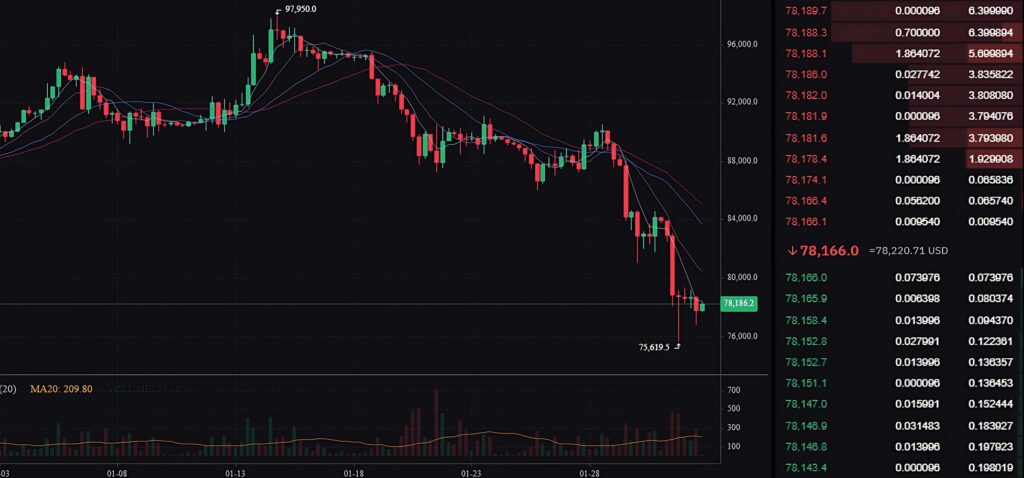
The cryptocurrency market is going through an unusually tense period as Bitcoin plunges sharply, dragging most other digital assets into a downward spiral. Consecutive deep red trading sessions have wiped out hundreds of billions of dollars in market capitalization and dealt a heavy blow to investor confidence, which had only recently recovered after an extended growth phase. The atmosphere now feels less like a routine technical correction and more like a defensive rush away from risk as pressure spreads across global financial markets.
In this picture, Bitcoin once again proves its central role. Every strong downward move in the largest cryptocurrency creates a chain reaction across the entire ecosystem. Prices are not falling solely because of a temporary imbalance between supply and demand, but also because the market structure still depends heavily on financial leverage, herd psychology, and short term speculative capital. When these elements reverse at the same time, selling pressure becomes far more intense than what fundamental valuation models alone can explain.
One striking feature of this downturn is the unusual speed of the decline. Within a short time, several important support levels were broken with almost no meaningful rebound. This suggests not only a lack of proactive buyers but also the presence of forced selling. Such behavior is often a sign of leveraged positions being liquidated, where investors who borrowed funds to trade are forced to close positions because their collateral has lost too much value.
This mechanism works like a domino effect. When prices fall to a certain threshold, systems automatically sell assets to recover loans, pushing prices even lower and triggering additional liquidations. This spiral makes volatility extreme and gives the market the appearance of panic rather than an orderly correction. Notably, much of this activity occurs in derivatives markets, where trading volumes at times exceed those of the spot market.
Amid the sell off, one of the most common questions is whether hedge funds are quietly heading for the exits. In reality, large investment funds are not a single unified bloc acting under one coordinated script, but the pressure to reduce risk is very real. When technology stocks swing sharply and bond yields move quickly, many multi strategy funds are forced to cut exposure to high volatility assets to protect their overall portfolios. Bitcoin, given its sensitivity to speculative flows, often ends up among the first assets to be trimmed.
At the same time, some crypto focused funds also have to adjust when investor capital flows out or when leveraged strategies no longer fit the new market conditions. As liquidity weakens and price swings widen, maintaining large positions becomes far more dangerous. Rather than a coordinated dump, the real picture looks more like a chain reaction of risk management systems flashing warning signals at the same time.
Psychology plays an equally important role. After a strong rally in the prior period, the market accumulated a large number of investors who bought at higher levels, expecting the upward trend to continue. When prices began to weaken and negative news started to appear more frequently, optimism quickly shifted into defensiveness. Late entrants often react more aggressively because they lack the cushion of earlier profits. Selling to preserve what remains of their capital unintentionally adds fuel to the downward move.
In this context, many analysts have begun discussing more negative price scenarios for Bitcoin. If the market fails to find a strong enough support zone to absorb selling pressure, the possibility of a retreat toward the 30000 USD area is not unrealistic. Bitcoin’s history includes multiple episodes where prices fell by more than half within a few months, especially after overheated rallies fueled by high leverage.
A move toward that region would not be just a technical story but also a matter of capital flows. If funds continue reducing exposure to risk assets, if retail investors remain fearful, and if derivatives markets keep seeing large scale liquidations, natural buying demand may not appear quickly enough to halt the fall. On the other hand, a positive macro policy surprise, fresh institutional inflows, or signs of stabilization in traditional markets could help form a balance point before the worst case scenario unfolds.
While Bitcoin struggles, other cryptocurrencies show a clear dependence on its trajectory. Even though each project promotes its own technology, ecosystem, and use cases, actual trading behavior shows that most altcoins still move in the same direction as Bitcoin, often with even larger swings. When Bitcoin drops, investors tend to pull money out of higher risk assets first, putting heavier selling pressure on altcoins and quickly thinning their liquidity.
This reflects the current nature of the crypto market, where Bitcoin remains the primary barometer of overall sentiment. Many traders do not price altcoins based on real usage demand but on speculative expectations and Bitcoin’s price action. When the largest cryptocurrency loses momentum, confidence in the entire asset class weakens alongside it. As a result, even if other blockchains continue operating normally from a technical standpoint, their token prices still fall under the weight of widespread risk aversion.
Even so, strong market swings can bring some degree of divergence. A few projects with their own positive developments, such as major network upgrades or significant partnerships, may hold up better than the broader market for a short time. However, these cases rarely have enough strength to reverse the overall trend if Bitcoin remains under pressure. The high correlation among digital assets shows that the market is still relatively young and heavily driven by speculative capital rather than sustained real world usage.
From a broader perspective, the current sell off is a reminder that cryptocurrencies, despite their rapid development, have not escaped cyclicality and psychological extremes. Blockchain technology may continue to advance and applications may expand, but prices in secondary markets are still led by short term capital flows and expectations of quick profits. When the global financial environment shifts toward tightening or instability, high volatility assets like Bitcoin often react first and most dramatically.
For investors, this period calls for clarity rather than emotional reactions. The scenario in which prices could fall further, even toward the 30000 USD zone if strong support fails to appear, is one that should be considered rather than dismissed. Risk management, controlling the share of digital assets in a broader portfolio, and limiting the use of leverage become critical. Large gains in this market always come with the potential for equally large losses, and sell offs like the current one are the other side of the explosive growth phases that came before.
Ultimately, even though the short term outlook is stormy, extreme volatility also helps cleanse the market. Weak business models, poorly grounded projects, and excessive speculative strategies are often washed out after each deep downturn. Bitcoin and other digital assets may recover in the future, but the path upward is rarely a straight line. This latest sell off is therefore not just a story of falling prices, but also a stress test for the resilience of the entire cryptocurrency ecosystem on its path toward greater maturity.
