


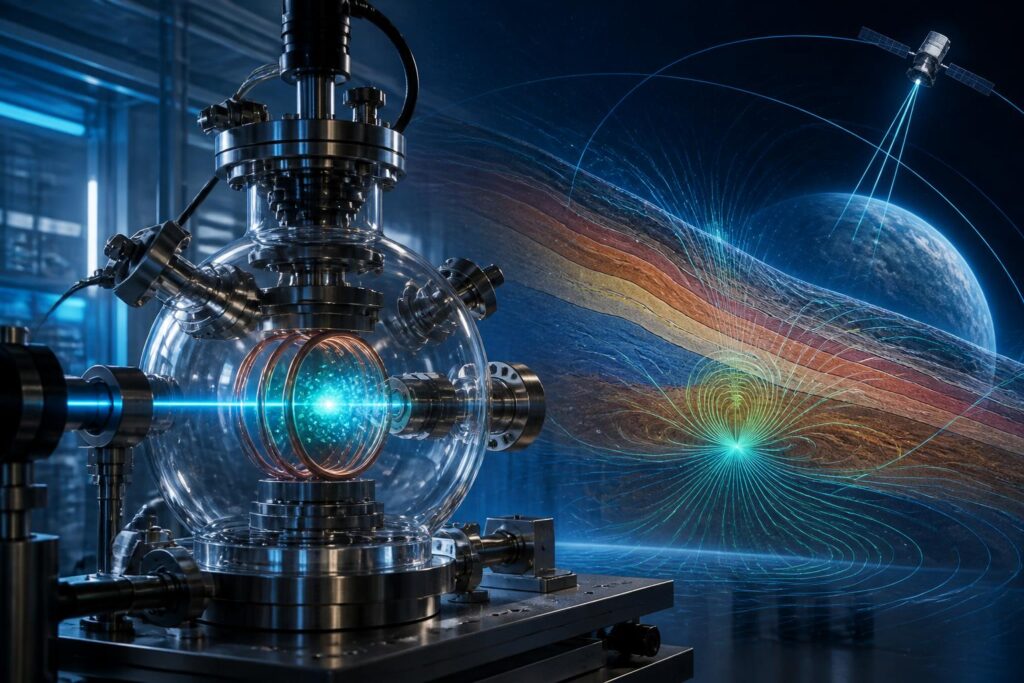
When quantum technology is mentioned, most attention tends to focus on quantum computers and their prospects for processing problems that classical computers struggle to handle. However, another area of development that may reach everyday life sooner is quantum sensing. Rather than using quantum states to perform calculations, quantum sensors exploit the way quantum systems respond to magnetic fields, gravity, acceleration, time, or very small changes in the environment.
What is noteworthy about quantum sensors is not that they always measure everything more accurately than traditional devices. Their value emerges in situations where the signal being observed is too weak, too deep underground, too far away, or too difficult to access using conventional methods. This could involve a small change in a magnetic field, a variation in geological structure, the movement of a submarine, or an extremely slight discrepancy in time measurement.
To turn that potential into products, developers must solve several problems simultaneously: maintaining quantum states, eliminating noise, shrinking systems, reducing energy requirements, and demonstrating that the measurement benefits are large enough to justify operating costs. Therefore, quantum sensing is a field with clear promise, but it should not be described as a technology that automatically replaces every existing sensor.
How Are Quantum Sensors Different from Conventional Measuring Devices?
Every sensor has the task of converting a physical quantity into a signal that can be observed or processed. A thermometer converts temperature into a reading, an accelerometer records changes in motion, and a magnetometer detects the strength and direction of a magnetic field. Quantum sensors perform a similar sequence of functions, but their sensing elements are built on the quantum states of atoms, ions, photons, electrons, or other material systems.
In the quantum world, the state of a system can change in response to a very small influence. That change is encoded in characteristics such as oscillation frequency, phase, energy level, or spin direction. The device prepares the quantum system, allows it to interact with the quantity being measured, then reads the resulting change and converts it into a measurement.
Concepts such as superposition and quantum entanglement are sometimes mentioned when discussing sensor sensitivity. However, they are not a guarantee that every quantum sensor will outperform every other sensor under all conditions. Final accuracy is also influenced by measurement time, the number of repetitions, signal quality, readout equipment, processing algorithms, and the surrounding environment. A quantum system may be highly sensitive in principle but still produce an impractical product if it is easily disrupted by vibration, temperature, or environmental radiation.
Application Areas with Strong Potential
Time Measurement and System Synchronization
Atomic clocks are an important example of using quantum properties to create a stable time standard. The energy-level transitions of atoms can serve as a reference oscillation, supporting systems that require precise synchronization. Telecommunications infrastructure, positioning, power grids, and many scientific activities all depend on determining time and location.
In satellite positioning systems, timing signals directly affect distance calculations. When positioning signals are obstructed or unreliable, alternative positioning methods need to rely on inertial sensors, maps, and other data sources. Smaller clocks and time sensors could help extend the period during which vehicles can operate independently, although they do not eliminate the need for positioning infrastructure and calibration.
Observing Magnetic Fields and Brain Activity
Magnetic fields occur in many natural and artificial activities, from electric currents in devices to the movement of geological materials. Some quantum sensors can detect changes in magnetic fields with a level of sensitivity suitable for tasks that conventional magnetometers find difficult. In biomedicine, recording the very weak magnetic fields generated by the brain’s electrical activity is a notable area of research.
This capability could support research into neural activity without the need to introduce electric currents directly into tissue. However, biological signals are often extremely weak and easily mixed with environmental noise. A practical system requires shielding, calibration mechanisms, signal processing, and reliable methods for interpreting results. Therefore, a more sensitive sensor is only part of the problem; clinical procedures and medical evidence will continue to play a decisive role before the technology can be widely used.
Geological and Resource Surveys
Earth’s gravity and magnetic fields vary according to the material structures beneath the surface. These changes can provide clues about geological layers, tunnels, cavities, or the distribution of certain types of resources. Quantum sensors could help improve sensitivity or measurement capabilities in areas where exploratory drilling is costly and difficult to carry out.
In this field, sensor data do not point to a single conclusion on their own. An anomalous signal may originate from many different structures, so it must be combined with geological models, survey data, and independent measurements. The practical benefit usually lies in narrowing the area that needs to be examined or improving the quality of maps, rather than turning a sensor into a tool that can see through the ground in an absolute sense.
Positioning and Navigation without Satellite Signals
Current inertial navigation systems use accelerometers and gyroscopes to estimate motion. Small errors in individual measurements can accumulate over time, causing the estimated position to gradually diverge from reality. Quantum sensors based on cold atoms or similar configurations are being studied as a way to measure acceleration and motion with greater stability under certain conditions.
This application is significant for ships, aircraft, underwater vehicles, and equipment operating where satellite signals are weak or jammed. Nevertheless, a navigation device must withstand vibration and temperature changes, while also meeting size constraints and requiring rapid responses. A device that is highly accurate in a laboratory may not necessarily be suitable for a vehicle that is constantly in motion.
Why Are Quantum Sensors Difficult to Bring to Market?
The first obstacle is the environment. Many systems require very low temperatures, vacuum chambers, stable lasers, shielding, or complex control systems. These conditions help protect the quantum state but increase size, cost, and maintenance difficulty. Once a device is deployed in the field, mechanical vibration, dust, heat, electromagnetic interference, and pressure changes can all degrade measurement quality.
The second obstacle is the data readout and processing chain. A quantum state cannot always be measured directly as a number on a screen. The system often needs to prepare a state, carry out an interaction, repeat the measurement, and use statistical methods to estimate the quantity being sought. If the signal-readout hardware is not stable enough or the software does not correctly model sources of noise, theoretical sensitivity will not translate into practical accuracy.
The third obstacle concerns economics and operating procedures. A successful product must not only measure well but also be easy to install, have a suitable startup time, consume an acceptable amount of energy, and be compatible with existing data systems. Customers also need to know which decisions the new sensor improves, which costs it reduces, or what capabilities it enables that existing devices cannot provide.
Not a Complete Replacement
A more realistic view is to regard quantum sensors as an additional layer of tools for today’s measurement systems. In many cases, conventional sensors have advantages in cost, durability, speed, and mass production. Quantum sensors should be used only in areas where their sensitivity, stability, or ability to detect weak signals creates sufficient value.
A combined model may be more feasible. A quantum sensor could handle reference measurements or detect anomalous signals, while classical sensors provide continuous data on motion, temperature, and equipment status. Software could then merge these data sources to produce more stable results. This approach also helps the system remain operational when the quantum sensor needs calibration or temporarily fails to meet optimal conditions.
What Will Determine the Next Step Forward?
Progress in quantum sensing depends not only on creating more sensitive sensing elements. Research groups and businesses need to focus on the entire ecosystem, from materials, laser sources, and vacuum equipment to control circuits, processing algorithms, and operating interfaces. The ability to manufacture devices consistently is just as important as an outstanding result in the laboratory.
Evaluation must also be based on specific usage conditions. A highly sensitive measurement that operates only in a strictly controlled environment has a different value from a less sensitive device that can be deployed in the field for many days. Criteria such as operating time, failure rate, calibration time, total cost of ownership, and integration capabilities need to be considered alongside technical metrics.
For users, the important thing is to clearly define the problem before choosing a technology. If the problem can be solved with a cheaper commercial sensor that is accurate enough, a quantum sensor may not be a reasonable choice. Conversely, in fields where a very small signal can change a decision about safety, surveying, or research, investing in new technology may deliver significant benefits.
Quantum sensors are therefore not merely a secondary branch of the quantum race. They sit at the intersection of fundamental physics, measurement engineering, data science, and real-world operational needs. The first applications may not bring about dramatic changes, but they will emerge in specialized tasks where these devices can detect signals that older methods struggle to recognize. The success of this field will be determined by its ability to turn the sensitivity of the quantum world into reliable, easy-to-use tools with clear value beyond the laboratory.
