


The quantum Internet is not a faster version of the Internet
When people hear about the quantum Internet, many imagine a more advanced version of today’s Internet that can transmit data faster or download large files in less time. This understanding is not accurate. The goal of the quantum Internet is not to replace the entire classical data transmission system with a higher-speed network, but to add a new infrastructure layer that allows devices to exchange and use quantum information.
On today’s Internet, data is encoded into bits with values of 0 or 1 and then transmitted through cables, radio waves, and numerous routing devices. A quantum network will still need classical communication channels to control, synchronize, and transmit ordinary information. The difference is that network nodes will be able to create, store, transmit, or share qubits, meaning units of information governed by the laws of quantum mechanics.
Such infrastructure could enable new ways to protect communications, coordinate quantum processors located far apart, and conduct experiments that conventional networks cannot support. However, turning this idea into a widely available service requires researchers to solve numerous problems in physics, hardware, protocols, and network operations at the same time.
How are qubits transmitted?
In many designs, photons are important candidates for transmitting quantum information. Photons can travel through optical fibers or free space while carrying quantum properties such as polarization. When a photon is prepared in a suitable state, it can represent the quantum information that needs to be transmitted between two locations.
However, transmitting a qubit is not like sending a bit. If the state of a qubit is measured directly, the recipient may destroy the very state that is meant to be transmitted. Moreover, it is impossible to create a perfect copy of an unknown quantum state. This is a fundamental limitation, meaning that quantum networking techniques must rely on methods different from copying and amplifying signals in classical networks.
A key concept is quantum entanglement. Two quantum systems can be prepared in a special correlated state, such that the measurement result in one system is correlated with the result in the other. Entanglement does not allow information to travel faster than light, nor does it automatically send the content of a message. Nevertheless, it can be used together with a classical channel in protocols for distributing quantum states or establishing connections between processors located far apart.
Network nodes and quantum repeaters
A large-scale quantum network cannot rely solely on directly connecting every device with long transmission lines. Photons can be absorbed or disrupted as they travel through an environment, especially over long distances. In today’s optical networks, amplifiers can help restore signals. However, amplifying a quantum state cannot be done by simply copying the signal in the classical manner.
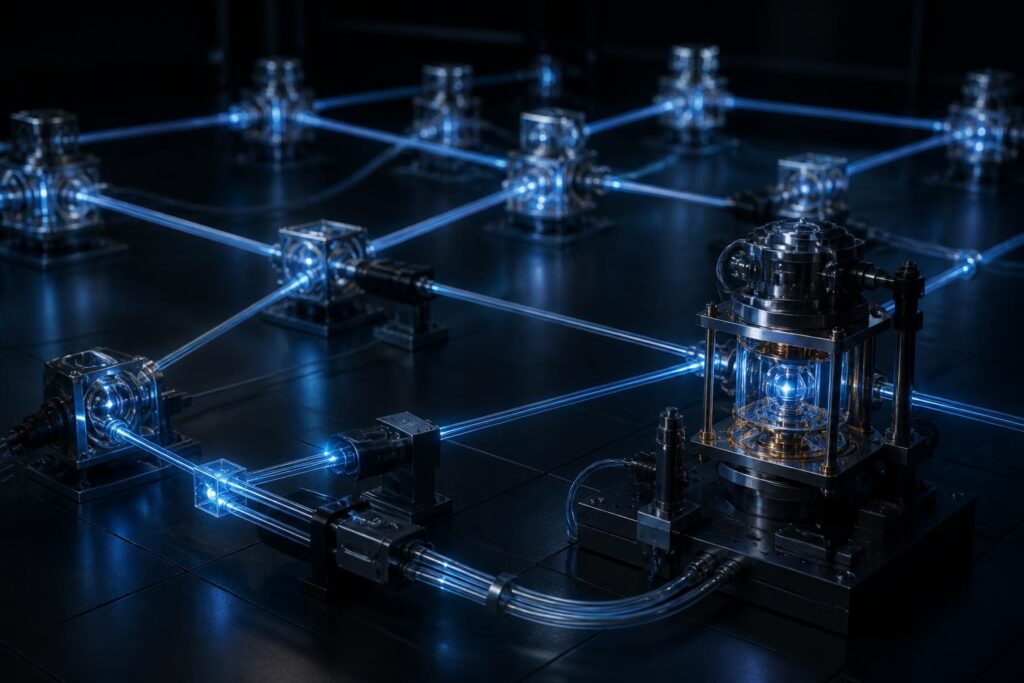
For this reason, researchers have developed the concept of the quantum repeater. A repeater of this kind does not simply receive a signal and retransmit it. It must create entangled pairs of states, store part of the information in quantum memory, perform appropriate operations, and connect short network segments into a longer link. This process requires equipment that can create and detect photons with high reliability while preserving the quantum state long enough for the coordination steps to be completed.
In practice, quantum memory is one of the most difficult components to build. The memory must be able to receive a state from a transmission channel, maintain it for the required period, and release it when requested by the network. Storage time cannot be considered separately from transmission speed, photon-detection capabilities, and the accuracy of operations at network nodes. Just one weak link can significantly reduce the effectiveness of the entire system.
What does quantum security offer?
The application most often associated with quantum networks is quantum key distribution. In this model, two parties can use quantum states to create a shared secret key and then use that key with suitable encryption methods. If a third party attempts to interfere with certain transmission steps, the eavesdropper’s measurements may alter the quantum state and produce signs of abnormal activity.
It is important to note that quantum security does not mean every system using photons is automatically safe. Security also depends on the protocol, source, measurement devices, key-management practices, classical channel, and operating procedures. Hardware flaws or implementation errors can create vulnerabilities even when the protocol’s theoretical principles are highly rigorous.
Therefore, quantum networking should not be viewed as an immediate replacement for all current encryption technologies. It is a complementary approach that may be suitable for communication channels requiring a high level of protection and having the conditions to deploy specialized equipment. Businesses or agencies seeking to adopt it must still assess the cost, scope of protection, maintenance requirements, and dependence on classical network infrastructure.
Connecting quantum computers
Another potential application is linking multiple quantum processors located in different places. A single quantum computer may be limited by the number of qubits, control methods, cooling systems, or the physical requirements of its hardware platform. If processors can share quantum states through a reliable method, the network could support distributed computing architectures.
This does not mean that simply connecting multiple computers will immediately produce a more powerful machine in the familiar sense. Distributed quantum computing must address synchronization between nodes, algorithm partitioning, error management, and coordination of measurements. Transmission latency is also important because a quantum state may be lost before the next computational step can be performed.
Distributed systems also need orchestration software capable of understanding the difference between classical data and quantum states. The scheduler must know when to keep a state in memory, when to establish a link between nodes, and when a measurement can be performed to convert the result into ordinary data. This is a new class of problem at the intersection of computer architecture, information theory, and network engineering.
Obstacles on the path to deployment
The first obstacle is the degradation of quantum states. Heat, vibrations, electromagnetic interference, optical losses, and unintended interactions with the environment can all alter the state of a qubit. The longer the network and the more nodes it has, the more opportunities there are for errors to occur. Maintaining the quality of the connection throughout transmission is therefore a much greater challenge than connecting two devices over a short distance in a laboratory.
The second obstacle is the lack of standardization among hardware platforms. A system may use photons for transmission but a different type of qubit for storage and processing. Converting between different types of quantum systems requires precise interfaces. If devices do not use the same wavelengths, protocols, or synchronization methods, expanding the network will become complicated.
The third obstacle concerns measurement and operation. Quantum networks require sensitive photon detectors, stable sources, synchronized clocks, and continuous monitoring systems. Technicians must distinguish between errors caused by the transmission channel, memory, measurement equipment, or control software. This is an expensive requirement and differs significantly from managing a conventional data network.
In addition, quantum networking protocols still need to be refined so that they are easy to verify and interoperable among providers. A system that operates only in a closed environment will have difficulty creating broad value. Standards for information formats, network-node management, authentication, error tracking, and coordination with classical networks will play an important role as the technology moves from experimentation to deployment.
Can the quantum Internet change today’s Internet?
The most realistic possibility in the near future is not a quantum network that completely replaces the Internet, but a hybrid model. Servers, data centers, user devices, and conventional transmission routes will still handle most data transfers. Some specialized nodes will provide quantum services for specific tasks, such as creating secure links, connecting research equipment, or coordinating quantum processors.
This model resembles the way many new technologies are integrated into existing infrastructure: the new layer does not eliminate the entire old foundation but adds capabilities that the old foundation has difficulty providing. Therefore, the value of the quantum Internet will be determined not only by the creation of a good quantum device, but also by the ability to connect that device with existing network systems, data centers, and operational processes.
Ordinary users may not directly notice that a quantum network is operating behind a service. Its impact may appear indirectly through more secure services, laboratories capable of coordinating remotely, or computing applications that require multiple specialized processors. The pace of development will depend on whether the technology can demonstrate clear benefits compared with the additional cost and complexity.
Conclusion
The quantum Internet is an effort to move quantum information beyond the confines of individual devices. It relies on photons, quantum entanglement, memories, and specialized network nodes, but it still needs classical communication channels for control and information exchange. Potential benefits include key distribution, connections between quantum processors, and support for forms of coordination that conventional networks cannot perform.
Even so, the distance from principle to large-scale infrastructure remains very great. State degradation, memory limitations, equipment reliability, synchronization requirements, and the lack of interoperability standards are all problems that cannot be solved by a single improvement. The most realistic view is to regard the quantum Internet as a specialized network layer being built step by step. As the hardware, protocols, and operating models mature together, it could become an important addition to the Internet ecosystem rather than a comprehensive replacement occurring within a short period.
