


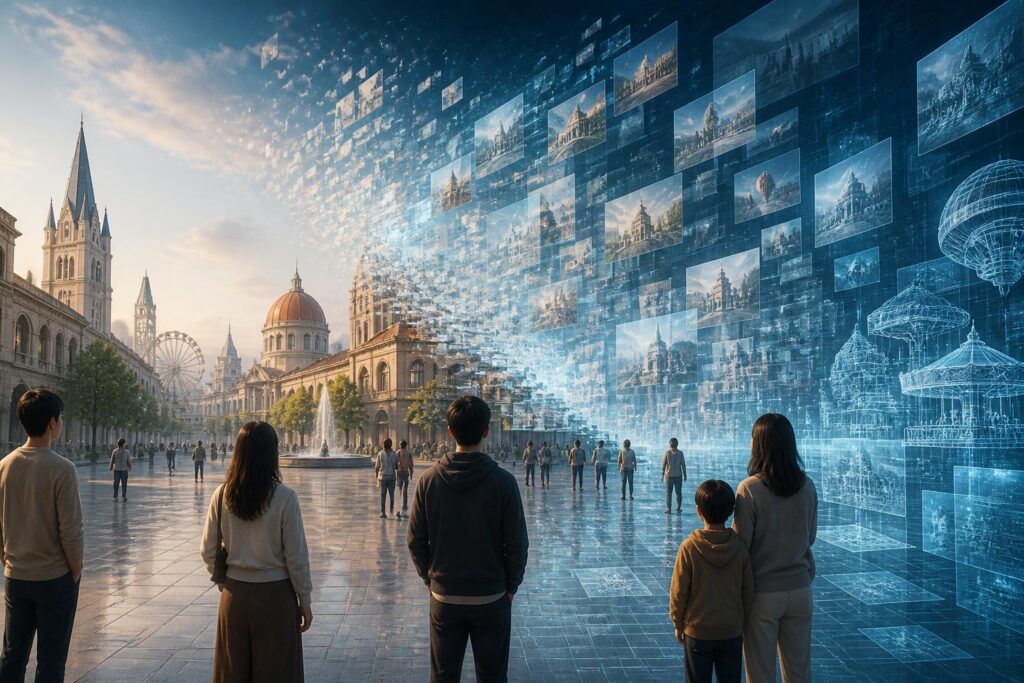
Virtual worlds are often imagined as spaces that are constantly in motion. Today, users enter a familiar square to chat, attend an event, or build a structure. Tomorrow, that square may be redesigned, reduced in size, repurposed, or disappear entirely after an update. An item that once held special meaning may have its appearance changed. A pathway that has become part of one’s routine may no longer exist. For developers, this is the process of improving a product. For users, it can sometimes feel like a very concrete loss.
Memories in virtual worlds do not exist only in images stored on servers. They are formed through encounters, repeated actions, community events, and the periods of time users have spent in a space. When the environment changes, memories do not disappear immediately, but the connection between memory and place can be severed. This raises a notable question: to what extent does a platform have a responsibility to preserve the traces created by its community?
Virtual Spaces Also Have a History
In physical life, a house, street, or schoolyard often carries many layers of memory. People remember a place not only because of its architecture, but also because of the events that took place there. Virtual spaces can also create a similar sense of attachment, even though they exist in a different way. A room built by users, an area often chosen as a meeting point, or a square that has hosted many activities can become a community landmark.
The difference is that virtual spaces depend heavily on the operator’s decisions. Everything from the scale of the map, interaction rules, and decorative objects to access capabilities can be modified through software. In the physical world, a structure may deteriorate but still leave visible traces. In the virtual world, a system change can make an entire old landscape inaccessible through ordinary means. Without a backup, images, or accompanying documentation, users are left only with their personal memories of a place that newcomers can no longer see.
Therefore, the history of virtual worlds is not only the history of software versions. It is also the history of how people use spaces, give objects new meanings, and create community rituals. A location initially designed merely for passing through may gradually become a place where people meet. An item released as a decorative component may become associated with an important period in its owner’s life. That meaning is often absent from the official description and instead takes shape through use.
Product Updates and Quiet Disappearance
Updates are an indispensable part of digital platforms. Developers need to fix bugs, improve performance, add features, and meet new safety requirements. A virtual world cannot remain still if it is to continue operating. However, product language often presents change as progress, while users may experience it as disruption.
That disruption does not necessarily have to be a major event. Sometimes, changing the lighting, sounds, layout, or routes is enough to make a place feel different. Small details that once helped users navigate and recognize a space may be replaced by a new design. A more modern interface may be functionally effective but eliminate familiar cues. For newcomers, the change may seem insignificant. For those who have been attached to the space for a long time, it weakens the sense of continuity between the past and the present.
The issue becomes more apparent when platforms do not fully explain what will be changed. Update notices usually focus on new features, performance, or bug fixes. Elements that hold emotional, cultural, and historical value for the community are rarely mentioned. Users may know that an area is about to be closed, but they do not always have the opportunity to save images, download their creations, or say goodbye to the place.
Not every change needs to be preserved as it is. A platform may need to remove harmful content, fix an unsuitable design, or change its operating mechanisms. What matters is distinguishing improvement from erasure without leaving any trace. When a space is meaningful to a community, the transition process should be considered from both technical and cultural perspectives.
Who Has the Right to Retell the Past?
When a virtual location disappears, its story can be retold through screenshots, videos, articles, or the memories of participants. But these materials always have limitations. A photograph capturing the appearance of a space cannot fully recreate how users moved through it, the sounds they heard, or the interactions that took place. A video may show the landscape but cannot fully reflect the social rules that made the place important.
Therefore, preserving digital memories requires more than copying data. It requires recording context. A valuable archive does not merely answer the question, “What did the space look like?” It also explains who used it, for what purpose, during what period, and how the community gave it meaning. This is an area to which users, community groups, researchers, and operators can all contribute.
Operators generally control the data and display tools, but they are not always the people who best understand the value of a space. Users, on the other hand, have direct experiences and specific stories, though their ability to preserve them may be limited. If only one side decides what is worth keeping, the history of virtual worlds can easily be reduced to product history, in which operational metrics are thoroughly recorded while community memories are overlooked.
A balanced approach is to treat preservation as a collaborative process. Before major changes, a platform can give early notice, provide tools for recording the space, allow the community to contribute materials, and openly state the limits of the data being preserved. Users also need to understand that preserving content does not mean everything must exist forever or that all personal data must be retained. Preservation must go hand in hand with privacy, consent, and the ability to remove information that should no longer continue to be circulated.
Designing for Change, Not Just for the Present
If memory is part of the experience, virtual-world design needs to account for the possibility of change from the outset. A platform could create archives of older versions, historical galleries, or tour modes for spaces that are no longer active. These solutions do not necessarily have to recreate the entire previous system. Even a carefully selected set of landmarks, images, objects, and accounts can help users recognize the continuity of the community.
Designing for change also concerns how users’ objects and creations are built. If a structure can exist only within one version of a platform, its value becomes entirely dependent on the operator’s decisions. Exportable formats, tools for capturing structures, or ways to preserve descriptive information would give creations a chance to be presented again in a different context. Of course, portability is not always simple, because each virtual world has its own rules, visual language, and interaction systems. Nevertheless, acknowledging this need could encourage more open-ended designs.
Equally important is designing how the end of an experience is announced. A platform should not treat closing an area or changing an experience as merely a technical operation if that place has become part of the community’s daily life. A transition period, concluding activities, and opportunities to record materials can help users understand what is happening. Such farewell rituals do not unnecessarily slow technological progress. They help the community process change with a sense of being respected.
Digital Memories and Users’ Responsibilities
The entire responsibility for preservation cannot be placed on the platform. Users also have a role in preserving what they consider important. They can organize photographs, videos, descriptions, and stories with context, rather than merely saving disconnected images. Community groups can build shared archives, record sources, and clearly distinguish personal experiences from verified information.
However, archiving requires care regarding privacy. An archive about a virtual world may inadvertently contain account names, conversations, images, or information relating to people who did not consent to public disclosure. One person’s memory can sometimes become another person’s sensitive data. Therefore, before sharing, users should consider what is truly necessary, who might be affected, and in what context the material may be used.
It is also important to avoid turning the past into a standard for rejecting the present. An old space may have emotional value while still containing limitations in accessibility, safety, or management. Preservation does not mean freezing everything, nor does it mean that every earlier version was better. A more reasonable goal is to help the community understand what it has gone through, why changes occurred, and which values are worth continuing.
Preserving Traces So Virtual Worlds Can Have Depth
A virtual world has genuine depth only when users can sense a connection between different points in time. If every update erases all traces of the past, the space may always seem new but have difficulty developing a history. Conversely, if everything is kept unchanged, the platform will struggle to adapt to new needs. The challenge is not to choose absolutely between preservation and innovation, but to create a layer of memory clear enough for users to recognize the community’s origins.
Digital memory should therefore be regarded as part of the design and governance of virtual worlds. It involves data, access rights, privacy, user experience, and community culture. Every update can be an opportunity to build the future, but it is also a moment to look back at what is at risk of being forgotten.
When a virtual space changes, what matters is not only whether it has become more beautiful, faster, or more convenient. The questions that need to be asked are whether users will still recognize the history of the place, whether their contributions will be acknowledged, and whether the community will have an opportunity to tell its story. A virtual world that knows how to preserve its traces will not be trapped in the past. On the contrary, it will have a stronger foundation for innovation without denying the memories that have given it meaning.
