

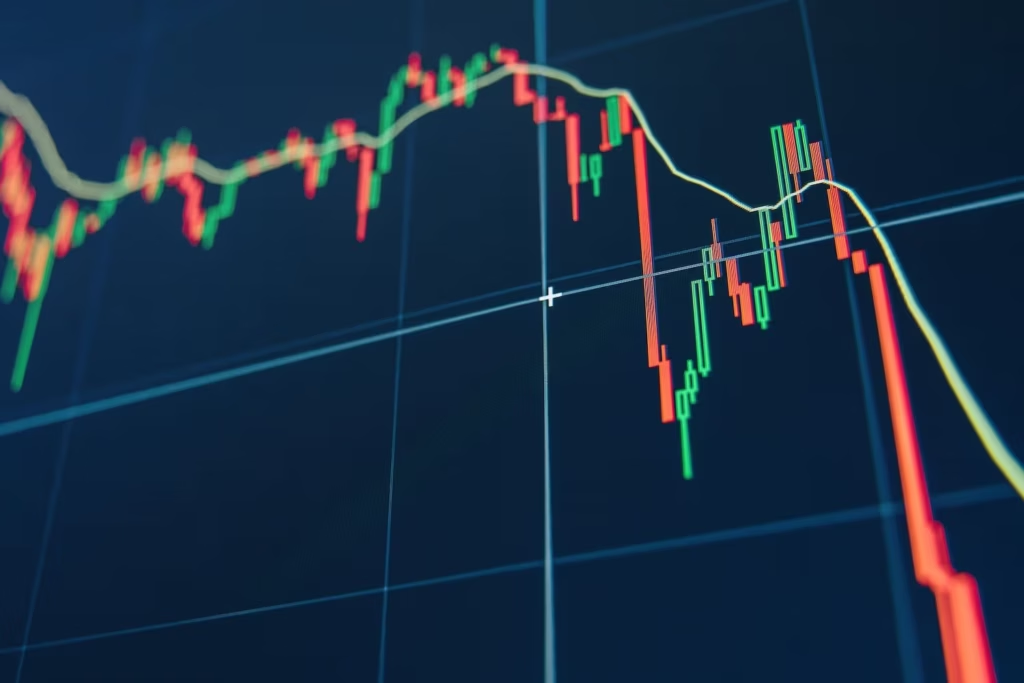
The cryptocurrency market has always been a place where excitement and risk coexist, and the story of RAVE DAO is a striking example. Within a very short period, this token surged dramatically to exceed the $20 mark, capturing widespread attention across the community. Yet almost immediately afterward, the price collapsed by nearly 90% in less than a single day, leaving many investors trapped at the top. This sequence of events is not unusual. In fact, it reflects a familiar pattern within the meme coin segment, where emotions and speculative capital often outweigh intrinsic value.
The rise of RAVE DAO began with a wave of intense enthusiasm. Initially, the project positioned itself around a Web3 music narrative, offering a story compelling enough to draw interest. However, what truly drove the price upward was not its technological foundation or business model, but rather the rapid spread of crowd psychology. As the price began climbing, early participants showcased their profits, fueling a viral effect across social media platforms. New capital flowed in quickly, driven by the fear of missing out, pushing the price even higher.
This phenomenon is commonly known as FOMO, or the fear of missing out. In the meme coin market, FOMO is not just a secondary factor but often the primary driver. When a token rises too quickly, many investors stop focusing on valuation or risk. Instead, they become fixated on how much further the price might go. This creates a psychological feedback loop where rising prices fuel FOMO, and FOMO in turn drives prices even higher.
However, the speed of such growth is also a warning sign. When an asset increases by dozens of times within a short timeframe, it typically indicates that most of the capital involved is short-term speculation. Early buyers are usually quick to take profits once their targets are reached. When selling pressure begins to build, the market can reverse rapidly, especially for tokens with limited liquidity that cannot absorb large sell orders.
The crash of RAVE DAO unfolded almost immediately after reaching its peak. The decline was not only swift but also extremely deep, reflecting a situation where many investors tried to exit at the same time. In such moments, liquidity becomes the critical factor. When sellers significantly outnumber buyers, prices fall sharply. Large sell orders can trigger a cascade, sending the market into free fall. Investors who entered at higher price levels often cannot react quickly enough or fail to sell at acceptable prices, resulting in severe losses.
This pattern is not unique to RAVE DAO. It has been repeated numerous times throughout the history of meme coins. Tokens associated with political figures, celebrities, or viral internet trends have all gone through similar cycles. Prices surge rapidly over a short period, attracting waves of new investors, and then collapse when speculative capital exits. The common thread across these cases is the lack of sustainable underlying value, making prices heavily dependent on market sentiment.
One defining characteristic of meme coins is the extremely short duration of their boom-and-bust cycles. Unlike projects with real technological foundations or practical applications, meme coins lack long-term support mechanisms for their valuations. As a result, when market attention shifts to a new token, capital quickly follows. This explains why many meme coins can multiply in value within days, yet lose most of that value within hours.
In this environment, heavy investor losses are almost inevitable. Late entrants typically bear the highest risk. By the time they buy in, prices are already elevated and the upside potential is limited. Meanwhile, the downside risk becomes significantly greater, particularly when the market turns. Compounding this issue is the psychological tendency to hold onto losing positions in the hope of a rebound, which often leads to even larger losses.
Another factor that exacerbates the situation is the lack of transparency in many meme coin projects. While not all fall into this category, a significant number are created to capitalize on short-term trends rather than to build long-term value. This makes it difficult for investors to properly assess risk. In some cases, large holders can influence price movements, driving up the market to attract new buyers before selling their positions at a profit.
The story of RAVE DAO raises important questions about how investors approach the market. In a highly volatile environment like cryptocurrency, especially within meme coins, risk management becomes more crucial than ever. Not every opportunity is suitable for every participant. Chasing rapid price increases without a clear strategy can lead to serious consequences.
One of the key lessons from such events is the importance of understanding the nature of the asset being traded. Meme coins can generate significant returns, but they come with equally high risks. If participating in this segment, investors should treat it as short-term speculation rather than long-term investment. Setting predefined profit targets and stop-loss levels can help limit potential damage when market conditions turn unfavorable.
Capital allocation is another critical consideration. It is unwise to commit a large portion of one’s portfolio to high-risk assets like meme coins. Instead, investors should consider allocating only a small percentage of their capital to speculative opportunities, while maintaining a core portfolio of more fundamentally sound assets. This approach helps reduce the overall impact of extreme market volatility.
Information and media also play a powerful role in shaping market behavior. In the age of social media, news spreads rapidly, but it is not always accurate or complete. Stories of massive profits tend to be widely shared, while losses are often underreported. This creates a distorted perception of reality, leading many to underestimate the risks involved.
In truth, behind every impressive price surge lies a large number of unsuccessful participants. Those who profit are typically early entrants who exit at the right time. Meanwhile, the majority who arrive later face significantly higher risks. This imbalance is a structural feature of speculative markets, not just meme coins.
On a broader level, the existence of meme coins highlights an interesting aspect of the cryptocurrency market. It is a space where culture, community, and psychology can heavily influence asset values. This creates both opportunities and dangers. For investors, recognizing these dynamics can lead to better decision-making.
The RAVE DAO phenomenon will eventually fade, just as many similar episodes have in the past. However, the lessons it leaves behind remain relevant. New tokens, new narratives, and new price surges will continue to emerge. What truly matters is how each investor responds to these opportunities.
In a market defined by volatility, maintaining clarity and discipline often makes the difference. Keeping emotions in check, questioning risks, and understanding the nature of each trade can help avoid common pitfalls. There is no strategy that guarantees success, but a well-informed approach can significantly improve outcomes.
The story of RAVE DAO, like many meme coins before it, serves as a reminder that high returns always come with high risk. Rapid price increases can be enticing, but they can end just as quickly. In this game, success does not necessarily belong to the fastest, but to those who understand the rules and know when to step away.
