

One of the greatest obstacles facing quantum computers is not producing a calculation strange enough, but keeping that calculation from being disrupted before it is completed. Qubits can exist in superposition and become linked through entanglement, but that very sensitivity also makes them vulnerable to heat, electromagnetic fluctuations, control inaccuracies, and unintended interactions with the environment. A small error during operation can change the final result.
In classical computers, data protection usually relies on redundant bits. A bit can be copied, checked, and restored when a discrepancy is detected. With qubits, this direct approach cannot be applied simply because a quantum state cannot be copied arbitrarily. Therefore, the quantum computing field must develop a different approach: encoding quantum information into multiple physical qubits, tracking signs of errors without directly measuring the content being protected, and then using correction operations to prevent errors from spreading.
How Are Quantum Errors Different from Errors in Conventional Computers?
In classical systems, bits have only two basic states: off and on. A logic circuit may experience a bit flip, but parity checks or backups can often help detect and correct this type of error. Qubits are more complex because their states are described by probability amplitudes. Noise can alter measurement probabilities, produce phase errors, or cause a qubit to lose the quantum relationships it needs with other qubits.
Two commonly discussed forms of error are bit-flip errors and phase-flip errors. A bit-flip error changes the correspondence between a qubit’s two basis states. A phase-flip error does not necessarily change the measurement result immediately, but it can disrupt quantum interference, which is an important component of many algorithms. In practice, a qubit may be affected by multiple forms of noise at the same time, while measurements and quantum gates also introduce their own probabilities of error.
The difficulty is that data qubits cannot be continuously measured to ask whether they are in the correct state. A direct measurement usually changes the superposition state being used by the computation. If checking were performed in the classical manner, the system could inadvertently erase the very quantum information that needs to be protected. Quantum error correction therefore has to measure auxiliary information about errors rather than directly measuring the encoded quantum value.
The Idea of Encoding Information in a Group of Qubits
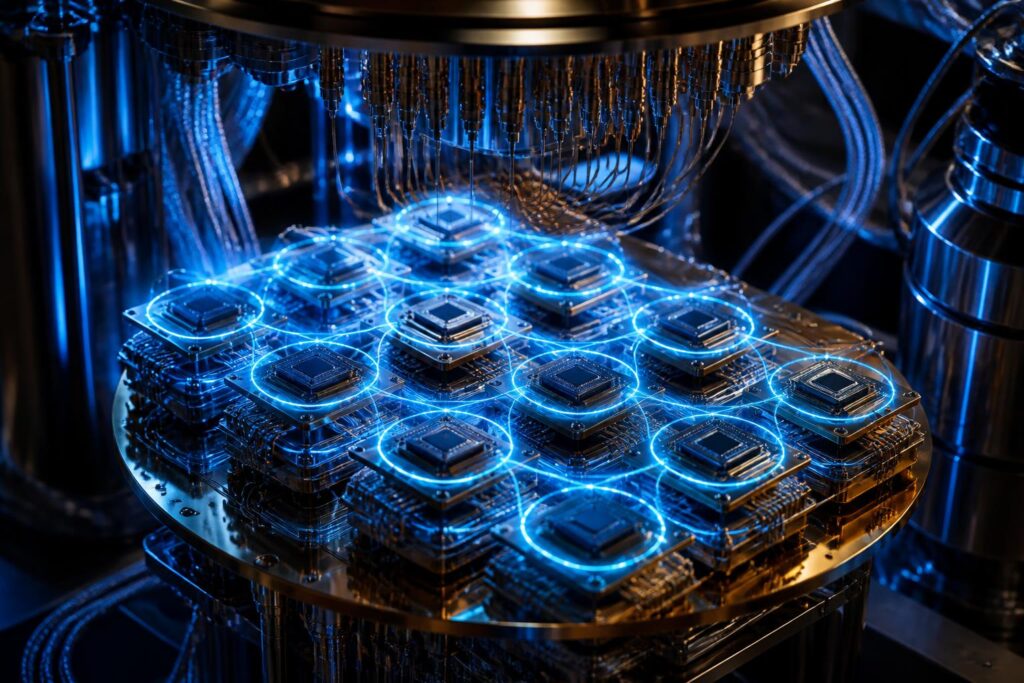
Instead of placing one unit of quantum information on a single qubit, researchers encode it in a state spread across multiple physical qubits. This group of qubits is commonly called a logical qubit. The qubits that directly make up the group are physical qubits. A logical qubit is not a new component separate from the hardware, but rather a way of organizing and controlling multiple physical qubits to create a more robust unit of information.
Within an encoding structure, certain measurements are used to check consistency among the qubits. These measurements do not directly answer what state the logical qubit is carrying. They only indicate whether there are signs of an abnormality in the relationships among the physical qubits. Such a sequence of check results is called an error syndrome. From the syndrome, the controller can infer the type of error that may have occurred and select an appropriate correction operation.
This inference is similar to detecting an error in a network without opening the entire data packet being transmitted. If only one physical qubit is affected, the encoding scheme may help isolate its impact. However, effectiveness depends on the hardware’s error rate, how the qubits are connected, the accuracy of syndrome measurements, and the processing speed of the control system.
Error Thresholds and the Goal of Fault Tolerance
Error correction does not mean that all errors disappear. The practical goal is to make the error probability of a logical qubit lower than the error probability of individual physical qubits. If adding physical qubits and increasing the size of the encoding makes the logical qubit increasingly reliable, the system can move toward a fault-tolerant state. Conversely, if adding hardware introduces too many inaccurate measurements and quantum gates, the entire protection mechanism may create more errors than it corrects.
The concept of an error threshold describes an important boundary. When the basic error rate of operations lies below the threshold appropriate for an error-correcting code, expanding the code can improve the reliability of logical information. When the error rate exceeds the threshold, adding qubits does not necessarily help. This threshold is not a fixed number for every system, because it depends on the noise model, connection structure, type of code, decoding method, and the way each measurement is performed.
This is why the number of physical qubits cannot be used as the sole measure of progress. A processor with many qubits but a high error rate, limited connectivity, or unstable readout may not yet have produced many useful logical qubits. More important is the consistency of the entire chain, from physical qubits and checking circuits to the controller and decoding software.
Why Must the Hardware Scale Significantly?
To protect a logical qubit, the system needs to allocate some physical qubits for data and others for checking operations. These qubits must be controlled according to a precise schedule, while the controller must collect measurement results and process them quickly enough to prevent errors from accumulating during the wait. When a longer computation is desired, the system generally has to increase its level of protection, leading to a need for more physical qubits.
The burden is not limited to the number of qubits. Each qubit needs suitable mechanisms for state creation, control, and readout. Connection lines must limit crosstalk, while cooling or environmental-isolation systems must maintain stable operating conditions. The more qubits are placed within the same architecture, the more complicated signal distribution, thermal management, time synchronization, and hardware fault detection become.
Software must also perform a difficult task. The decoder receives a time sequence of error syndromes and determines the most plausible explanation for the abnormal signs. If the decoder is slower than the rate at which the system generates data, error-correction information may accumulate in a backlog. Therefore, a fault-tolerant quantum computer is not only a problem of fabricating qubits, but also a problem involving control electronics, computer architecture, and data-processing algorithms.
Distinguishing Error Mitigation from Error Correction
While hardware has not yet reached full fault tolerance, research groups often use error-mitigation techniques. Error mitigation attempts to estimate the effects of noise from multiple program runs and adjust the results during post-processing. This approach can be useful for short experiments, but it is not the same as error correction in the strict sense.
Quantum error correction actively detects signs of errors during computation and protects logical information through encoding. It requires additional qubits, measurements, control gates, and decoders. Error mitigation can help make use of existing hardware at a lower cost, while error correction aims to enable longer and more complex computations. The two approaches are not mutually exclusive, but they address different limitations.
This distinction is important when evaluating an experimental result. The fact that a system produces an improved result after post-processing does not automatically prove that it has fault-tolerant logical qubits. To go further, it is necessary to examine the ability to preserve information over many cycles, the degree of error reduction as the code size increases, and whether the checks actually operate stably under different conditions.
From Laboratory Results to Usable Computers
A reliable error-correction system must pass multiple layers of validation. First, each physical qubit must have sufficiently stable and uniform characteristics. Next, syndrome measurements must introduce less noise than the amount of error they help detect. The decoder must then distinguish measurement errors from errors occurring on data qubits, because these two types of signals may appear simultaneously.
The control architecture must also be designed so that when a qubit or signal channel encounters a problem, the entire program does not immediately fail. This requires flexible calibration, monitoring, and replacement capabilities. A system capable of running a short experiment is not necessarily ready for algorithms that require long operating times. Reliability must be evaluated over many cycles and many types of circuits, rather than based on a single result.
From the user’s perspective, future fault-tolerant quantum computers may be accessed through software layers similar to those of other specialized computing platforms. Programmers will not need to track every physical error, but they will still have to understand the cost of encoding, execution time, and the resources required by each algorithm. A program described concisely at the logical level may require a substantial amount of hardware at the physical level.
What to Watch for in the Next Stage
Progress in quantum error correction should be viewed through specific questions: Does the logical-qubit error rate decrease as the level of encoding increases? Can the system preserve a state over many cycles? And does the control cost increase in a way that remains feasible? These questions are more practical than simply counting qubits or looking at a single demonstration computation.
The challenges that remain are substantial, but the direction has clarified the nature of the problem. A useful quantum computer needs more than qubits capable of producing superposition. It needs a layer of protection that can recognize noise without destroying information, a sufficiently stable hardware architecture, and software that is fast enough to respond to errors. When these layers are developed simultaneously, logical qubits may have the opportunity to become reliable units of computation rather than merely a theoretical concept.
Ultimately, quantum error correction shows that the field is moving from asking whether quantum effects can be produced to asking the more difficult question of how to control those effects at large scale and for a sufficiently long time. The gap between these two questions is precisely where most of the engineering work in quantum computing is taking place.
