


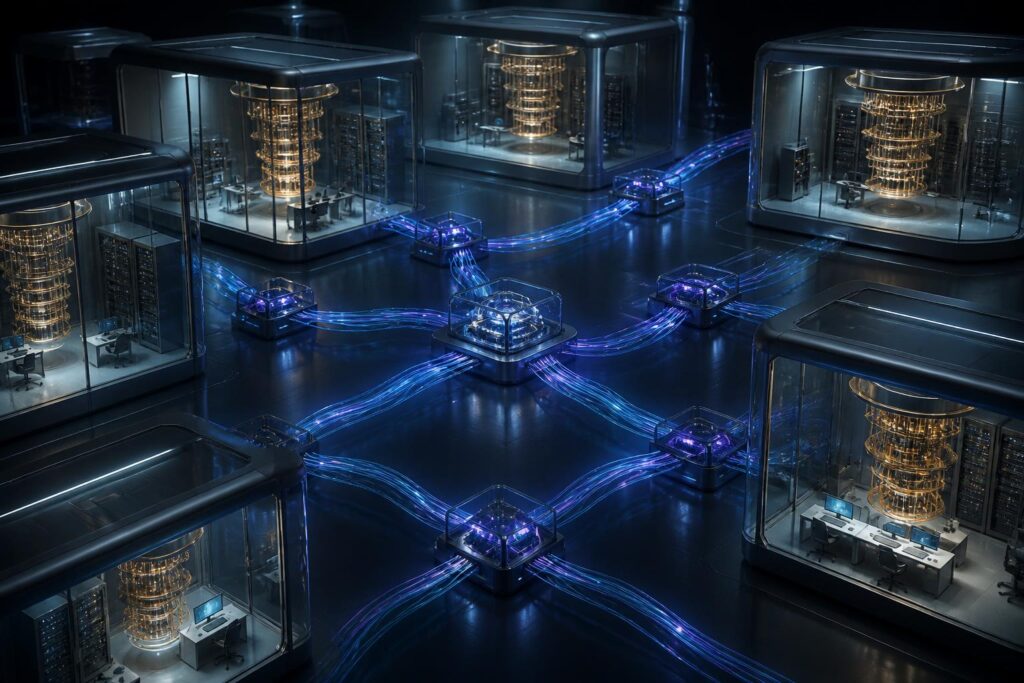
When people talk about quantum computers, most of the attention usually focuses on the number of qubits, error-correction capabilities, or the algorithms that can run on this new hardware. However, another equally important question is gradually emerging: what happens when a quantum computer does not operate alone but needs to connect with other machines? The answer lies in the idea of a quantum network.
A quantum network is not simply a matter of connecting quantum computers with faster network cables. It requires quantum data to be created, transmitted over distances, temporarily stored, and measured without losing its inherently fragile properties. For this reason, it is a distinct area of development at the intersection of quantum computing, optical communications, quantum physics, and control engineering.
How Is a Quantum Network Different from Today’s Internet?
The modern Internet transmits information using classical bits. Each bit can represent one of two basic states, commonly envisioned as zero or one. Data is copied, amplified, stored in memory, and checked as it passes through multiple intermediary devices. If a data packet is corrupted, the system can resend it or use familiar error-correction mechanisms.
Qubits operate differently. A qubit can exist in a superposition of basic states, and it can also be connected to another qubit through the phenomenon of quantum entanglement. These characteristics create special potential for computing and communications, but they also make qubits much more difficult to handle. When measured, a qubit can change state. When it interacts with its environment, quantum information can degrade or disappear, a process commonly known as decoherence.
In a quantum network, the goal is not to transmit a string of qubits in the same way as an ordinary data file. The network must preserve quantum relationships between nodes, such as entanglement, while limiting the effects of noise and distance. This requires end devices, transmission channels, quantum memories, and control protocols to be designed as an integrated system.
What Role Does Quantum Entanglement Play in Connecting Nodes?
Quantum entanglement is a special connection between quantum systems. When two qubits are created in an entangled state, the measurement result of one qubit is correlated with the measurement result of the other, even if the two qubits have been taken to different locations. This correlation does not mean that messages can be sent faster than light. The transmission of useful information still requires classical exchanges and must follow known physical limits.
In the context of networks, quantum entanglement can be viewed as a resource for carrying out tasks that classical networks have difficulty providing. One important example is transmitting a quantum state from one node to another without directly transporting the physical carrier of the original state. This process is commonly called quantum teleportation. The name can be misleading, because it does not move matter and does not allow quantum states to be copied arbitrarily. Instead, the state is reconstructed at another location through a pair of entangled qubits, measurements, and classical information.
This capability makes quantum entanglement the foundation of many proposed network architectures. But creating an entangled pair in a laboratory is one thing; maintaining an entangled pair across multiple devices and distances is another. Transmission loss, the accuracy of photon sources, detector efficiency, and memory stability can all reduce the quality of the connection.
Why Can’t Quantum Signals Simply Be Amplified?
In conventional telecommunications networks, a weak signal can be amplified at intermediate stations. This approach cannot be directly applied to a qubit whose state is unknown. A basic principle of quantum mechanics states that a perfect copy of an arbitrary quantum state cannot be created. If a device attempts to copy a qubit to strengthen the signal, it will be unable to produce an exact copy in every case.
This is why quantum networks require different solutions. One important approach is the quantum repeater. Instead of amplifying the original state, the system divides the distance into a number of shorter segments. Intermediate nodes create and store entangled pairs, then carry out linking procedures to extend the quantum relationship across multiple segments. This idea avoids requiring a single photon to travel the entire long distance without loss, but in return it requires the intermediate nodes to be capable of storing, synchronizing, and processing quantum states.
A quantum repeater is not a simple device that can be installed in an existing network. It needs a quantum memory that is stable enough to wait for events to occur across different network segments. This waiting time is important because the process of creating entanglement does not always succeed on the first attempt. If the memory loses its state too quickly, the benefit of dividing the distance into smaller sections will be limited.
The Main Components of a Quantum Network
A complete quantum network may include multiple layers of devices. At the creation and processing layer, qubit sources must produce states of sufficiently high quality. Depending on the architecture, qubits may be represented by different physical systems, with photons often receiving attention for transmission because they can travel through optical channels. However, a device suitable for transmission may not necessarily be suitable for storage or computation, so converting between platforms is a significant technical challenge.
The transmission layer consists of optical fibers, optical devices, and other channels capable of carrying quantum states from one node to another. Signals traveling through a channel are always affected by loss and noise. For classical data, many errors can be detected and corrected relatively conveniently. For quantum data, the measurement used for checking can alter the very state that needs to be protected, so monitoring methods must be designed carefully.
The quantum-memory layer holds states for as long as necessary for the network to coordinate its operations. This is one of the most difficult links in the chain. The memory must preserve the state for a sufficient length of time while also allowing it to be written, read, and interacted with other devices. If the rate at which entanglement is created between nodes is uneven, the memory must also help the system absorb differences in timing.
Finally, there is the control and protocol layer. The network needs to know when a link has been established, when to try again, which states need to be stored, and how to combine quantum information with classical messages. This shows that a quantum network is not merely a hardware problem. It also requires coordination software, rules for allocating resources, and methods for evaluating connection quality.
Potential Applications Go Beyond Security
One of the applications most often mentioned for quantum networks is communications with special security properties. Some quantum key distribution protocols rely on the fact that actions interfering with a quantum state can leave traces in measurement results. However, it should not be assumed that simply having a quantum network automatically solves every information-security problem. Real-world systems still depend on hardware, software, methods for authenticating endpoints, and operational procedures.
Quantum networks could also support connections between quantum processors located in different places. An individual quantum computer may be limited by its number of qubits, cooling capabilities, error rate, or physical size. If multiple processors can share quantum resources, computing architectures could scale in a distributed manner. But accomplishing this would require the network to provide links that are sufficiently reliable and have latency appropriate for the operations that need to be coordinated.
Another direction is connecting quantum sensors. Multiple sensors located in different places could jointly collect information about time, fields, or other physical quantities, and then combine the data to produce a measurement that a single device would have difficulty achieving. In this case, a quantum network could serve as a link between measuring devices rather than merely supporting the exchange of messages between people.
Barriers Before Quantum Networks Become Infrastructure
The first barrier is reliability. Experiments that demonstrate a principle under well-controlled conditions do not necessarily mean that a stable network can operate in the field. A network must function in an environment involving vibrations, temperature changes, channel loss, and many other sources of noise. Just one unstable link can reduce the effectiveness of the entire system.
The second barrier is scalability. A small network with a few nodes can be calibrated manually, but a large network needs automated procedures for detecting faults, allocating links, and managing resources. As the number of nodes increases, maintaining synchronization between devices also becomes more complicated. Protocols must account for cases in which a link is temporarily unavailable, a memory is full, or the quality of entanglement fails to meet requirements.
The third barrier is the difference between hardware platforms. One technology may be strong in storage, another may be advantageous for transmission, while a different platform may be better suited to processing. For these systems to work together, converters and standardized interfaces are needed. Without common standards, quantum networks risk becoming divided into clusters of devices that are difficult to interoperate.
Cost, energy, and operational expertise are also factors that cannot be ignored. Quantum systems often require tightly controlled environments, precise optical equipment, and teams with interdisciplinary expertise. Therefore, the path from research prototypes to widely used infrastructure will require many stages of testing, evaluation, and refinement rather than relying on a single breakthrough.
The Practical Prospects of Quantum Networks
Quantum networks may be developed in stages. The initial stage could focus on short links, with the goal of demonstrating the creation, transmission, and measurement of quantum states between a small number of nodes. The system could then add memories, intermediate devices, and mechanisms for connecting multiple segments. Such networks would not necessarily replace today’s Internet; they could operate alongside it, using classical channels for control and the exchange of supporting information.
This perspective helps avoid two common extremes. A quantum network is not a new version of the Internet that can immediately support every online activity. But neither is it merely a distant idea without technical value. It is a long-term research direction in which every advance in photon sources, detectors, memories, protocols, or error-correction methods can help solve part of the problem.
What is noteworthy is that the development of quantum networks will force the technology industry to rethink the concept of connectivity. In classical networks, copying and amplifying data are fundamental tools for expanding infrastructure. In quantum networks, information must be preserved according to different rules, in which measurement, copying, and retransmission all have limits. These limits create difficulties, but they also open up forms of coordination between computers, sensors, and communications devices that current architectures do not provide.
Therefore, the story of quantum networks is not simply a race to create faster transmission lines. The real focus is on building a system capable of preserving quantum information for long enough, with sufficient accuracy and flexibility, for computers to work together. As these foundations mature, quantum computers may no longer be devices operating in isolation, but instead become nodes in a broader computing and measurement infrastructure.
