


One of the biggest obstacles facing quantum computers is not creating a qubit, but keeping that qubit operating long enough and accurately enough to complete a computation. Qubits can be created using many different technologies, but their quantum states are highly sensitive to the environment. Heat, vibration, electromagnetic radiation, errors in control pulses, or unintended interactions with neighboring qubits can all cause the computational result to deviate from what was expected.
In classical computers, errors are often handled by copying data. A bit has only two states, 0 and 1, so a system can store the same information in multiple locations and then use the majority principle to detect and correct errors. With qubits, this approach cannot be applied directly. The no-cloning theorem in quantum mechanics states that it is impossible to create a perfect copy of an unknown quantum state. Moreover, measuring a qubit to determine its specific state can alter the very state that needs to be protected.
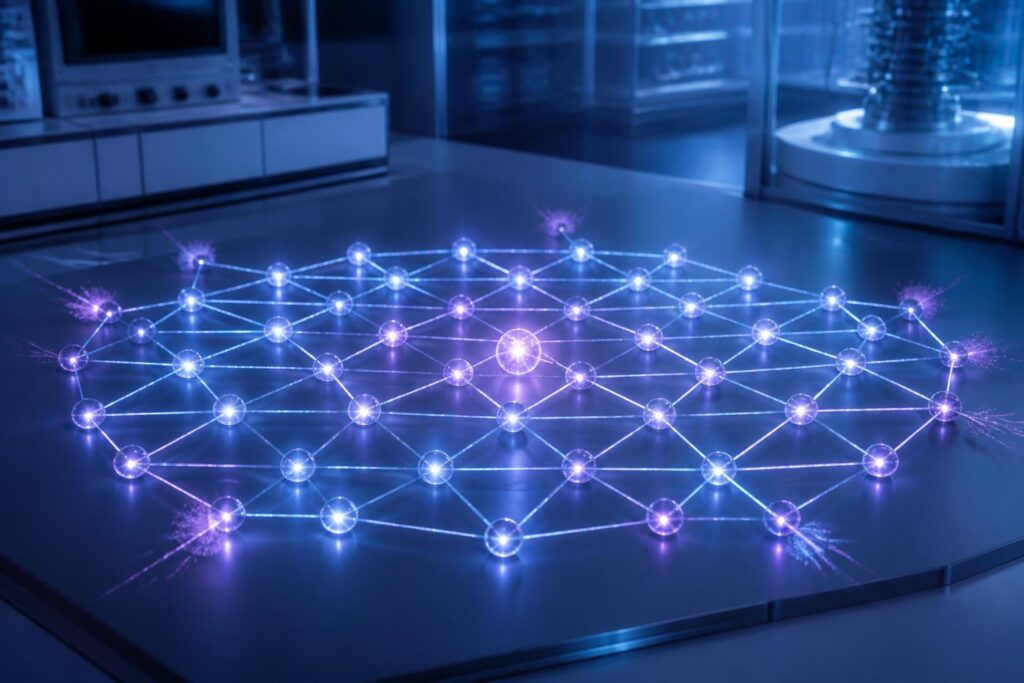
That is why quantum error correction has become a central field in this technology. The goal is not to duplicate a qubit exactly, but to distribute quantum information across a structure made up of many physical qubits. The system then measures indirect signs indicating where an error has occurred, while attempting to preserve the core quantum information. If implemented accurately enough, multiple physical qubits can be combined to form a logical qubit with greater reliability.
Why Are Qubits Prone to Errors?
A qubit can exist in a superposition of 0 and 1, and it can also become connected to another qubit through entanglement. The very properties that give quantum computers their potential also make the system difficult to control. A small interaction with the environment can cause the superposition to degrade. This process is commonly known as quantum decoherence.
Quantum errors do not come in just one form. A qubit may be flipped from the state corresponding to 0 to the state corresponding to 1, or vice versa. It may also experience a phase error, in which the phase relationship between the components of the superposition changes. There are also errors that combine bit flips and phase flips. In a real quantum circuit, errors can arise when qubits are initialized, quantum gates are performed, control signals are transmitted, or results are read.
The difficulty is that directly observing the state of each qubit is usually not an appropriate solution. If the quantum information being computed is measured, the system may collapse the superposition or disrupt the entanglement. Therefore, quantum error-correcting codes are designed to measure auxiliary quantities, commonly called error syndromes. These syndromes do not reveal the entire state of the data, but they can indicate whether a local error has occurred and suggest its location.
Physical Qubits and Logical Qubits
A physical qubit is a unit created directly through hardware, such as a superconducting circuit, a trapped ion, a neutral atom, or another platform. These are the components that actually experience noise and errors. By contrast, a logical qubit is an information unit encoded across multiple physical qubits according to a particular error-correcting code.
A logical qubit can be imagined as a layer of protection placed over the underlying hardware. The information is not stored in a single qubit but spread across a cluster of qubits. Syndrome measurements are performed repeatedly to detect abnormal changes. A classical controller analyzes the measurement results, infers the errors that are likely to have occurred, and selects an appropriate correction operation. In some architectures, error correction can be performed using quantum gates; in others, the system primarily tracks the history of syndromes and then adjusts how the results are interpreted.
This process does not make every physical qubit perfect. Instead, it seeks to reduce the error probability of the logical qubit as the scale of the encoding increases. This is the idea behind the quantum error-correction threshold. If the error rate of the physical components is below a certain threshold and the implementation conditions meet the requirements of the code, adding more physical qubits can make the logical qubit more reliable. Conversely, if the hardware has too many errors, adding qubits may make the system more complex without providing any protective benefit.
Surface Codes and the Challenge of Scaling
One of the most widely studied approaches is the surface code. In this approach, qubits are arranged in a two-dimensional structure and linked to syndrome measurements. Repeated measurements help the system track error chains across space and time. Surface codes are attractive because they can operate with local interactions, making them suitable for some hardware architectures currently under development.
However, an error-correcting code is not software that can be installed after a computer has been completed. It affects the arrangement of qubits, the design of control wiring, the measurement frequency, the signal-readout system, and the capacity for classical data processing. A quantum computer with error correction must perform many auxiliary operations alongside the main algorithmic circuit. Each auxiliary operation can in turn introduce new errors, so the entire cycle must be optimized simultaneously.
The challenge also lies in transmitting and processing error syndromes with low latency. The system must not only collect measurement data but also distinguish between genuine errors, noise in the measurement equipment, and correlated fluctuations among multiple qubits. Error decoders therefore play an important role. They may be based on classical algorithms, statistical models, or methods optimized for a specific architecture. If the decoder processes data too slowly, the quantum hardware may have to wait or continue accumulating errors before receiving a correction decision.
The Cost of Reliability
Quantum error correction generally requires many physical qubits to create a single logical qubit. The specific number depends on the type of code, the quality of the hardware, the type of error, the target reliability, and the structure of the algorithm. Therefore, the number of qubits announced for a system does not fully indicate its ability to run long and complex problems. A device with many physical qubits but a high error rate may be less useful than a smaller device that is more stable for a particular task.
The cost is not measured only in the number of qubits. The system also requires control hardware, readout equipment, signal connections, cooling or isolation capabilities depending on the platform, as well as a layer of classical computers to manage corrections and decoding. As the number of qubits increases, avoiding crosstalk, synchronizing pulses, and controlling temperature also become more difficult. An architecture that performs well in a small-scale experiment may not necessarily be easy to expand into a large system.
This is why researchers often assess progress using multiple metrics. Quantum-gate error rates, state-preservation times, qubit-readout accuracy, and the quality of logical qubits are all important. Demonstrating the correction of one type of error under tightly controlled conditions is a notable result, but it does not mean that a complete fault-tolerant quantum computer has been achieved. The gap between a proof of principle and a system capable of running long algorithms still needs to be evaluated carefully.
What Changes When Logical Qubits Are Available?
If logical qubits achieve sufficiently high reliability, the way quantum algorithms are developed could change significantly. Designers would no longer have to optimize every circuit primarily around the short lifetimes of physical qubits. They could build longer computations, as long as the resource and time costs remained within the system’s limits. Algorithms requiring many consecutive steps, which are highly sensitive to accumulated errors, would have a greater chance of being implemented in practice.
This does not mean quantum computers will replace classical computers for every task. Classical computers remain suitable for most everyday tasks and play an essential role in controlling, monitoring, decoding, and processing data for quantum systems. If quantum computers achieve their promise, their value will likely lie in certain groups of problems whose structure is suited to quantum computation, such as simulating quantum systems or exploring specialized solution spaces. Determining useful applications will still require testing, cost analysis, and comparison with the best classical methods.
For businesses and ordinary users, quantum error correction is not yet a technology that can be deployed independently like a memory upgrade or software installation. It is a deep infrastructure layer involving physics, control engineering, chip design, and algorithms. Nevertheless, understanding it helps explain why the advertised number of qubits should not be regarded as the sole criterion for evaluating a quantum computer.
The Road Ahead
Progress in quantum error correction will depend on coordination among many areas of research. Hardware needs to reduce error rates and increase connectivity. Quantum codes must balance the level of protection, the number of qubits required, and measurement demands. Decoders need to become faster, more accurate, and more adaptable to real-world errors rather than operating only in idealized models. Software tools must also help programmers describe algorithms on logical qubits without requiring them to handle every physical detail at each step.
This challenge means that the development of quantum computers cannot be measured by a single milestone alone. An important result might be reducing gate errors, improving readout quality, demonstrating the ability to preserve a logical qubit, or showing that the error rate falls as the code is scaled up. Each step needs to be tested under reproducible conditions and compared using clear criteria.
Quantum error correction is therefore not an optional feature but the foundation for turning experiments with fragile qubits into reliable computing systems. The road is still long and requires the simultaneous resolution of many problems, from fundamental physics to systems engineering. But if these layers of quantum protection become increasingly effective, the boundary between a demonstration device and a computer capable of carrying out useful computations will gradually become clearer.
