


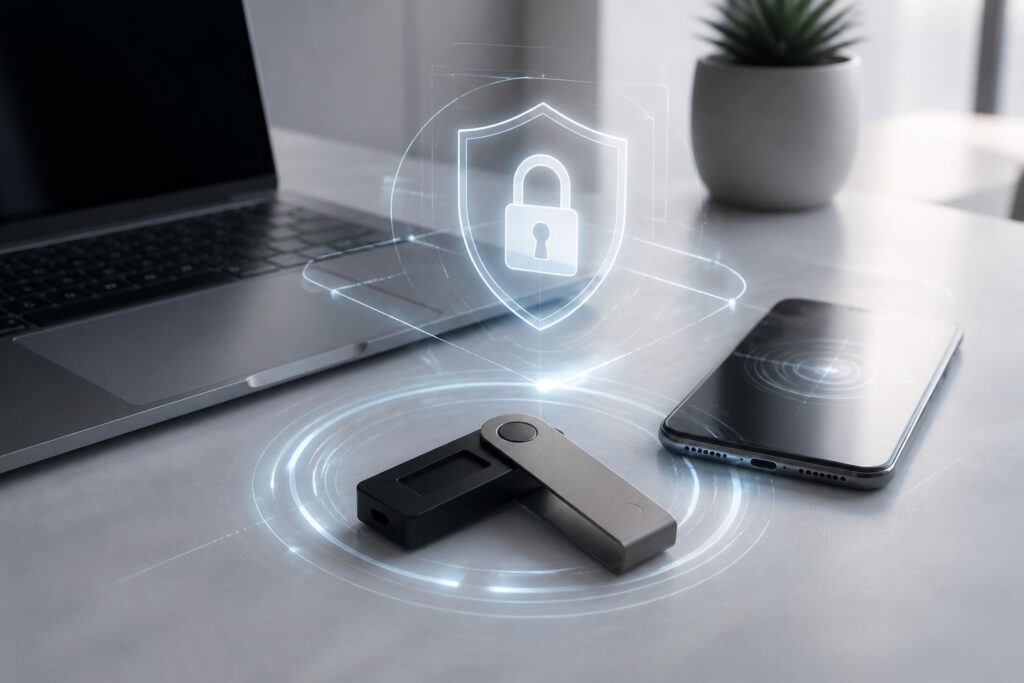
In the blockchain ecosystem, a wallet is often described as a place where users store digital assets. This description is easy to understand but not entirely accurate. The assets themselves are recorded on the blockchain network, while the wallet provides tools for users to manage the cryptographic information needed to prove control and sign transactions. This distinction is very important, because losing a phone does not mean losing the assets, whereas exposing a private key or recovery phrase can cause control to be transferred to someone else.
Self-custody provides a greater degree of control than entrusting assets to an intermediary platform. Users do not have to depend entirely on a service’s ability to provide access, but at the same time, there is no support department that can freely restore access if security information is lost. Therefore, blockchain wallet security is not merely a matter of choosing a well-known application. It is the process of building habits, checking information and separating risks throughout the period of use.
Understanding Wallets, Private Keys and Recovery Phrases Correctly
A blockchain wallet is generally associated with a public address and a private key. A public address can be shared to receive assets, similar to recipient account information in some payment systems. By contrast, a private key must be kept secret. This key allows the creation of digital signatures to confirm transactions, so in principle, anyone who obtains it can take actions on behalf of the owner on the corresponding network.
A recovery phrase is a more user-friendly representation of data that helps recreate access to a wallet. Depending on the type of wallet and the standard used, this phrase may restore multiple addresses or different accounts. Users should not view a recovery phrase as an ordinary password. A password can sometimes be changed or reset, whereas if a recovery phrase is exposed, changing the application password does not make the old data safe.
The key point to remember is that a wallet does not protect users with a single layer. The application, device, unlock code, private key, recovery phrase and transaction-confirmation habits are all connected. If even one link is handled carelessly, the entire process can be weakened.
Risks Often Begin with Very Small Actions
Many incidents do not result from a complex attack but from users hastily following instructions displayed on a screen. A fake link may lead to a website that imitates a familiar interface and asks for a recovery phrase. An app from an unclear source may be promoted through advertisements, messages or social media accounts. Someone claiming to be a support employee may apply pressure by saying that an account is about to be locked unless the user provides confidential information.
There is no legitimate reason for an ordinary support service to ask users to send a private key or recovery phrase. This is a fundamental principle that should be remembered even when the request appears professional. Domain names, branding and the language in a message can all be forged. When in doubt, users should open the application or official website themselves from a source saved previously rather than accessing a link sent in a message.
Another risk lies in signing transactions without understanding their contents. Some transactions do not merely transfer assets immediately but also grant permission to interact with a contract or application. If permissions are granted too broadly, users may unintentionally allow a program to use assets within a scope they did not intend. Therefore, checking the network name, receiving address, asset type, amount and the details of the permissions being granted should become mandatory steps before confirmation.
Establishing a Multilayer Protection Process
The first layer is the installation source. Users should download wallets from the official website or a trusted app store, while also carefully checking the developer’s name and any unusual signs. Appearing in an app store does not automatically prove that every application is safe, so users should avoid installing files sent directly through messages or from links that cannot be verified.
The next layer is how the recovery phrase is created and stored. It should be written down in a private environment, not captured in a screenshot, sent by email, saved in a conversation or entered into an online form. The record should be kept in a place with limited access by others, and users must also consider the risk of loss caused by physical damage. Creating multiple copies can reduce the risk of misplacement, but each copy also increases the number of places that need protection. The goal is not to create as many copies as possible, but to find a balance between recoverability and confidentiality.
The device unlock code and application password should also be created separately, without reusing email or social media login information. If the wallet supports additional authentication, users should enable it according to the official instructions. However, additional authentication does not replace protecting the recovery phrase. It may reduce certain risks involving accounts or devices, but it cannot invalidate a private key that has already been exposed.
Separating Assets and Developing Transaction Habits
Not all assets need to be managed in the same way. A wallet used to test new applications may be best kept separate from a wallet containing assets that need long-term protection. Separation helps limit the extent of damage if users interact with an untrusted application or mistakenly sign a transaction. A wallet used for regular activities should also contain an amount of assets appropriate to its purpose, rather than holding all assets in a place that is frequently connected to multiple services.
Before each transaction, users should pause to check the details. Blockchain addresses are often long and difficult to read, so looking only at the first or last few characters is not always sufficient. A test transaction with a small value can be made when the network and address are new, followed by checking the status on an appropriate block explorer. This approach does not eliminate every risk, but it can help identify some input errors or network mix-ups before a large value is transferred.
Checking the permissions granted to applications should also be done periodically if the ecosystem and the tools used by the user support this function. When an application is no longer in use, users may consider revoking the corresponding permissions. Revoking permissions does not mean deleting a transaction already recorded on the blockchain, but it may limit the continued use of a previously granted permission, depending on the mechanisms of each network and application.
Do Hardware Devices Solve the Entire Problem?
Hardware wallets are generally designed to keep transaction-signing information more separate from computers or phones connected to the internet. This can be a useful layer of protection, particularly for users seeking long-term custody or managing significant assets. Even so, a hardware device is not an absolute shield. Users can still be tricked into signing a transaction, entering a recovery phrase on a fake website or losing backup information.
The value of a hardware wallet lies in reducing certain attack paths, not in eliminating the need for caution. During setup, users should create the recovery phrase directly according to the device’s instructions, check the information displayed on the device itself whenever possible and never use a phrase generated in advance by another source. Any urgent, unusual or officially noncompliant request should be treated as a signal to stop and verify.
A Recovery Plan Should Be Prepared Before an Incident
Security is not only about preventing strangers from gaining access; it is also about being able to recover when a device is lost, damaged or no longer usable. Users should answer practical questions for themselves: Where is the recovery phrase? Who can access it? If the record is damaged, what is the alternative plan? And does a trusted person know how to handle the situation in an emergency? The answers do not necessarily need to be shared widely, but they should exist in the form of a clear plan.
For high-value assets or situations in which several people participate in management, models requiring multiple approval steps can reduce dependence on a single individual. However, the more complex the model, the more it requires appropriate documentation, checks and drills. A mechanism that is theoretically secure but that no one understands how to operate can still create risks when an incident occurs.
Wallet Security Is an Ongoing Process
Blockchain can record transactions in a way that is difficult to reverse, but that characteristic also makes mistakes during the signing and transfer of assets serious. No setting can completely replace checking information, keeping private keys secret and maintaining cautious usage habits. Users should start with the basics: install from the correct source, protect the recovery phrase, avoid unusual requests, separate use cases and prepare a recovery plan.
Self-custody should not be viewed as a technical competition. It is the responsibility of managing access through processes that users can understand and maintain over the long term. When each transaction is performed a little more slowly, each source of information is checked more carefully and each layer of protection is placed in the right position, a blockchain wallet becomes a more empowering tool rather than a weakness that is difficult to control.
