


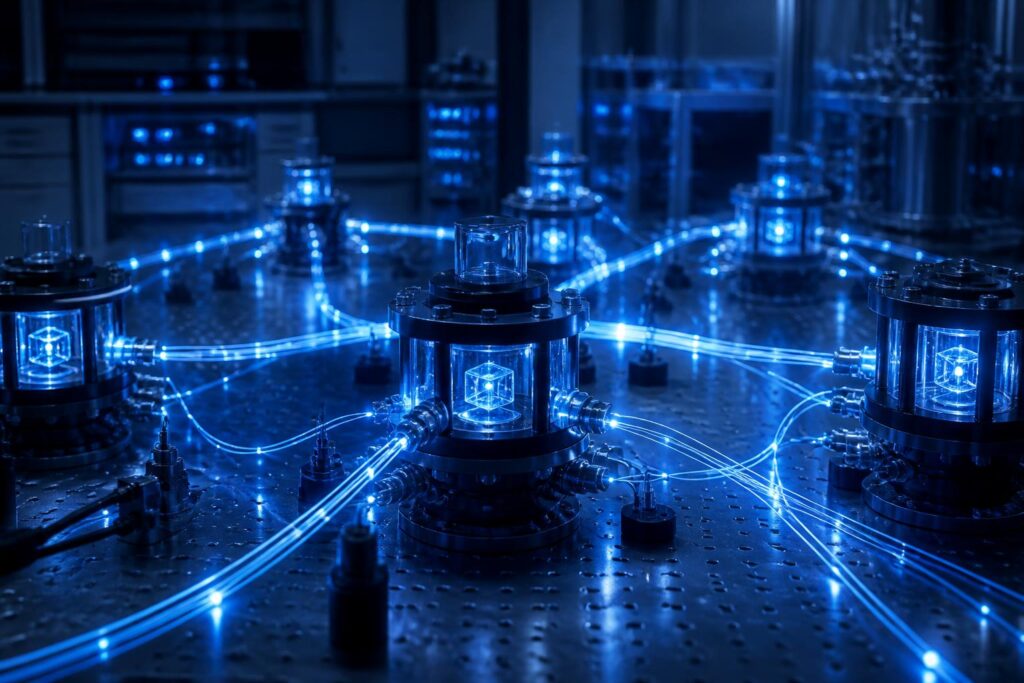
When quantum technology is discussed, most attention tends to focus on machines that can perform computations differently from classical computers. However, computing is only one piece of a larger picture. Another important area of development is quantum networking, meaning systems that allow devices to exchange or share quantum states over a certain distance.
This concept is sometimes misunderstood as a new generation of the Internet with higher speeds. That interpretation is not accurate. Quantum networks are not primarily intended to transmit more data per second, nor are they an immediate replacement for the Internet infrastructure currently in use. Their goal is to create forms of connectivity that classical networks cannot provide, such as sharing entangled states, supporting quantum communications, and connecting quantum processors located in different places.
What Do Quantum Networks Operate On?
In traditional networks, information is encoded into bits with values of 0 or 1 and transmitted through cables, radio waves, or other means. Quantum networks use physical systems that can represent qubits. Qubits can be created from many different platforms, such as the state of a photon or a quantum system controlled in a laboratory. The important point is that this state follows the laws of quantum mechanics, so measuring, copying, and transmitting it are not the same as handling classical data.
One phenomenon often mentioned in quantum networking is quantum entanglement. Two quantum systems can be prepared in a shared state, causing the results of their measurements to have a special correlation. Entanglement does not allow messages to be sent faster than light, nor is it automatically a secret communication channel. To use it in a complete protocol, the parties still need a classical communication channel and an appropriate verification process.
In a practical network, end devices may create or receive quantum states, while intermediate nodes help distribute those states. These components must coordinate with classical control systems to synchronize timing, confirm measurement results, manage errors, and decide how to handle signal degradation. As a result, a quantum network is a hybrid system from the outset, in which the quantum and classical components depend on each other.
Fundamental Differences from Today’s Internet
The classical Internet is designed so that data can be amplified, stored, copied, and routed through multiple nodes. If a data packet weakens while traveling, a network device can regenerate the signal and send it onward. With a quantum state, copying an unknown state exactly is not possible in a simple way. Measuring the state can also change or destroy the information being transmitted.
This is why a quantum network cannot be built simply by replacing current routers with a “more powerful” device. The system requires methods for generating stable photons or qubits, highly accurate detection equipment, synchronized clocks, quantum memories, and specialized control protocols. When transmitted over long distances, the signal may also experience loss, noise, and interactions with the environment.
One solution being studied is the quantum repeater. In a classical network, a repeater amplifies a weakened signal. In a quantum network, direct amplification is unsuitable because a quantum state cannot be copied arbitrarily. Quantum repeaters therefore have to rely on processes such as creating entanglement across individual segments, storing states for the necessary amount of time, and performing measurements or operations to extend the connection distance. These processes impose very high demands on hardware quality and error-correction capabilities.
Potential Applications
Quantum Communication and Intrusion Detection
The application most often mentioned is quantum key distribution. In some protocols, two parties can use quantum states to create a key for encrypting classical data. If a third party attempts to interfere and measure the signal, that interference may alter the statistical properties of the system. The two parties can check part of the data to assess whether the communication channel shows signs of being monitored.
However, quantum key distribution does not mean that every communication becomes absolutely secure. Security also depends on the design of the protocol, the devices, the identity-authentication process, how the key is protected after receipt, and the surrounding software components. If an endpoint is compromised or the key is poorly managed, using a quantum channel does not resolve all the risks.
Connecting Quantum Computers
If future quantum computers can be connected through a network, they may be able to share resources or cooperate on tasks that exceed the capabilities of a single device. This approach could help laboratories and data centers experiment with distributed architectures instead of having to place all the hardware in one system.
This is a long-term goal with many obstacles. A qubit transmitted between devices must retain information for long enough to complete the necessary operations. Network nodes must handle loss and errors, while the protocol must ensure that operations on different machines take place in the correct order. Connecting devices does not automatically make a quantum computer more powerful; the benefits appear only when the hardware and algorithms are designed to take advantage of that connection.
Distributed Measurement and Sensing
Quantum networks may also support sensing systems deployed in multiple locations. Sensors prepared in quantum-correlated states can be used to compare measurements or improve the ability to detect very small changes in an environment. Such research directions may relate to positioning, physical observation, or scientific measurements, but practical effectiveness still depends heavily on operating conditions and device stability.
Barriers That Cannot Be Ignored
The first barrier is signal loss. Photons or other quantum systems can be absorbed, scattered, or affected by noise during transmission. As distance increases, maintaining a reliable connection becomes more difficult. Existing transmission lines may support some experiments, but large-scale networks require coordinated designs for optical fiber, detection equipment, memories, and intermediate nodes.
The next barrier is quantum memory. A network node needs to preserve a state for long enough to wait for other parts of the system to become ready. If the state degrades too quickly, the entire process of distributing entanglement or transmitting information will lose its effectiveness. Quantum memory must therefore balance multiple requirements: storage time, writing and reading capabilities, accuracy, operation speed, and the ability to integrate with transmission hardware.
Error correction is also a complex challenge. Quantum networks must not only handle errors in individual qubits but also track errors arising on the transmission channel, in measurement devices, and during synchronization. Quantum error-correction techniques often require many additional physical qubits to protect a single logical qubit. This increases the system’s scale, cost, and complexity.
Beyond technical issues, quantum networks also need common communication standards. A device from one laboratory must be able to coordinate with a device from another supplier at the protocol and control levels. If each system uses its own method of representing states, authentication method, and error-management process, expanding the network will be difficult even when each individual device works well.
Quantum Networks Will Supplement, Not Replace, the Internet
Most everyday data remains well suited to classical networks. Video, email, transactions, websites, and enterprise applications require flexible storage, copying, routing, and processing. Quantum networks do not offer a clear benefit for every type of data because they are built to address problems that require special quantum properties.
In a more realistic scenario, the two types of networks will coexist. Classical systems will handle most traffic, authentication, control, and storage. Quantum components will be deployed for specific tasks such as distributing quantum states, supporting certain security mechanisms, or linking specialized devices. This model requires organizations to clearly understand the boundaries between quantum security, classical security, and infrastructure management.
This also means that ordinary users do not need to change how they use the Internet simply because quantum networks are being researched. If an initial impact emerges, it will most likely come from research organizations, infrastructure providers, and industries with long-term data-protection needs. Standards, equipment, and operating procedures must be validated before the technology can become a widely available service.
A Realistic View of the Future
Quantum networking is a promising area of development, but it should not be described as an immediate replacement for the Internet or as an automatic layer of security immune to every attack. Its value lies in taking advantage of properties that classical systems do not possess while accepting an operating model that is more difficult, more sensitive, and more demanding of strict control.
For the technology to move closer to practical applications, researchers must address many issues at the same time: creating stable quantum states, transmitting them over suitable distances, storing them and correcting errors, synchronizing devices, building interoperable protocols, and protecting the entire system from weaknesses outside the quantum component. A single weak link can reduce the value of the entire network.
Therefore, the important question is not whether quantum networks are faster than the Internet. The more appropriate question is what capabilities they can provide that current networks cannot, under conditions of acceptable cost and reliability. Viewed in this way, quantum networking emerges not as a slogan about speed, but as a research platform for new forms of communication, computing, and measurement.
