


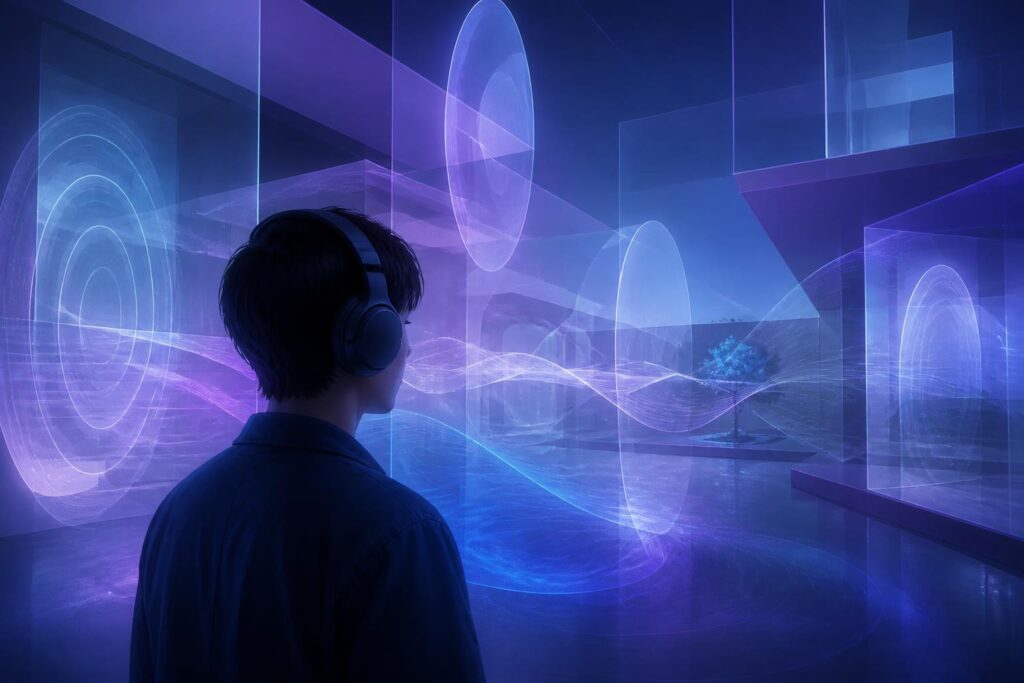
When people talk about the virtual world, most of the attention is usually devoted to visuals: the level of detail in the environment, the movement of characters, the ability to customize appearance, or the realism of display devices. However, a sense of presence is not created solely by what the eyes see. A footstep echoing from behind, a voice coming from the left, a door closing in the next room, or a sound fading as a character moves away all help users imagine their position in space. Sound is therefore an important structural layer of the virtual world, even though it is often less visible and less frequently discussed.
In the physical environment, people constantly use their hearing to perceive things beyond their field of vision. Sound indicates that an object is approaching, that someone is in a room, that an open space is unfolding, or that an activity is taking place behind a wall. When entering a digital space, these signals do not exist naturally; they must be designed, processed, and delivered to the user. If sound is treated as a decorative layer added at the end, the virtual world may look beautiful while still feeling flat, fragmented, and lifeless.
Sound Creates a Sense of Distance
The simplest sound in an application may be nothing more than a file played when the user presses a button. This approach is suitable for basic interfaces, but it is not enough to simulate a space where many people and activities are happening at the same time. In the virtual world, sound needs to reflect the relationship between the source, the listener, and the surrounding environment.
A nearby voice is usually perceived more clearly than a distant one. As a character moves, the volume, clarity, and direction of the voice should also change accordingly. If the user turns their head, the sound source should be perceived at its new position rather than continuing to play as though it were always directly in front of them. These changes do not necessarily have to be exactly like those in real life, but they must be consistent with the rules established by the space. Consistency helps users develop intuition: if a sound becomes louder, the source may be getting closer; if the sound shifts to one side, there may be activity in that direction.
The ability to locate sounds also makes large spaces easier to understand. A virtual plaza with multiple conversation groups, an exhibition area with a series of connected rooms, or a game with complex terrain all require sound to be distributed appropriately. If every sound source has the same volume and plays directly into the left and right channels, users will have difficulty identifying which information is important and which is background noise. Conversely, when sound is organized according to distance, direction, and priority, users can perceive the space without having to constantly look at indicators on the screen.
From Background Noise to Environmental Behavior
A convincing virtual world contains more than just character dialogue. The sounds of wind, water, machinery, footsteps, and the small noises of objects make the environment feel as though it is in motion. What matters is that background sound should not appear so randomly that users notice the repetition. If the same sound clip is played on a fixed cycle, the space quickly loses its natural quality. Sound design needs to create enough variation for users to perceive continuity without becoming distracted.
Sound feedback can also clarify the relationship between an action and its result. When users open a door, place an object on a table, step onto a different surface, or interact with a device, the corresponding sound helps confirm that the system has registered the action. This feedback is particularly useful when visuals cannot fully convey a state. A small action accompanied by an appropriate sound often feels more certain than one that only changes the image.
Nevertheless, sound should not be used to cover up interactions that have not been clearly designed. If every button produces a sound, every movement has a major effect, and all conversations are mixed into the same volume layer, users may become tired or ignore important signals. Good design is not about adding as much sound as possible, but about choosing the right sound for the right situation.
Voice and the Rules of Communication
In many virtual worlds, voice communication can create a greater sense of closeness than text messages, but it also raises important requirements concerning privacy and control. Users need to know when their microphone is active, to whom their voice is being transmitted, and how they can mute or adjust their ability to hear others. This is not merely a technical issue. A design that lacks transparency can make users reluctant to speak, especially in spaces where strangers are present.
Audio distance can support more natural communication rules. A private conversation in a small area may not need to be broadcast throughout the entire space. A presentation for a large audience, on the other hand, requires a mechanism for delivering the speaker’s voice to the right group of listeners. These modes should be represented through clear signals, rather than forcing users to guess who can hear them. When voice communication is designed together with user control, the virtual world can become more flexible without turning convenience into pressure to be constantly present.
The ability to filter sound is also meaningful for people who are sensitive to noise or have difficulty distinguishing multiple sound sources at once. Allowing separate volume adjustments for speech, environmental sounds, and interaction effects is one way for users to create conditions that suit them. Captions, visual indicators for sound sources, and notification history can also support people who cannot or do not want to rely entirely on hearing.
Designing for Multiple Devices and Situations
Not every user enters the virtual world through the same type of device. Some use headphones, some listen through computer speakers, some use phones, while others have to share a space with family members or colleagues. A design optimized only for high-quality headphones will overlook other common conditions of use. Therefore, sound needs to be tested in many contexts, from a quiet room to an environment with background noise, and from personal devices to simple speaker systems.
Loudness does not equal better communication. A sound with an appropriate frequency range, suitable pauses, and clear contrast between the main signal and background noise can be easier to hear without being particularly loud. Alert sounds also need to be considered carefully. If they appear too frequently, users will become accustomed to them and pay less attention. If they are too abrupt, the experience may become unnecessarily stressful.
For spaces used over many hours, restraint is even more important. Users may tolerate a strong effect for a few minutes but feel tired if that effect is repeated continuously. Sound design should take into account the length of use, the ability to turn off individual sound layers, and how important events are signaled. This is part of the overall experience, not an optional choice to be made after the visuals are complete.
Sound as a Tool for Orientation and Storytelling
In the virtual world, sound can direct attention without covering the screen with too many icons. A sound source coming from an unexplored area can suggest a new location. A changing rhythm as the user approaches an event can create a sense of anticipation. Different echoes between areas can help users recognize whether they are in a corridor, a large room, or an open space.
However, using sound to guide users should not become a form of manipulation. Users need to be able to distinguish between signals intended for orientation, elements that create atmosphere, and notifications related to safety or privacy. A mature virtual world should allow users to reduce unnecessary sound layers while still accessing essential information.
Sound also helps shape the identity of a space. Two environments may use similar visuals yet create completely different impressions through the pace, texture, and silences in their sound design. A community space may prioritize clear voices and a light background. An exploratory environment may leave more room for distant sounds, while a competitive game may focus on fast, easily distinguishable feedback. These differences make sound part of the language of design, not merely an illustrative accessory.
Questions to Ask Early On
For sound to truly support a virtual world, development teams should ask questions about the experience from the earliest stages of building the space. What do users need to hear to know where they are? Which sound sources should be prioritized? When several people speak at once, how will the system help listeners distinguish between them? What happens when users turn off the sound? These questions are directly related to the structure of interaction, so they should not be left until the final testing stage to be addressed.
Evaluation should also examine what users do not hear. A sound error may not cause an application to crash, but it can make users lose their sense of direction, miss dialogue, or fail to notice a warning. Testers should be asked to describe the location, distance, and meaning of sound sources in different situations. This approach helps reveal the gap between the designer’s intention and the way users actually perceive the experience.
Finally, sound needs to be considered alongside the culture and communication habits of the community using it. A signal understood as friendly in one context may be annoying in another. Voices, laughter, notification sounds, and simulated effects can all carry different connotations. Careful design does not seek to impose a single way of listening, but creates enough options for users to participate on their own terms.
The virtual world is not built only from images of places that have never existed. It is also built from how users listen, orient themselves, respond, and perceive the presence of others. A well-organized layer of sound can transform a digital space from a scene to observe into an environment with depth. Conversely, inconsistent sound can expose the limitations of the experience even when substantial investment has been made in the visuals.
Therefore, the important question is not how many sound effects a virtual world contains, but what each sound helps users understand. When designed with restraint, control, and consideration for different kinds of users, sound can create a sense of presence without being showy. It is the invisible infrastructure that helps a digital space become more understandable, rhythmic, and trustworthy.
