


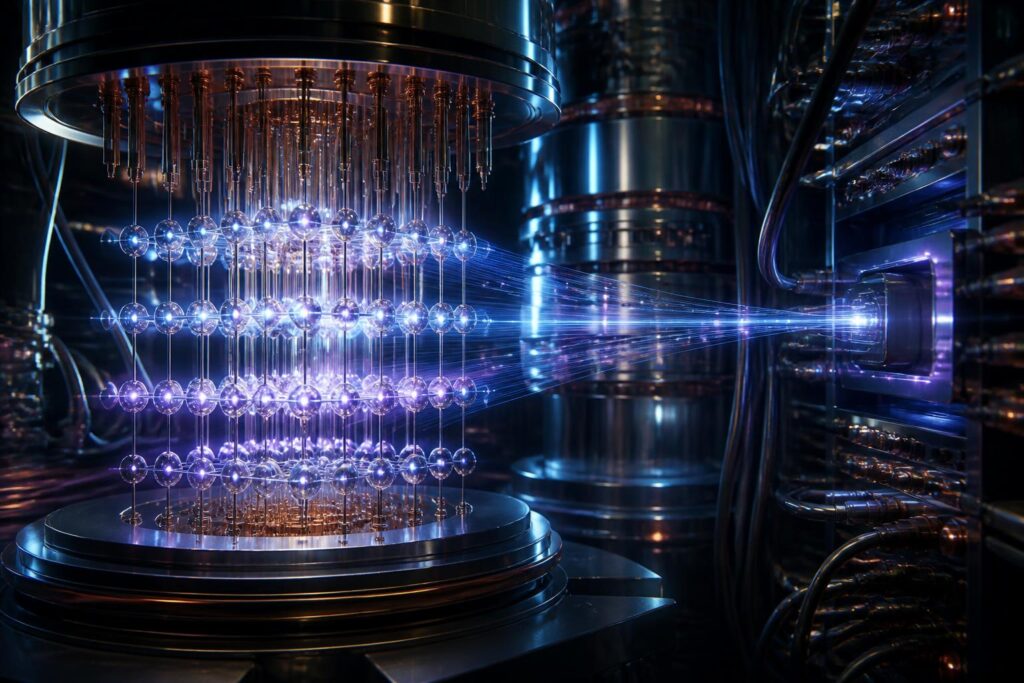
In discussions about quantum computers, the number of qubits is often used as the easiest metric to visualize. However, more qubits do not automatically mean a more powerful system. Qubits can be affected by vibrations, heat, electromagnetic noise, errors in control pulses, and unintended interactions with the environment. When a computation extends over many steps, these small deviations can accumulate and cause the final result to lose its meaning.
This is why quantum error correction has become one of the field’s central challenges. Classical computers also have to handle errors, but classical data is usually represented by bits with a value of 0 or 1. A flipped bit can be checked by copying and comparing it. With qubits, faithfully copying an arbitrary quantum state is impossible according to physical principles. Directly measuring a qubit can also alter the state that the computation needs to preserve. Quantum error correction therefore requires a different approach: distributing quantum information across multiple physical qubits and checking for errors through indirect signals.
Why Are Qubits Prone to Errors?
A qubit is the basic unit of information in a quantum computer. Unlike a classical bit, which can only be in one of two states, a qubit can exist in a superposition and participate in special quantum correlations. These properties create computational potential, but they also make qubits more sensitive to their environment.
One common type of error is the loss of quantum coherence. Put simply, this is the process by which a quantum state gradually loses the relationships needed to perform a computation. A qubit can also switch incorrectly between its basis states, or a control operation can produce a rotation angle that is slightly different from what is required. In addition to errors affecting individual qubits, the quantum gates used to link qubits can also operate imperfectly. As the number of operations increases, the probability that at least one error will occur also rises.
An important feature is that not all errors manifest in the same way. One error may change measurement probabilities, another may cause phase loss, while yet another may appear only when multiple qubits interact. Error-correction systems must therefore be designed to detect many types of deviations without directly reading the content of the quantum information.
From Physical Qubits to Logical Qubits
An important concept in quantum error correction is the distinction between physical and logical qubits. A physical qubit is an element actually created and controlled in a laboratory, such as through superconducting circuits, trapped ions, or other physical platforms. Every physical qubit has limitations in the amount of time it can maintain its state and in the accuracy of its measurements and quantum gates.
A logical qubit is quantum information encoded across a group of physical qubits. This group not only stores data but also provides a structure that allows the system to identify errors. When some physical qubits deviate within the limits permitted by the error-correcting code, the controller can infer the likely location or type of error and then perform an appropriate correction operation. The goal is not to make every physical qubit perfect, but to make the logical qubit more stable as the number of qubits used increases.
This approach creates a clear trade-off. A logical qubit may require many physical qubits, along with additional measurement and control circuits. Therefore, a device with a large number of physical qubits does not necessarily provide many high-quality logical qubits. When evaluating progress, it is necessary to consider the accuracy of operations, state-maintenance time, connectivity, measurement speed, and the efficiency of the entire error-correction process at the same time.
Checking for Errors Without Destroying the Information
Quantum error-correction systems commonly use ancillary qubits to check properties associated with a group of data qubits. These measurements are not intended to directly determine the specific quantum state of the data. Instead, they indicate whether the system is departing from the valid state space of the error-correcting code.
The results of ancillary measurements are often called error syndromes. A sequence of syndromes over time can indicate that a qubit has been affected or that a particular operation has introduced a deviation. The decoder then analyzes the syndromes and selects the correction method with the most appropriate probability. In some architectures, the correction does not necessarily have to be carried out immediately through a physical operation. The system can record the errors that have occurred classically and then adjust how the result is interpreted at the end of the computation.
The difficulty is that measurements can also contain errors. If a syndrome is read incorrectly, the decoder may make the wrong decision. For this reason, checks are typically repeated over multiple rounds to distinguish actual errors in the data from errors arising during the measurement process. The more detection capability is increased, the more the system must pay in terms of time, the number of ancillary qubits, and the processing capacity of the classical control system.
Error Thresholds and the Conditions for Scaling
A key idea in the theory of quantum error correction is the error threshold. If the error rates of the basic components are below a certain level, increasing the size of the code can help reduce the error rate of the logical qubit. In that case, adding resources not only makes the system larger but can also make the information more reliable. Conversely, if qubit and gate errors are too high, adding qubits can make the situation worse because the additional measurements and connections themselves create more opportunities for errors.
The specific threshold depends on the type of code, the error model, the hardware structure, and the control method. Therefore, the error threshold should not be understood as a single number that applies to every quantum computer. A design may achieve good results under laboratory conditions but still encounter difficulties when scaling the control system, cooling system, connections between qubits, or the rate at which data is transmitted to the processor.
Scalability is also related to the density of wiring and control devices. Many qubit platforms require special environments, while each qubit must be excited, measured, and calibrated with high precision. As the number of qubits increases, bringing signals in and measurement data out becomes more complicated. Quantum error correction is therefore not only an algorithmic challenge, but also a challenge involving manufacturing, electronics, materials, software, and system architecture.
Not Every Application Requires the Same Level of Error Correction
The required accuracy depends on the type of application. Some short experiments can produce useful results even without a complete error-correction system, provided that the data is collected and analyzed carefully. Large-scale quantum algorithms, by contrast, often require many consecutive operations. If errors are not controlled throughout the process, the result may be dominated by noise rather than by the algorithm.
This creates two parallel directions for development. The first focuses on improving the quality of physical qubits and reducing errors in each component. The second seeks to design algorithms, data encodings, and measurement procedures that are less sensitive to errors. Noise-reduction techniques can help make use of existing hardware, but they do not completely replace error correction when long and reliable computations are required.
For technology users, this is where the difference between a demonstration device and a quantum computer capable of running applications reliably lies. A system may be able to create a complex quantum state for a short time, but to solve a practical problem repeatedly, it must maintain information quality through many steps. Error correction is the foundation for turning physical capability into verifiable computational power.
Prospects and Open Questions
Progress in quantum error correction should not be judged solely by the number of qubits. More important indicators include the ability to create logical qubits whose error rates decrease as the code is scaled up, the reliability of the decoder, the time required for one checking cycle, and the amount of resources the system must consume. These measurements help distinguish a foundational improvement from merely increasing the scale of the hardware.
In the future, researchers will still have to solve many problems: how to reduce the physical-qubit cost of each logical qubit, how to perform universal logical operations with high accuracy, and how to organize the entire system so that the classical controller can process error data quickly enough. These questions do not have a single solution because each hardware platform has its own advantages and limitations.
Quantum error correction also highlights an important characteristic of the field: power does not come from a single component. It emerges when qubit physics, error-correcting codes, control software, and computer architecture all operate within strict constraints. The path to large-scale quantum computers may therefore be determined not by a single attention-grabbing demonstration, but by the ability to systematically repeat, measure, and reduce errors.
Ultimately, having more qubits is only the starting point. For quantum computers to become reliable tools, the field must demonstrate that quantum information can be protected for longer, processed more accurately, and scaled at a reasonable cost. Quantum error correction is precisely the bridge between a sensitive laboratory system and a computing platform capable of serving practical problems.
