


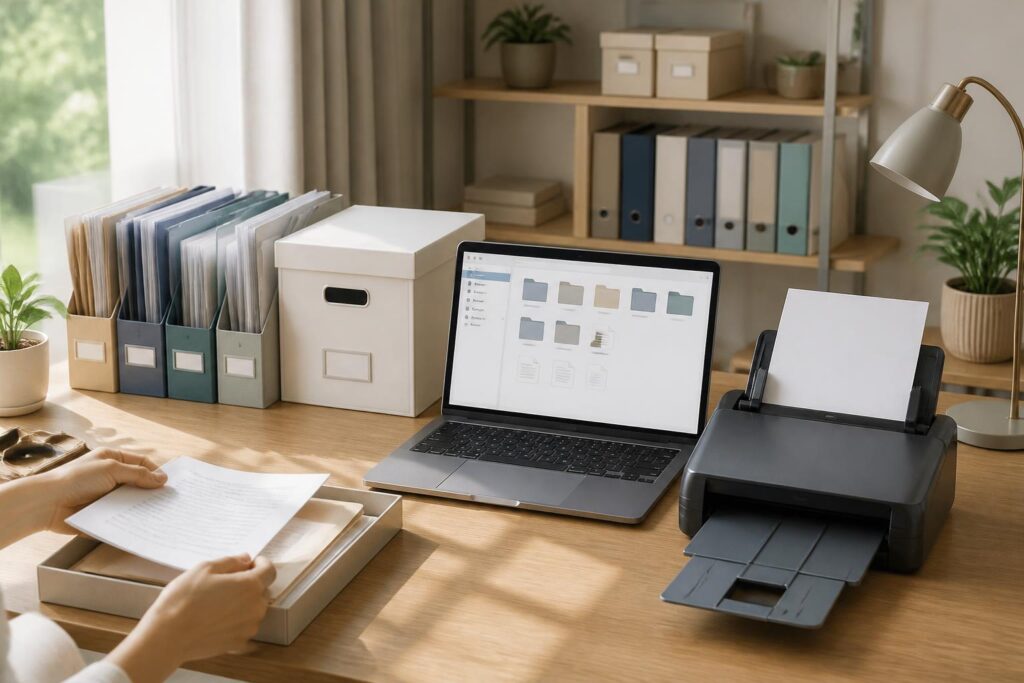
In a family, documents are often created and accumulated at different times. Birth certificates, identity cards, passports, marriage certificates, academic records, insurance contracts, property documents, purchase receipts, or vehicle-related documents may be scattered across various cabinet drawers, document folders, and electronic devices. When they are not needed, this disorder may seem like only a minor inconvenience. However, when it is time to complete procedures, claim benefits, or deal with an urgent matter, not knowing where the documents are can cause the whole family to lose a great deal of time and make it easy to overlook important papers.
Organizing family records does not mean turning the home into an office with too many procedures. The more practical goal is to build a system that is simple, easy to understand, and sustainable over time. Each family member should know where documents are stored, how originals differ from copies, when updates are needed, and who is permitted to access sensitive information. A good system should make it possible to find the right document quickly while still keeping the papers safe.
Start by Taking Inventory Instead of Buying More Storage Boxes
Many people begin by buying new folders, boxes, or cabinets before knowing what they already have. This approach can easily lead to documents continuing to be divided among different storage items without any consistent rules. The first step should be to gather documents stored in different places, spread them out on a clean, flat surface, and take inventory by group.
During the inventory process, documents can be divided into three basic categories. The first consists of original documents or papers with legal value that require careful preservation. The second consists of copies, scans, and reference materials. The third consists of expired documents, drafts, or materials that are no longer needed. Do not rush to throw away a document simply because it has not been used for a long time. If you are unsure about its value or retention period, set it aside in a group for review, then check it again before making a decision.
Taking inventory is also an opportunity to identify problems that are often overlooked, such as a document whose information has changed while related records have not been updated, a faded copy, a damp document, or a contract missing some of its appendices. Recording these issues immediately in the inventory list will help the family plan how to address them instead of merely rearranging things on the surface.
Classify Documents by Usage Needs and Level of Importance
There are many ways to classify records, but the easiest system to maintain is usually based on subjects connected to family life. A system might include categories such as personal documents, housing and property, finances and insurance, education, health care, vehicles, employment, or family business. Depending on their circumstances, each household can add or remove categories. What matters is that the category names are clear, not overly broad, and used consistently.
Within each major category, documents should then be organized by person or by asset. For example, personal records can be separated into an individual folder for each family member; housing records can be separated by house, rental agreement, or renovation file. Documents used frequently should be placed somewhere easy to access. Important original papers that are rarely used should have a separate storage area, limiting the chance that they will be taken out and mixed with everyday documents.
Some families prefer to classify folders by color, but color should only serve as a supporting indicator and should not replace the folder name. Labels should be brief and easy to read, such as “Personal,” “Housing,” “Insurance,” or “Vehicles.” If children, older adults, or people who do not regularly manage documents also use the system, the naming should be even more intuitive. Avoid creating too many folder levels, because searching becomes difficult when users do not remember which group contains a document.
Clearly Separate Originals, Copies, and Electronic Versions
Separating these types of documents helps avoid two opposite risks: taking an original out for use when it is unnecessary, or assuming that a photocopy can replace the original in every situation. Originals should be stored in a stable, dry place away from direct sunlight, and they should not be handled repeatedly. Paper copies can be used for routine tasks, but they should be labeled so they are not confused with originals.
Electronic versions can make searching and sharing more convenient, especially when a family has many documents. When scanning or photographing documents, make sure the images are clear enough, include all pages, and do not have any information covered. File names should follow a consistent format, such as including the document type, the relevant person or asset, and the year. Consistent naming is much more useful than saving files under generic names such as “new documents” or “document photos.”
Electronic documents containing personal, financial, or legal information should not be shared carelessly through unsuitable channels. Devices should be protected with passwords, folder access should be controlled, and copies should not be stored in places that many people can open and view. If an online storage service is used, the family needs to understand how to manage the account, recover access, and delete data when it is no longer needed. Having an electronic version does not eliminate the need to preserve the original for documents that must be presented in their original form.
Create an Index to Know Where Records Are Stored
A simple records index can help the whole family find documents without having to open every box. The index does not have to record every small piece of paper. It can focus on important documents, originals, active contracts, and records that are frequently needed. Basic columns include the document name, the related person or asset, whether it is an original or a copy, the storage location, the most recent update date, and any necessary notes.
This index should be kept somewhere accessible, but it should not publicly reveal all sensitive information. If the index contains account information, identification numbers, or private details, it should include only the minimum identifying information and the corresponding file should be protected. In some cases, simply writing “Person A’s insurance folder” or “housing records box” is enough to locate the document.
Alongside the index, the family can prepare a short guide for the person responsible for managing the records. The guide should state where originals are stored, how to open the cabinet or box if there are special procedures, where electronic versions are kept, and whom to contact when additional documents are needed. Passwords or security codes should not be written directly on the guide, as this would create additional risks.
Protect Documents and Sensitive Information
Documents should be kept in suitable folders or boxes, away from areas with high humidity, major temperature fluctuations, or a risk of water damage. Do not stuff too many documents into one folder, because the papers may bend, tear, or become difficult to remove. Frequently used documents can be placed in a separate compartment, while important originals should be handled only when necessary.
Not every family member needs the same level of access. Medical records, financial information, contracts, or identification documents must be handled carefully. Within the family, agreeing in advance on who may keep the originals, who may view electronic versions, and how documents should be handed over when needed can reduce random searching or sharing. However, these rules need to be practical and easy to follow; if they are too complicated, people may ignore them in everyday life.
When disposing of documents, do not simply crumple them up and put them in the trash if they contain personal information. Sensitive sections can be torn into small pieces, or an appropriate method can be used so that others cannot easily piece them back together. Before disposing of a document, check whether it is connected to a contract, benefit, or procedure that is still being handled.
Review Regularly and Update When Things Change
A records system is useful only if it is kept up to date. The family can choose a fixed time each year for a review, or conduct one immediately after important changes such as moving house, changing identification documents, purchasing property, signing a new contract, ending insurance coverage, or a change in family members. It is not necessary to check every record each time; the review can be divided into groups to reduce the time required and avoid feeling overwhelmed.
During each review, check whether the documents are still intact, whether electronic versions can be opened, whether file names are easy to search, and whether the index matches the actual storage locations. Copies that have become too faded or information that is no longer accurate should be marked for replacement. Expired documents should be separated from records that are still in use, but consider retaining them if they may later be relevant to transaction histories or benefits.
Most importantly, the system must fit the family’s habits. A simple arrangement that everyone understands will be more effective than a highly detailed system that only one person knows. After completing the setup, briefly explain the record categories, the location of originals, and how to find electronic versions to the other family members. When several people follow the same principles, the risk of documents being put in the wrong place will decrease significantly.
Conclusion
Organizing family records is a small task that provides long-term benefits. Starting with an inventory, classifying documents according to need, separating originals from copies, creating an easy-to-understand index, and protecting sensitive information will help the family manage its documents more proactively. The system does not need to be elaborate or expensive. What is essential is having clear rules, stable locations, and the habit of conducting regular reviews. When each family member knows where important documents are and how they should be handled, the family can save considerable time searching and reduce problems caused by lost records.
