


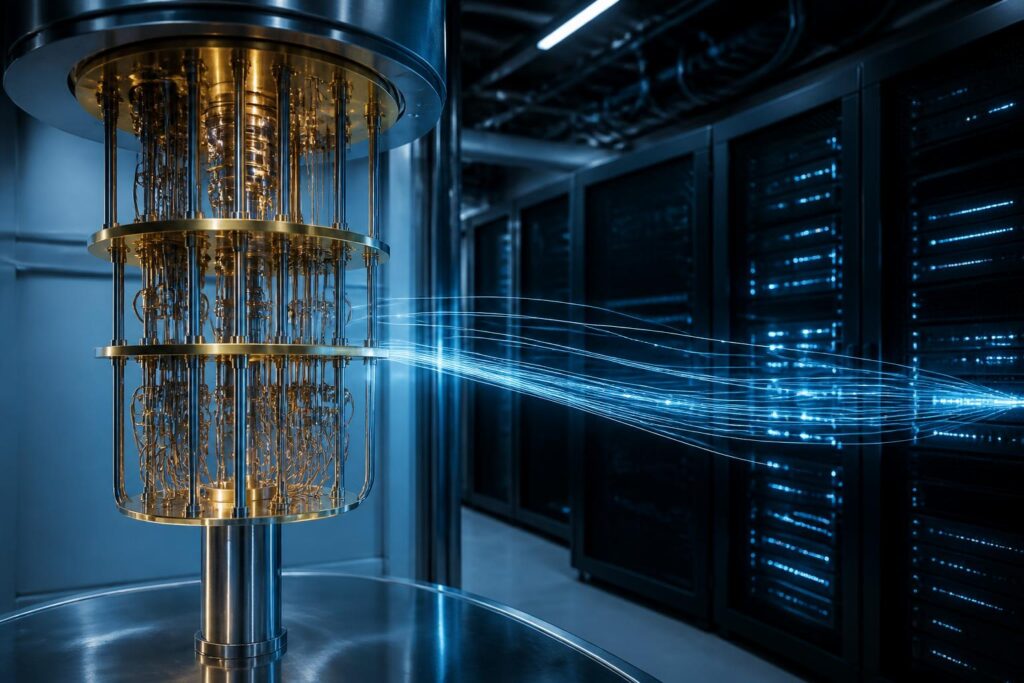
When quantum computers are mentioned, many people imagine a machine capable of replacing today’s computers and solving every problem faster. That picture does not yet reflect reality. Quantum computers are not designed to become more powerful versions of personal computers, servers, or supercomputers for every task. Their value lies in their ability to exploit phenomena from quantum mechanics to process certain specialized types of problems. While the technology still faces many limitations, one approach receiving considerable attention is hybrid quantum computing, in which a quantum processor works together with a classical computer rather than operating independently.
This model is not merely a temporary solution while quantum hardware matures. It reflects an important principle in the field: each type of machine should handle the work best suited to its capabilities. Classical computers remain good at coordination, data storage, ordinary calculations, and process control. Quantum processors can be assigned computational steps where quantum states may provide a potential advantage. The combination of the two creates a new workflow rather than a complete replacement.
How does hybrid quantum computing work?
In a hybrid system, the classical computer usually begins by preparing the data and describing the problem. Software then converts part of the problem into operations that can be performed on a quantum circuit. Measurement results from the quantum processor are sent back to the classical computer for analysis. Based on those results, the classical computer can adjust the circuit’s parameters and request another run. This cycle continues until a certain criterion is met or no significant improvement remains.
What is notable is that the quantum processor generally does not receive all the data in the way a conventional CPU receives data. The data must be encoded into the states of qubits through specific operations. Once the quantum circuit is complete, the user also does not obtain a complete state that can be read directly. Measurement produces only probabilistic results, so a circuit usually needs to be run many times to estimate the property relevant to the problem. The classical computer handles the management of these runs, aggregates the results, and makes the next decision.
In many current architectures, the quantum processor is also accessed through a server or a remote computing platform. This makes the hybrid nature of the system even clearer. Users write programs with software tools, send circuits to a quantum service, receive measurement data, and continue processing in a classical environment. From an operational perspective, a quantum computer resembles a specialized accelerator called upon at the appropriate moment, rather than an independent machine replacing the entire computing infrastructure.
Why not put the entire problem on a quantum computer?
The first reason is that loading data into a quantum processor is not simple. A classical system can store large amounts of data and access it through familiar structures. By contrast, encoding classical data into qubits requires suitable quantum circuits. If the encoding step is too costly, the expected advantage at the computation stage may be canceled out by the cost of preparing the data.
The second reason concerns reading the results. A quantum state cannot be observed in its entirety without changing it. Each measurement produces only one particular result according to a probability distribution. To understand that distribution, the program must repeat the run many times. The classical computer is therefore still necessary for performing statistics, filtering noise, comparing results, and checking stopping conditions.
Third, current quantum processors are still affected by noise and limitations on the number of operations that can be performed before the results lose reliability. Short circuits with a controlled number of operations are generally better suited to existing hardware. Rather than trying to turn the entire process into one enormous quantum circuit, the hybrid model divides the problem into smaller parts and lets the classical computer coordinate them.
Variational algorithms and how the two types of computers work together
One group of methods representative of hybrid quantum computing is variational algorithms. The basic idea is to build a quantum circuit with unknown parameters, run the circuit to collect results, and then use an optimization algorithm on a classical computer to adjust those parameters. The goal may be to reduce a loss-function value, find a lower energy for a simulated system, or improve the quality of a solution to an optimization problem.
This process creates a loop between two computational domains. The quantum processor generates an evaluation value based on the quantum state. The classical optimizer uses that value to propose a new set of parameters. Each iteration does not necessarily produce a clear improvement, because the measurement results are probabilistic and affected by noise. Consequently, the choice of circuit structure, optimization method, number of measurements, and data-processing approach all have a major influence on the final result.
One advantage of this approach is that the quantum circuit can be kept relatively shallow, meaning it has fewer layers of operations than a circuit that must perform an entire large algorithm. However, this does not mean that every variational problem already offers a quantum advantage. The loop between the classical server and the quantum processor can introduce latency. Optimization methods can also struggle when the improvement signal is too small or obscured by noise. Therefore, this is an important framework for research and experimentation, not a guarantee that every application will be faster than a classical method.
Fields that could benefit
Chemical and materials simulation is often considered a natural application of quantum computers, because a quantum system can describe certain properties of another quantum system more directly. In a hybrid model, the classical computer prepares the representation of the molecule, selects the quantities to be measured, and optimizes the parameters; the quantum processor performs the simulation designed for the available number of qubits and current noise level. Long-term goals may include supporting research into materials, catalysts, or chemical processes, but turning that potential into a practical tool will still require extensive validation.
Optimization problems are another area of interest. Scheduling, resource allocation, route design, and combination selection often involve extremely large solution spaces. Some quantum methods can represent a problem as an objective function and search for a solution through coordination between a quantum circuit and a classical optimizer. Even so, it is important to distinguish between producing a usable solution and proving that a quantum computer has found a better, faster, or more economical solution than existing algorithms. For businesses, the comparison criteria must also include data-preparation time, the cost of accessing the hardware, and post-processing time.
Quantum machine learning is also often built according to a hybrid model. A quantum circuit may serve to generate features or transform data, while training, evaluation, and dataset management continue on a classical system. This approach makes it possible to take advantage of existing software tools, but it also raises an important question: does the quantum component actually provide a benefit that an equivalent classical model could not achieve at lower cost? The answer must be based on specific experiments and cannot be inferred merely from the fact that a model uses qubits.
Barriers involving data, software, and evaluation
Hybrid quantum computing is not only a matter of building qubits. Developers need a software layer capable of converting mathematical models into quantum circuits, communicating with devices, collecting results, and coordinating with classical computing libraries. This process requires application developers to understand both traditional algorithms and the limitations of quantum hardware.
Evaluating effectiveness is also more complicated than measuring the speed of an ordinary program. A quantum run may require many samples. Results can vary depending on the state of the device, the calibration method, and the approach used to mitigate the effects of noise. If one measures only the time required to execute the circuit while ignoring queuing time, data transmission, initialization, post-processing, and optimization iterations, conclusions about performance can easily be misleading.
Therefore, a serious experiment needs a classical baseline for comparison. This baseline must be built using an appropriate algorithm, run on hardware equivalent to that used in the relevant context, and evaluated according to the same quality criteria. For some problems, classical computers may remain superior for a long time. Such a result does not make quantum research meaningless; it helps identify precisely the conditions under which a quantum method may be worth considering.
From technological expectations to a practical strategy
For organizations seeking to experiment with quantum computing, the first step should not be to find a very large problem and send it directly to a quantum platform. A more sensible approach is to identify a workflow that can be divided into parts, with the quantum component having a clear role and specific measurement criteria. The implementation team needs to know how the data will be prepared, how many times the circuit will be run, how the results will be validated, and what the classical alternative is.
Starting on a small scale also helps businesses assess the capabilities they need. Personnel require not only knowledge of qubits and quantum circuits but also an understanding of optimization, statistics, numerical simulation, and software engineering. Good pilot projects often focus on learning the workflow, building evaluation tools, and identifying data-related barriers rather than hastily promising an unproven speedup.
Hybrid quantum computing should therefore be viewed as a coordinated architecture. The classical computer continues to play a central role in many steps, while the quantum processor is used where it may be able to contribute. As hardware improves, the quantum portion of the workflow may expand. If an advantage does not emerge, the system can still return to the classical method without requiring the entire application to be changed.
Conclusion
Quantum computers do not necessarily have to operate alone to create value. At the current stage, the hybrid model allows this technology to work together with mature classical platforms while limiting the quantum component to steps that can be controlled. This is a more practical approach than expecting a quantum processor to soon replace every type of computer.
The greatest challenge remains proving an advantage for specific problems after fully accounting for the costs of data preparation, the number of measurements, latency, and post-processing. When the question is framed this rigorously, hybrid quantum computing is no longer a slogan about the future but becomes an engineering direction that can be tested, measured, and improved step by step.
