


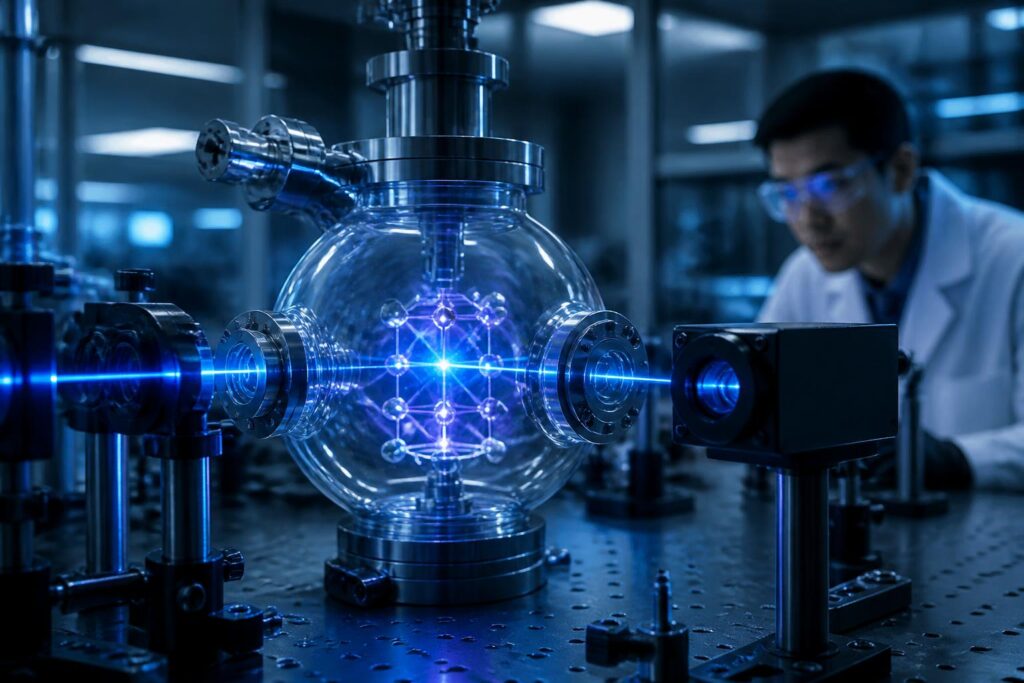
When quantum technology is mentioned, many people immediately think of quantum computers and the problems that conventional computers struggle to handle. But another area of development is also attracting considerable attention: quantum sensors. Rather than using qubits to perform algorithms, quantum sensors harness the principles of quantum mechanics to observe and measure the world with an extremely high degree of precision.
This concept does not mean that every measuring device with the word “quantum” in its name is superior in every situation. Quantum sensors still have to operate in real-world environments and are affected by temperature, vibration, electromagnetic interference, and the limitations of data-reading systems. Their value lies in problems where traditional measurement methods have reached their limits, or where a very small signal may carry important meaning.
What Do Quantum Sensors Operate On?
Quantum systems possess characteristics that classical systems are difficult to reproduce, such as superposition, the interference of probabilities, and discrete energy levels. When carefully prepared, controlled, and observed, these characteristics can reflect extremely small changes in the external environment.
Imagine an atom, ion, electron, or photon in a controlled state. A small influence from a magnetic field, acceleration, gravity, or an electric field can change the phase, energy level, or spin direction of the system. The device reads that change and converts it into information about the quantity being measured. In many designs, what matters is not directly “seeing” the quantum effect, but measuring the relative change between states using interferometry and precise references.
Therefore, a quantum sensor usually consists of several components: a quantum system that is sensitive to its environment, a source or controller for preparing the state, signal-reading equipment, and data-processing software. A sensitive material alone, without the ability to control and calibrate it, cannot yet become a useful sensor in practical settings.
Common Groups of Quantum Sensors
Atomic Clocks and Time Measurement
Atomic clocks are based on stable energy-level transitions in atoms to create a frequency standard. For a long time, these devices have played an important role in systems that require highly accurate time synchronization, including telecommunications, positioning, and certain scientific activities. Every improvement in time stability can help signal-distribution and positioning systems operate more reliably.
Atomic clocks are not products intended only for laboratories. However, high-precision versions often require complex equipment, a controlled environment, and strict operating procedures. One important area of development is miniaturizing atomic clocks so they can be incorporated into mobile devices or systems outside the laboratory while maintaining the required performance.
Magnetic-Field Sensors
Magnetic fields occur in many places, from electrical equipment, wires, and motors to living organisms and geological structures. Some quantum sensors use electron spin in materials, cold atoms, or superconducting systems to detect changes in magnetic fields. These devices can support materials research, nondestructive testing, positioning, and the measurement of electrical activity in the body.
Defects in diamonds, commonly known as nitrogen-vacancy centers, are a notable example. Their spin properties can change when exposed to magnetic fields, light, or temperature. One advantage of this approach is that the sensitive element has the potential to operate under conditions close to ordinary environments, although the entire system still requires a suitable light source, signal receiver, and control mechanism.
Atom Interferometers
In an atom interferometer, atoms are cooled and controlled to create different quantum-evolution paths before being combined again. The phase difference between these paths contains information about acceleration, motion, or gravity. This principle can be used to build inertial and gravimetric measuring devices.
This measurement capability opens up applications in geological surveying, underground research, and positioning. For example, very small changes in gravity may be related to the distribution of matter beneath the surface. However, interpreting the signal is not simple. Groundwater, terrain, vibration, and many other environmental factors also affect the measurement, so the sensor must be combined with models and supplementary data.
Potential Applications in Daily Life and Industry
In healthcare, magnetic-field sensors could help record very weak biological signals without introducing an electric current directly into the body. Systems for measuring brain or heart activity are an important area of research, but practical devices must meet stringent requirements for safety, interference shielding, and data interpretation. Quantum sensors do not automatically turn a measurement into a diagnostic tool. They only provide a way to capture signals, while the clinical process must be evaluated separately.
In industry, quantum sensors could help inspect materials, monitor electrical current, or detect abnormal changes in equipment. The ability to measure magnetic fields with high sensitivity can be useful when inspecting components without completely disassembling them. However, high sensitivity also makes sensors more likely to detect unwanted signals. A device used in a factory must distinguish the phenomenon being monitored from vibration, electrical interference, and thermal fluctuations produced by the manufacturing environment itself.
In Earth surveying, gravity and acceleration sensors can add information to geological maps, studies of underground structures, or the monitoring of changes in infrastructure. In positioning, quantum inertial sensors are expected to support operations when satellite signals are weak or unavailable. Even so, this field requires a balance between accuracy, size, energy consumption, and data-update speed.
Why Are Quantum Sensors Not Yet Widely Used?
The first obstacle is the environment. Quantum states are highly sensitive to external influences. Heat, vibration, uncontrolled light, electromagnetic interference, and instability in the power supply can all reduce measurement quality. Some designs require very low temperatures, vacuum chambers, or special shielding layers. These requirements increase the size, cost, and operational complexity of the devices.
The second obstacle is calibration and repeatability. A sensor must not only produce a sensitive measurement, but also deliver consistent results over time and across devices. Manufacturers need to know the sensor’s deviation, how it responds to environmental conditions, and when it must be recalibrated. These are technical issues that attract less attention than the concept of “quantum sensitivity,” but they determine whether a device can be used in a real-world process.
The third obstacle lies in the supporting systems. The quantum element may be very small, but the accompanying lasers, magnets, controllers, vacuum systems, temperature sensors, and processing computers can account for most of the device. To commercialize the technology, research teams must find ways to integrate multiple components, automate operation, and make the device robust enough for ordinary use conditions.
Quantum Sensors Should Not Be Confused with Quantum Computers
These two technologies are both based on quantum mechanics, but they have different goals. Quantum computers use quantum states to represent and transform information, with the aim of executing specialized algorithms. Quantum sensors use changes in quantum states to measure a physical quantity. A sensor system may contain complex control and data-processing components, but that does not turn it into a quantum computer.
This distinction matters when evaluating products and technology claims. A device can provide practical benefits without performing quantum computation in the conventional sense. Conversely, labeling something as quantum does not guarantee that the device is always more accurate, less expensive, or better suited than a classical solution. Comparisons must be based on the specific problem, sensitivity requirements, operating conditions, ownership costs, and ability to integrate into existing processes.
The Outlook for Quantum Measurement Technology
The greatest promise of quantum sensors lies in bringing measurements that were once feasible only in laboratories into systems with more accessible sizes and costs. This trend requires simultaneous progress in materials, optics, electronics, control engineering, and software. No single type of sensor is suitable for every task. Magnetic-field sensors, atomic clocks, and atom interferometers will develop according to their own specific requirements.
In the early stages, specialized applications may emerge before mass-market products. Places that derive high economic or scientific value from a precise measurement will have an incentive to invest in equipment that is more expensive and complex. As manufacturing processes improve, some components may be miniaturized and standardized, thereby broadening the range of uses.
It is essential to evaluate the technology based on specific measurement results rather than vague general expectations. A good sensor must indicate what quantity it measures, under what conditions, how stable it is, and how its results are verified. These questions help distinguish a valuable technical advance from an unsupported promotional claim.
Conclusion
Quantum sensors open up a new approach to observing time, magnetic fields, acceleration, and gravity. They harness the sensitivity of quantum systems to detect extremely small changes, thereby offering potential benefits for healthcare, industry, geological surveying, and positioning. However, the technology still has to address many issues involving interference, durability, calibration, size, and cost.
The value of quantum sensors will not be determined by their name, but by their ability to produce reliable measurements in real-world environments. As quantum elements, control equipment, and processing software become better integrated, this technology could become a new layer of tools alongside traditional measurement methods, complementing them wherever accuracy and the ability to detect weak signals are especially important.
