


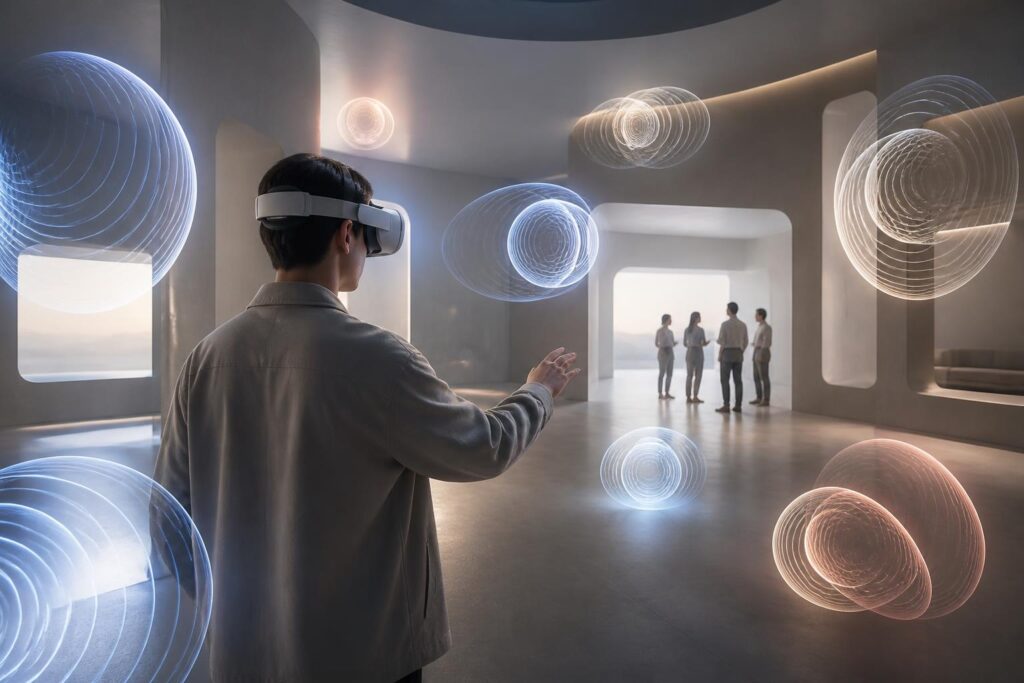
Sound Is No Longer Secondary to Visuals
When people talk about the virtual world, most discussions tend to revolve around virtual reality headsets, three-dimensional graphics, avatars, or the ability to interact with digital objects. Sound is sometimes viewed merely as a decorative layer, whose purpose is to make the scene feel less silent. This perspective does not accurately reflect the role of hearing in an immersive experience. A space can be rendered with highly detailed visuals and still feel unfamiliar if the sound does not help users understand where they are, what is happening, and how the people around them are present.
In everyday life, people rarely perceive their environment through their eyes alone. Footsteps, the sound of a door opening, audio reverberating from a room, or a voice coming from nearby all provide information about distance, direction, and proximity. When entering a virtual world, these signals need to be reproduced using methods suited to the digital environment. When done well, sound gives depth to a space that has never existed. When handled carelessly, users may feel as though they are standing in front of a screen playing effects rather than actually being present in a place.
Using Hearing to Navigate Three-Dimensional Space
One of the most important functions of virtual sound is helping users find their way. In a flat space, a notification usually appears at a fixed position on the interface. In a three-dimensional environment, information may come from the front, back, left, right, or from a higher or lower position. Differences in the direction from which sound comes allow users to imagine the structure of a space without constantly turning their heads or looking at a control panel.
This is especially evident in experiences where many activities take place simultaneously. A conversation in the distance, a sound coming from a door, and the noise of operating equipment may all coexist. Users do not necessarily have to observe every sound source, but can distinguish them based on their relative direction and distance. Sound then becomes a kind of invisible map, helping users build a sense of their environment by listening.
However, sound-based orientation is not simply a matter of placing an effect in the left or right channel. Sound needs to change according to the listener’s position, the sound source’s position, and the direction in which the user’s head or character is facing. A voice coming from behind should not continue to sound as though it is in front after the user turns around. This consistency creates the feeling that the sound source genuinely exists in space, rather than simply being played according to a fixed script.
How Is Distance Heard?
In the real world, sound often changes as distance changes. The voice of someone standing nearby has a different clarity from a voice echoing from the end of a corridor. An object in the distance may produce only a weak signal, while a nearby source dominates the listener’s attention. The virtual world can simulate these rules to make distance easier to perceive.
Reducing volume is the most obvious approach, but it is not enough. When a sound is far away, its clarity may decrease, some frequencies may be absorbed by the environment, and the reverberation may change according to the surrounding architecture. A small room, a large train station, and an outdoor area should not produce the same acoustic impression. Users do not need to know the calculations behind these effects, but they will notice when the space lacks consistency: a whisper still echoing as loudly as a voice right beside them, or a closed door failing to alter the sound coming from the next room.
Distance design is also connected to communication. If every voice retains the same clarity no matter how far away the speaker is, the space loses its sense of privacy and intimacy. Conversely, if sound fades too quickly, users may miss a conversation or fail to understand why a character has suddenly disappeared from their auditory experience. The goal is not to simulate every detail of real life, but to create rules that are stable enough for users to predict.
Voices and the Human Sense of Presence
In many virtual spaces, voice is the most direct bridge between participants. Avatars may be simplified and gestures may still feel unnatural, but a voice with a clear position in space can make a conversation feel less abstract. Users can identify who is speaking, where that person is standing, and whether they are directing their attention toward the user or toward another group.
This creates higher demands for communication design. A conversation involving several people must not only transmit voices, but also preserve the ability to distinguish between different voices. If all sounds have the same volume and distance, listeners must concentrate too intensely to keep track. If background effects are too dense, speech will be obscured. A good environment needs to distribute attention through sound, allowing important signals to stand out without turning everything into continuous noise.
Voices can also change the atmosphere of a space. In the same room, a voice processed as though it were nearby will create a sense of intimacy, while broadly reverberating sound may suggest an auditorium or public area. These choices are not merely technical. They affect how users behave, how comfortable they feel speaking, and how they perceive the boundary between a private area and a crowded place.
Environmental Sound and the Risk of Overload
A lively virtual world does not mean that it must produce sound at all times. Birdsong, machinery, background music, notifications, voices, and interaction effects, if all amplified together, will create a dense layer of sound that makes it difficult for users to determine what information deserves attention. Unorganized richness can quickly turn into fatigue.
Designers need to distinguish between sounds that create context and sounds that convey information. The sound of wind or water can reinforce a sense of place, but should not compete with instructions. A warning signal needs to be distinct enough for users to recognize it without looking at the screen. Repeating effects also need to be considered, because what is impressive during the first few minutes may become irritating after a long period of time.
Providing separate volume controls for each group of sounds is useful, but the design should not shift all responsibility onto the user. If users must constantly open the settings panel to lower each type of noise, the experience has already revealed a structural problem. Well-timed silence, pauses between signals, and the ability to change intensity according to the situation are just as important as the number of effects produced.
Designing for Different Ways of Hearing
Not everyone perceives sound in the same way. Some people are sensitive to volume or repetitive sounds, some use hearing aids, and some cannot rely entirely on hearing to understand what is happening in an environment. Therefore, sound in the virtual world needs to be designed as an information channel that can be combined with other channels, rather than as the only gateway into the experience.
Captions can turn speech into text, but not every sound can be addressed by transcribing speech. A visual indicator or gentle vibration can show the direction of a sound source, the category to which a signal belongs, and its level of urgency. These indicators need to be used selectively so that they do not make the interface cluttered. The goal is to preserve the meaning of the information, not to mechanically reproduce every sound.
Providing options should also follow the principle of clarity. Users should know which sounds can be adjusted, turned off, or converted into other signals. Important settings should not be hidden behind multiple layers of menus. A truly user-friendly virtual space does not force users to endure the default design before they can find a way of listening that suits them.
When Sound Becomes Part of Architecture
Sound can help distinguish areas where visuals are not clear enough. A narrow passage, a plaza, a meeting room, or an area that requires quiet can be recognized through reverberation characteristics, the density of noise, and the way sound travels. As a result, virtual architecture is created not only with walls, floors, and light, but also through the way sound sources respond to space.
This approach opens up the possibility of building places with distinct personalities. A virtual library might maintain a low and steady soundscape, while a creative workshop might allow multiple sound sources to coexist. What matters is that these characteristics serve the user’s activities rather than merely displaying technology. In many cases, the best sound is the sound that helps users understand where they are without needing to be told directly.
Acoustic architecture is also connected to privacy. A conversation in an enclosed area should not be transmitted with the same clarity as one taking place in the center of a plaza. These boundaries can be expressed through doors, partitions, distance, and decreasing volume. When users understand the rules governing how sound travels, they have a stronger basis for choosing where to speak and what content they want to share.
Measuring Quality Through Experience, Not Just Specifications
Technical specifications can indicate how many audio channels a system processes, how quickly it responds, or how accurately it reproduces the position of a sound source. However, these numbers do not automatically guarantee a good experience. What needs to be evaluated is whether users can locate the direction of a sound source, distinguish speech from background noise, estimate distance, and avoid feeling fatigued after using the system for a period of time.
Testing should therefore take place in real-world situations, with various types of spaces and levels of complexity. A sound may be clear when only one person is participating but blend into the background when a large group is present. A signal that is easy to recognize in a quiet room may lose its effectiveness in a public area. These differences appear only when the design is placed in the exact context that users will experience.
As virtual worlds continue to develop, sound increasingly needs to be regarded as a component of architecture, communication, and navigation. It does not merely make visuals more lively; it also determines how people perceive distance, privacy, and one another’s presence. A trustworthy virtual space does not necessarily need to be noisy or showcase numerous effects. It needs to know when users should hear something, where they should hear it from, at what level, and when to leave room for silence.
