


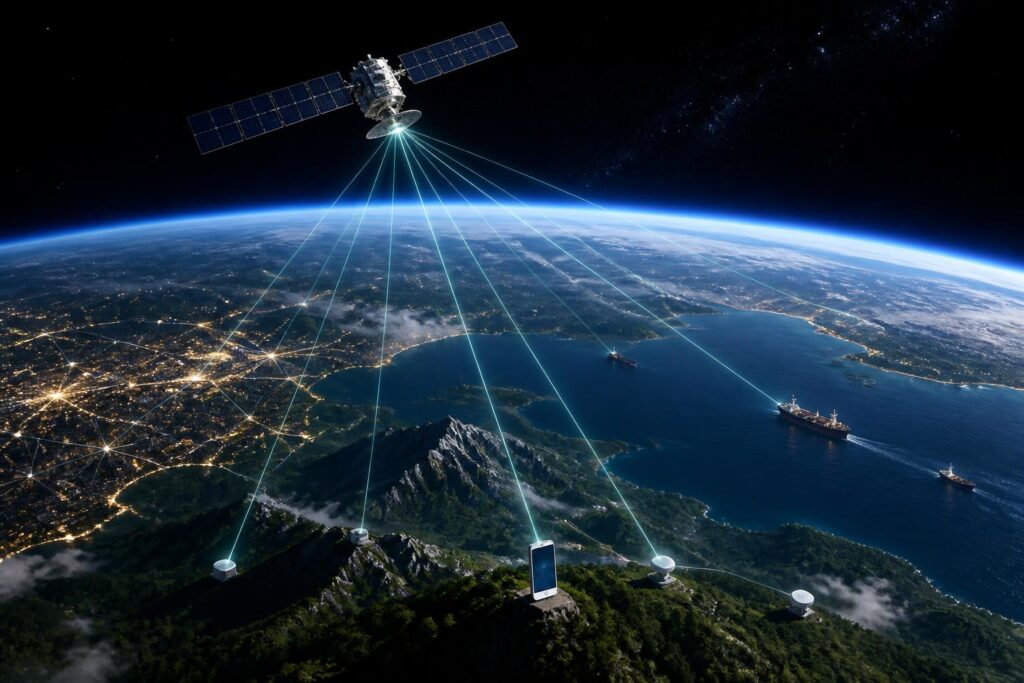
For many years, mobile connectivity has been built around a fairly clear logic: users’ devices communicate with ground-based stations, while those stations connect onward to the provider’s core network. This model is effective in cities and areas with a population density high enough to justify the investment. However, in coastal waters, on islands, in mountainous regions, deserts, or areas frequently affected by natural disasters, laying cables and building additional base stations is not always feasible.
Direct connectivity from satellites to devices, often referred to as direct-to-device, is being viewed as a supplementary layer for existing telecommunications infrastructure. Instead of requiring users to own specialized satellite equipment, this model aims to allow phones or Internet of Things devices to send and receive data with low Earth orbit satellites under suitable conditions. This is not a promise to replace terrestrial mobile networks entirely, but an effort to fill gaps that traditional infrastructure cannot cover economically.
From Ground-Based Stations to Stations in Orbit
The notable aspect of the new model lies in changing the location of part of the access infrastructure. Low Earth orbit satellites travel around the Earth at a closer distance than many traditional satellite systems, thereby reducing latency and improving communication quality in some situations. When a satellite passes over an area without a ground-based station, it can serve as a temporary relay point between user devices and the network behind it.
To make this possible, the system must coordinate multiple components: satellites, ground stations, the carrier’s core network, radio resource management software, and end-user devices. Satellites must not only receive signals but also track moving devices, hand over connections between satellites, and maintain communications as a satellite leaves the service area. On the ground, carriers need to integrate satellite services into routing, subscriber authentication, billing, and customer support processes.
For users, the ideal experience is seamless. When a phone loses its signal from a ground-based station, the device could switch to a satellite channel with certain limitations without requiring complicated actions. But achieving that seamless feel requires manufacturers to address numerous technical issues related to transmit power, antenna design, modem software, and visibility of the sky. A phone inside a building, beneath dense tree cover, or in terrain-obstructed areas will not be able to operate in the same way as a device placed outdoors.
The Greatest Value Lies in Connectivity Gaps
The most readily understood application of direct satellite connectivity is emergency communication. When a rescue team is operating in the mountains or offshore, a channel for sending short messages, coordinates, and safety status can make a major difference. In situations where terrestrial networks have been damaged by storms, floods, earthquakes, or prolonged power outages, satellites can provide a temporary communications link to maintain essential notifications.
However, the technology’s value is not limited to rescue operations. People working at sea, transport routes passing through sparsely populated areas, environmental monitoring stations, and farms far from population centers can all benefit from an additional layer of connectivity. For sensor devices that only need to send small amounts of data periodically, bandwidth requirements are not particularly high. A system for tracking location, issuing temperature alerts, monitoring machinery, or updating cargo status can operate in places where building a separate terrestrial network would be too costly.
In agriculture and resource management, satellite connectivity can support distributed operations across wide areas. Data from sensors does not necessarily need to be transmitted continuously at high speed. More important is that devices can send data at the right time, maintain operation with reasonable power consumption, and remain connected as geographic conditions change. This is why satellite services are generally expected to be used first for small tasks that do not require video transmission or continuous real-time interaction.
Not a Base Station in the Sky
The simple description that satellites will provide coverage everywhere can easily create excessive expectations. In reality, coverage on a map does not mean a stable user experience in every circumstance. Satellites are constantly moving, while ground-based devices may be indoors, underground, or between high-rise buildings. Signals are also affected by weather, obstructions, the angle of view toward the sky, and the device’s processing capabilities.
Bandwidth is another important limitation. A ground-based station can serve an area with infrastructure density designed to match demand. By contrast, satellite resources must be shared across many broad geographic regions. When the number of devices rises rapidly or many people access the system at the same time, the system must determine which types of traffic to prioritize, how to limit speeds, and how to handle resource contention. Initial services may therefore focus on messaging, sensor data, and short information packets rather than offering a broadband experience equivalent to an urban 5G network.
Latency also needs to be considered according to the task. Low Earth orbit connectivity can improve latency compared with systems in higher orbits, but the transmission path still passes through multiple layers and depends on the location of ground stations. Sending a message or synchronizing data periodically is a different challenge from making video calls, playing online games, or remotely controlling machinery. Technology should be evaluated based on actual requirements rather than theoretical speed alone.
The Coordination Challenge Between Carriers and Satellite Providers
For direct satellite connectivity to become a mainstream service, cooperation among the parties involved will be decisive. Satellite providers possess the ability to launch, operate, and control satellite constellations. Carriers maintain relationships with subscribers, authentication systems, and core network infrastructure. Phone manufacturers, meanwhile, determine which frequency bands, protocols, and power levels devices can use. If these components are incompatible, users will have to purchase separate equipment or accept a complicated usage process.
Deep integration with carriers could make satellite services more familiar. Users would continue using their existing subscriptions, while satellite connectivity would be activated when the device leaves terrestrial coverage. Even so, this approach requires commercial agreements, technical standards, and roaming mechanisms between networks. In countries with multiple operators, the question of who is responsible when an emergency call passes through several systems must also be resolved in advance.
Spectrum management is an unavoidable layer of challenges. Radio spectrum is a finite resource, and shared use between satellites and terrestrial networks must avoid causing interference. Regulators need to balance encouraging innovation, protecting the quality of existing networks, and ensuring that services comply with regulations in each territory. A system may work well technically but still be unable to launch commercially if licensing procedures and spectrum coordination have not been completed.
Data Security and Resilience Against Disruptions
When satellites are added to the transmission path, the service’s operational surface also expands. Data may pass through the user device, satellite, ground station, and many other network components before reaching the destination system. Every connection point needs to be authenticated, monitored, and securely updated. Especially for emergency communications, location and user identity information can be highly sensitive, so privacy must be incorporated into the design from the outset.
Resilience against disruptions also depends on more than the number of satellites. A reliable service needs contingency plans for situations in which a ground station loses power, a satellite encounters a failure, control software is attacked, or traffic surges suddenly. Retaining backup channels on terrestrial networks, allowing devices to switch flexibly, and establishing emergency operating procedures will be no less important than expanding coverage.
Users also need to clearly understand what data is transmitted via satellite and under what conditions. If a device automatically switches to a satellite channel, the operating system should transparently indicate the connection status, service limitations, and possibility of additional charges. Transparency not only helps prevent misunderstandings but also gives users a basis for choosing the appropriate communication method in sensitive situations.
A Practical Path of Development
In the initial phase, direct satellite connectivity will most likely develop as a supplement rather than a replacement. Terrestrial networks will still carry most daily traffic in residential areas, industrial zones, and busy transportation corridors. Satellites will focus on areas where infrastructure is difficult to build, services with minimal communication requirements, and situations in which terrestrial networks are disrupted.
The technology’s maturity will depend on several key factors: devices must become more energy-efficient, connection procedures must become simpler, service quality needs to become more stable, and costs must suit actual needs. Common standards will also help reduce the risk of the market becoming divided into closed ecosystems in which each service operates only with a particular group of devices or a specific carrier.
Most importantly, satellites should be viewed as part of a multilayer connectivity architecture. No single technology can solve every coverage challenge. Ground-based stations, fiber-optic cables, fixed wireless networks, Wi-Fi, and satellites can complement one another if designed with clearly defined roles. In this picture, direct satellite connectivity opens up a notable option for places once considered too remote, too expensive, or too difficult to serve. Its true value will not lie in claims of broad coverage, but in its ability to maintain a useful communications link at the right time and in the places where people need it most.
