


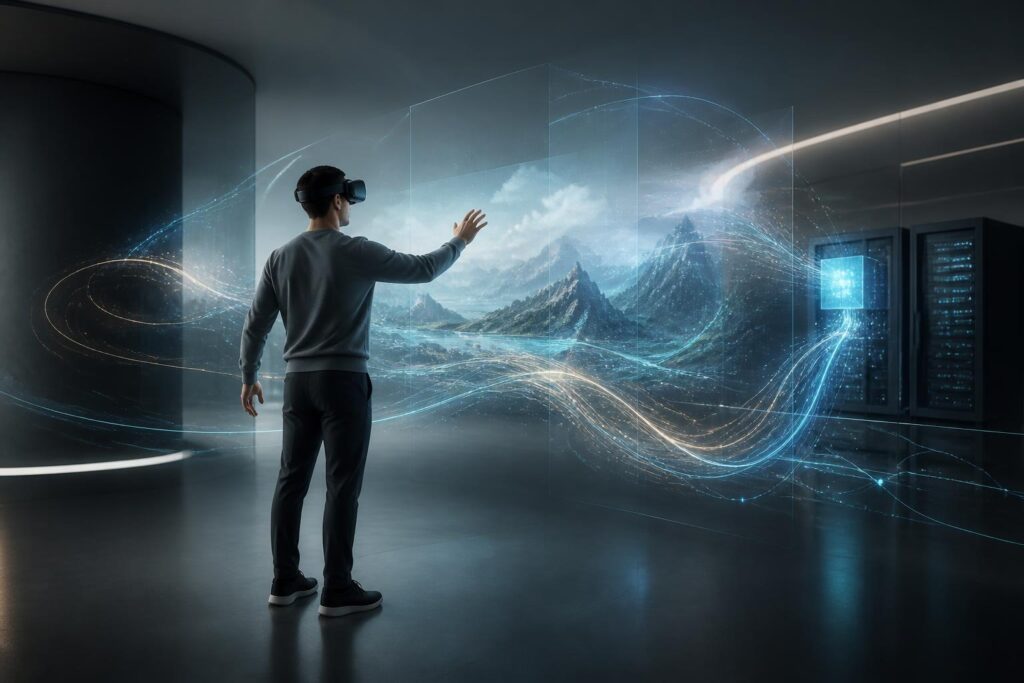
When entering a virtual world, users usually pay attention first to the visuals: Does the space look realistic? Are the characters well designed? Do the lighting effects create a sense of vitality? However, even an eye-catching experience can quickly become frustrating if the system responds slowly. If users turn their heads but the image updates late, touch an object but the action occurs afterward, or move through an environment where the response is constantly interrupted, their sense of presence noticeably diminishes.
Latency is therefore one of the foundational elements of a virtual world. It is not easy to notice when everything runs smoothly, but it immediately becomes apparent when something goes wrong. Unlike an ordinary interface error, latency can cause users to lose their bearings, make mistakes, become fatigued, or lose interest in returning to the platform. This issue involves the device, software, network connection, servers, and the way developers design the experience all at once.
What Exactly Is Latency?
Simply put, latency is the amount of time between when a user performs an action and when they receive the corresponding response. In a virtual environment, an action may begin when the user turns their head, moves their hand, presses a button on a controller, says something, or changes position. The signal then has to be captured by the device, processed by the software, and used to generate an image or sound before the result is returned to the user.
This chain does not have just one point where delays can occur. Sensors may not register movement quickly enough. The processor may need additional time to render a frame. The network connection may slow the exchange of data with the server. The server may have to process the actions of many people at the same time. Finally, the display, headset, or haptic feedback device also needs time to present the result. Total latency is the cumulative effect of multiple stages, even if each individual stage seems insignificant.
In applications that only display static information, a small amount of latency usually has little impact. But virtual worlds require continuous coordination between body movement and changes in the space in front of the user. Users are not merely observing a pre-existing image; they are constantly checking whether the environment is responding appropriately to them. As a result, the same delay may be virtually harmless in an ordinary application but become highly noticeable in virtual reality or an interactive game.
When Images Fail to Keep Up with Movement
One of the easiest situations to recognize is when the image fails to keep up with head movement. The user turns to the side, but the scene remains unchanged for a moment before updating. This mismatch forces the brain to process inconsistent signals: the body has moved, while the eyes are still seeing a world that has not moved accordingly.
People may react differently. Some may simply feel that the experience is unnatural, while others may quickly experience eye strain or lose focus. Some may feel dizzy, especially when the virtual environment is constantly moving or when the system maintains an unstable frame rate. Importantly, the issue is not solely about graphics quality. A scene with a moderate level of detail but consistent responsiveness can be more comfortable than a very beautiful scene that frequently stutters or updates slowly.
This is why developers often have to weigh the level of detail against their ability to maintain stable responsiveness. Increasing lighting effects, shadows, materials, or object density can make images more appealing, but it also places an additional burden on the hardware. If improving the visuals prevents the system from maintaining smoothness, the overall quality of the experience may decline rather than improve.
Network Latency and the Illusion of a Shared Space
In virtual worlds with multiple participants, not every response is processed immediately on the user’s device. Character positions, interactive actions, object states, and other data may have to be exchanged with a server. When the connection is unstable, users may see other characters moving erratically, actions occurring late, or an object seemingly failing to respond even though an action has already been performed.
This issue presents a particular challenge: the system must create a sense of a shared space even though each participant has different connection conditions and devices. If every action waits for server confirmation before being displayed, the experience becomes sluggish. But if the device predicts too much, the image may temporarily differ from the final state recognized by the server.
To resolve this tension, software often has to distinguish between immediate feedback for the user and states that need to be synchronized accurately. A simple movement can be displayed immediately to create a sense of continuity, then adjusted slightly if data from the server shows that the actual position is different. For actions with important consequences, such as changing in-game assets or affecting shared progress, the system must instead prioritize consistency and clear confirmation.
Users usually do not see the mechanisms behind this process. They only perceive a world as “smooth” or “not smooth.” That impression, however, is the result of many technical decisions involving prediction, data synchronization, temporary storage, and how interruptions in the connection are handled.
Not All Latency Has the Same Impact
Latency needs to be assessed in context. During a tour of a virtual space, a slight delay in the appearance of an information panel may not be serious. By contrast, in an action requiring hand-eye coordination, even a small delay can cause users to press the wrong button or feel that the device is unreliable. In a conversation, audio latency can cause two people to speak over one another and disrupt the rhythm of communication.
This shows that platform quality cannot be evaluated using a single criterion. Developers need to consider the type of activity, the level of precision required, and the consequences of a delayed response. A free-form creative space may allow users to wait longer for a new area to load, but it still needs to ensure that basic actions such as looking, walking, selecting objects, or talking occur consistently.
Interface design can also make latency feel more or less tolerable. A button with no visual feedback leaves users unsure whether their action has been registered. Conversely, a clear confirmation signal, appropriate sound, or well-designed transitional motion can help users understand that the system is processing their action. However, these signals should not be used to conceal a persistent problem. If the feedback is merely decorative while the actual action still occurs late, a sense of unreliability will soon emerge.
Designing Virtual Worlds Under Imperfect Conditions
Not every user has powerful hardware, a stable connection, or an ideal physical space. A platform that works well only under high-end conditions will be difficult for the majority of people to access. Adaptability therefore needs to be considered part of the design, not an emergency fix applied after the product is complete.
An application may allow users to reduce visual effects, adjust display quality, change movement speed, or choose a more suitable interaction method. These options not only serve users with less powerful devices but also help users control the level of visual and physical stimulation. In addition, the system should clearly indicate when the connection is unstable rather than leaving users to guess whether the problem lies with the device, the network, or the platform.
Designers also need to account for the possibility that users may suddenly leave a connected session. When the network becomes unstable, a good experience does not necessarily have to maintain every function, but it should switch to a safe and understandable state. Important data needs to be protected, incomplete actions need to have a clear status, and users need to know whether they can continue without losing their progress.
Latency Is an Experience Issue, Not Just a Technical Specification
In discussions about virtual worlds, resolution, the number of objects, and visual effects are often easier to promote because they can be seen immediately. Latency is less prominent, even though it directly affects how people perceive presence. A convincing virtual world does not only need to look real; it needs to respond in ways that match the expectations of the body and mind.
This also relates to trust. When users reach out their hands, they expect an object to respond at the right moment. When they speak, they expect others to hear them without having to constantly guess whether the signal has been transmitted. When they move, they expect the space to remain stable. Each time the system responds late or inconsistently, users have to devote part of their attention to checking the technology instead of focusing on the main activity.
In the long term, the successful platforms may not be those that create the most spectacular images, but those that allow the technology to recede into the background of the experience. When feedback is fast enough, movement is stable enough, and error states are handled transparently, users can focus on learning, working, entertainment, or communication in a virtual environment.
Virtual worlds are still being shaped by many different layers of technology. Although hardware and connectivity will continue to improve, latency will not disappear entirely, because every system has to process data and confront physical limitations. A more realistic goal is to reduce the delays that matter most, design responses appropriate to each situation, and ensure that users always understand what is happening. When that happens, the sense of presence will no longer depend on flashy appearances, but will be built on consistency between human actions, system responses, and human expectations.
