


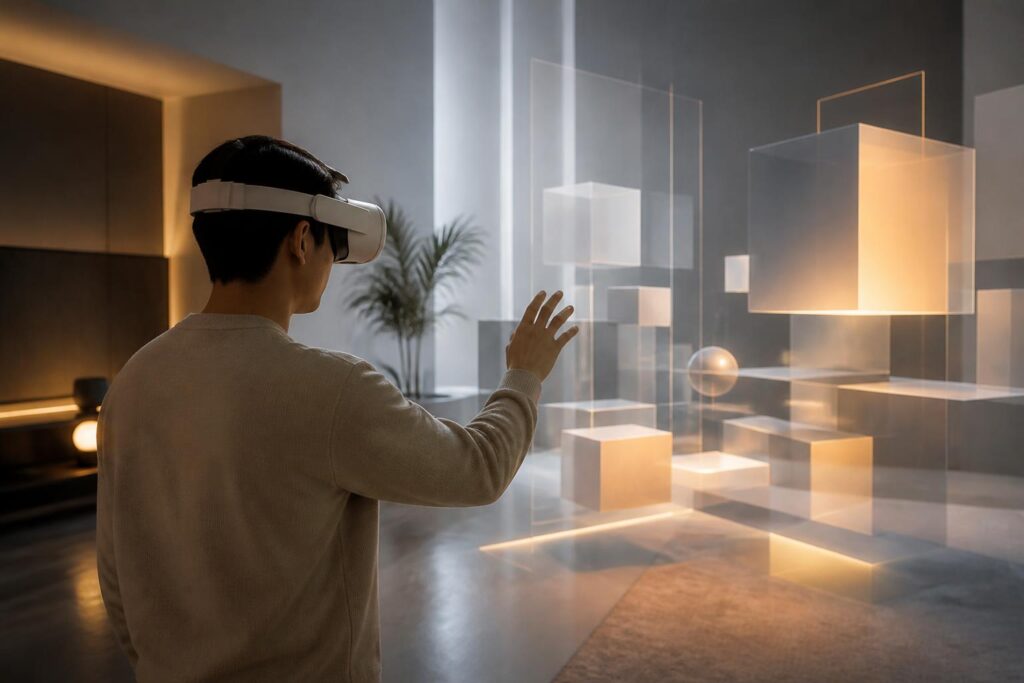
A virtual space may begin with very simple images on a screen, but the user’s experience does not stop at seeing them. When sound changes according to the direction in which the user turns their head, when images respond to bodily movement, or when a virtual character looks toward the person it is facing, users may develop a sense that they are present in a specific place. This feeling is often called a sense of presence, one of the important elements behind the appeal of virtual reality, online games, virtual meeting rooms, and many interactive digital platforms.
A sense of presence does not mean that users completely forget the physical environment around them. It refers to the extent to which a person feels that they are participating in a digital space rather than merely observing it from the outside. Two people using the same application may see similar images, but their levels of immersion may differ. One may feel as though they are sitting in a virtual room, while the other sees only an interface with numerous moving objects. This difference is influenced by the device, the design, the user’s mental state, and the context of use.
Presence Does Not Come Only from Beautiful Images
When people talk about virtual spaces, they often immediately think of resolution, lighting effects, or rendering capabilities. These factors play a role, but a beautiful image alone is not enough to create a sense of presence. Users need to perceive that the space is responding to their actions consistently. If they tilt their head and the scene changes in the correct direction, reach out and an object responds appropriately, or move closer and the sound and viewpoint change accordingly, the brain has more reason to regard that environment as a place with which it can interact.
Consistency is more important than complexity. A highly detailed virtual world with slow responses, inaccurate movement, or mismatched sound can quickly remind users that they are in front of a computer system. By contrast, a simply designed space with clear rules can still create a convincing experience. This is why designing virtual spaces is not merely a race involving hardware or graphics. It is also a problem involving pacing, distance, sound, lighting, viewpoint, and the way people anticipate what will happen next.
The body also helps shape this feeling. In everyday life, people use sight, hearing, balance, and their sense of bodily position to understand where they are. The more seamlessly an immersive system can respond to these signals, the more natural the experience is likely to feel. However, if the signals are inconsistent, users may feel discomfort, disorientation, or fatigue. Therefore, an immersive experience should not be evaluated only by how long users want to stay, but also by their level of comfort and their ability to leave the space without experiencing negative effects.
Three Layers of an Immersive Experience
A sense of presence can be viewed from several perspectives. The first is spatial presence: the feeling of being inside a location rather than viewing that location through a flat frame. Users may perceive the distance between objects, the direction of sounds, and their own position within the virtual room. Small cues such as shadows, reverberation, and changes in viewpoint all contribute to this awareness.
The second layer is the presence of the self. In a virtual space, users may be represented by hands, a digital body, or a character whose appearance differs from their physical body. What matters is not necessarily that the avatar resemble the user, but that its actions create a sense of ownership. When users move their hands and see virtual hands move in sync, they are more likely to regard those hands as part of themselves in the digital environment. If the avatar responds at the wrong time or moves unnaturally, the sense of connection weakens.
The third layer is social presence. A virtual room takes on a different meaning when other people appear in it, whether they are represented by realistic images or minimalist characters. Eye contact, the direction of head movements, gestures, and the distance between avatars can all influence how people perceive a conversation. However, social presence also places greater demands on design. If users do not know where the other person is looking, whether they can hear them, or whether they are actually participating in the conversation rather than standing still like an object, communication can easily become awkward.
Why Is a Sense of Presence So Convincing?
In the physical world, people are constantly making predictions. When we reach toward a cup, we estimate its position, size, and distance. When we hear a sound behind us, we automatically imagine the direction from which it came. Virtual spaces create similar predictions and then provide feedback for users to test them. If the feedback is appropriate, the experience becomes smooth. If the feedback is consistently inaccurate, users must adjust their perceptions and quickly begin to feel that the environment is artificial.
This explains why a small amount of latency can sometimes have a greater impact than certain graphical details. An object may not be perfectly realistic, but if it moves at the right time and in the right direction, users will still accept the rules of the space. Conversely, a very beautiful scene that responds slowly will disrupt the continuity of the experience. The convincing quality of a virtual world therefore does not lie in simulating everything exactly as it is in real life, but in creating a system that is consistent enough for people to understand and predict.
However, a sense of presence also depends on the user’s mood and purpose. Someone concentrating on work may notice delays that a person playing a game would overlook. A first-time user of an immersive device often needs time to become familiar with the controls, while an experienced user may expect more nuanced responses. There is no single level of presence suitable for everyone. Good design should allow users to adjust the intensity of the experience, movement speed, viewpoint, and the amount of information appearing before them.
Benefits and Limitations to Recognize
When used for the right purposes, a sense of presence can make learning, creativity, and communication more vivid. A learner can observe a three-dimensional model instead of merely reading a description. A design team can examine an object together in a shared space. Someone taking part in a virtual tour can pay attention to layout, sound, and the relationships between different areas in a way that differs from watching a video. These experiences do not automatically replace activities in the real world, but they open up another way of engaging with them.
In communication, a sense of presence can reduce the distance between people who are not in the same place. A meeting in a virtual space allows participants to share a direction of view, point to objects, and gain a relatively clearer sense of one another’s positions. Nevertheless, digital presence cannot guarantee the quality of a relationship. A good interface cannot replace listening, goodwill, or the ability to respect other people’s boundaries. If too much emphasis is placed on making a meeting feel real, designers may overlook basic needs such as the right to remain silent, the right to turn off the camera, or the ability to leave the conversation.
Health-related aspects also need to be considered carefully. Some people may experience eye strain, headaches, nausea, or disorientation when using immersive environments for long periods. The effects vary from person to person and from one device to another, so discomfort should not be regarded as a sign that users lack the ability to adapt. Platforms should provide clear guidance, allow users to take breaks, and avoid encouraging continuous use merely to increase interaction time.
A sense of presence can also make emotional experiences more intense. A hurtful remark in a virtual room may have a greater impact than an isolated line of text because users experience it as happening directly in front of them. Similarly, a friendly action can create a sense of closeness. This requires participants to understand that behavior in a virtual space can still affect real people. Creating an environment that is easy to become immersed in must go hand in hand with user-protection tools, reporting mechanisms, and options for controlling interactions.
Designing Human-Centered Virtual Worlds
A trustworthy virtual space does not necessarily have to make users forget the world outside. On the contrary, responsible design should help them remain aware of where they are, how long they have been using the system, and how they can return to the physical environment. Orientation cues, motion-reduction modes, safe areas, and options to limit interaction do not make the experience less engaging. They create a necessary layer of control so that users are not carried away against their will.
Accessibility is also part of a sense of presence. Not everyone has the same ability to see, hear, move, or control a device. A space that relies solely on hand movements, directional sound, or rapid actions may exclude many users. Flexible design should provide alternative control methods, captions, visual signals, and ways to adjust speed. When more people can participate in ways that suit them, the virtual world becomes not only more realistic but also more open.
Ultimately, users should be given the power to decide how immersed they want to be. Sometimes they may want to focus completely on the digital environment; at other times, they may need only an additional layer of information supporting the real world. A mature design does not force everyone into the same experience. It allows users to switch between levels of presence, clearly explains what the system is doing, and respects their choice to leave.
Presence Does Not Replace Reality
A sense of presence shows that technology can affect perception in ways more subtle than simply providing images or information. When sound, movement, space, and interaction work together smoothly, an environment created from data can provide an experience very close to the feeling of being somewhere. But that convincing quality does not turn the virtual world into reality, nor does it automatically make every activity within it as valuable as an activity in the real world.
What matters is maintaining a clear-minded distance between the experience and the nature of the technology. Users may become deeply immersed while still needing to know that they are using a system designed by people and operated through hardware, software, and certain rules. By understanding those limits, we can make use of a sense of presence for learning, creativity, and connection without sacrificing comfort, autonomy, or relationships in real life. The virtual world may become more convincing, but the way it serves people is what ultimately determines its value.
