


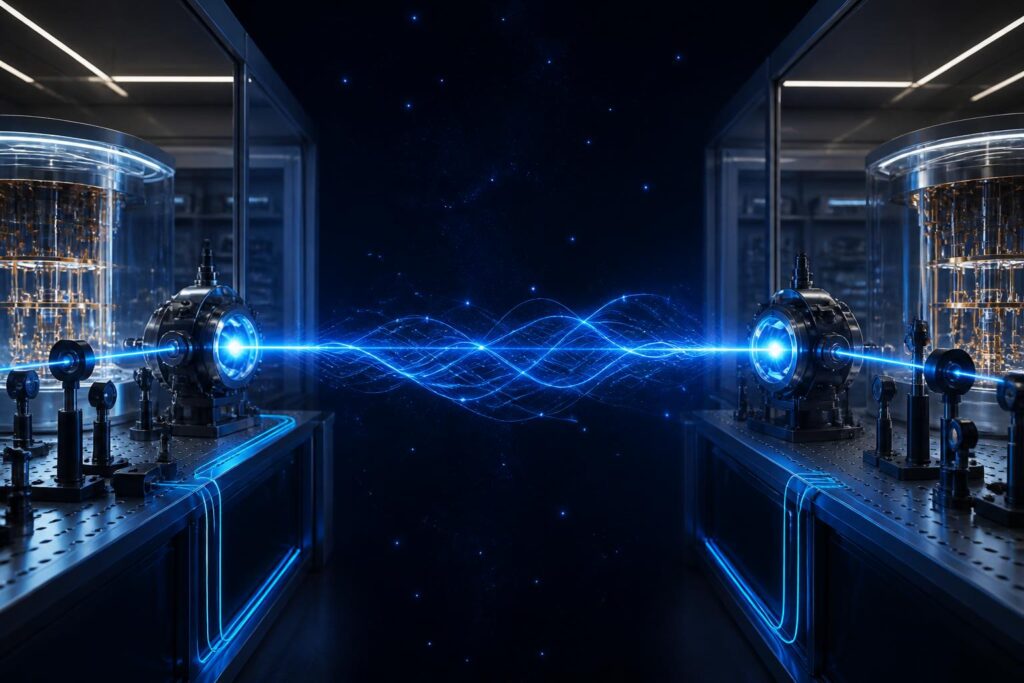
When quantum computers are mentioned, most attention tends to focus on qubits, algorithms, and the ability to process problems that traditional computers struggle to solve. However, a single quantum computer is not the only destination. Many research groups are also working toward connecting quantum devices into a network so that they can share quantum states, coordinate computations, and transmit information according to principles different from those of today’s Internet.
This idea is commonly called a quantum network. The term may lead readers to imagine a faster Internet, but that understanding is not accurate. Quantum networks will not immediately replace traditional networks, nor will they turn all data into quantum data. Their goal is to add a new layer of capability in which quantum states are created, transmitted, stored, and measured under special forms of control.
How Are Quantum Networks Different from Today’s Internet?
The traditional Internet transmits information using bits, with each bit representing either 0 or 1. Data is divided into packets, which pass through routers and are recreated multiple times along the transmission path. If a packet becomes weakened or corrupted, the system can use error-detection and error-correction techniques to resend it or recover its contents.
In a quantum network, information is encoded in qubits. A qubit can exist in a superposition state before it is measured, and it can also be related to another qubit through the phenomenon of quantum entanglement. This characteristic creates new possibilities, but it also makes data transmission much more difficult. Quantum states are highly sensitive to their environment. Unwanted interactions with light, heat, vibrations, or surrounding materials can destroy the properties needed by a qubit.
Another important difference is that quantum states cannot be copied arbitrarily. In a traditional network, an intermediary device can read a data packet and create a copy to forward it. For unmeasured quantum information, the same approach is no longer suitable. As a result, quantum networks need special methods to transmit states between nodes without relying on direct copying.
The Role of Quantum Entanglement and Quantum Teleportation
Quantum entanglement is a phenomenon in which qubits are described by a shared state, even after they have become far apart. When one qubit in an entangled pair or group is measured, the measurement result is related to the results of the remaining qubits. However, quantum entanglement does not allow meaningful messages to be sent faster than light. To complete an exchange of information, the network still needs a traditional channel to send measurement results or control information.
In a quantum network architecture, quantum entanglement can be viewed as a resource that must be distributed and maintained. Two distant nodes may first create pairs of entangled qubits and then use them for tasks such as transmitting quantum states or supporting cryptographic protocols. Creating entanglement over long distances is not simple, because quantum signals attenuate along the transmission path and cannot simply be restored with ordinary amplifiers as classical signals can.
Quantum teleportation is a protocol that clearly illustrates how a quantum network can operate. The name does not mean that matter or people are transported instantaneously. In principle, the protocol makes it possible to transfer the quantum state of one qubit to another distant qubit through an entangled pair and some classical information. The original state is not retained intact at the sender’s location, so the protocol does not create a copy in violation of the limits of quantum mechanics.
To carry out this process, the sender must perform an appropriate measurement on the qubit to be transferred and one qubit in the entangled pair. The measurement result is sent through a traditional channel to the recipient. Based on this information, the recipient applies the corresponding transformation to the remaining qubit, thereby recovering the state to be transmitted. This process shows that a quantum network is a combination of a quantum channel and a traditional channel, rather than a system operating completely separately from existing infrastructure.
The Components That Make Up a Quantum Network
A complete quantum network requires more than quantum computers at the two ends of a transmission path. First are the quantum nodes. Each node may contain processing qubits, devices for generating and measuring photons, or quantum memory used to temporarily store a state for the necessary amount of time. Depending on its purpose, a node may be a laboratory, a data center, a ground station, or a smaller device deployed in an experimental network.
Next is the transmission path. Fiber optic cable is a natural choice because it is already widely used in telecommunications infrastructure. However, optical fiber still causes attenuation of quantum signals, especially as the distance increases. Another approach is to transmit photons through free space, such as between ground stations and devices at high altitudes. This approach may reduce some of the limitations of ground-based transmission, but it depends on atmospheric conditions, pointing capability, and the length of time the devices can see one another.
Over long distances, a network may need quantum repeaters. In a traditional network, a repeater receives a weak signal, amplifies it, and retransmits it. A quantum repeater must use different mechanisms, often involving the creation of entangled links over short segments and then joining them into a longer link. Such a device requires quantum memory, synchronization mechanisms, and the ability to handle imperfections. If qubits cannot remain stable for long enough, connecting network segments will become inefficient.
In addition to hardware, a network also needs a control layer and software. The nodes must know when to create entangled pairs, which pairs are still usable, which measurements need to be performed, and what classical information must be forwarded. The system also needs to manage timing, routing, device authentication, and failed states. This is why a quantum network is not merely a matter of building better qubits, but also a systems-architecture problem.
Expected Applications, but Not Yet a Mainstream Product
One frequently mentioned application is quantum key distribution. In some protocols, two parties can create a shared encryption key by exchanging quantum states and checking part of the data for signs of interference. The characteristics of quantum measurement mean that unauthorized observation can change the state, thereby revealing the risk of eavesdropping. However, quantum key distribution does not automatically solve every cybersecurity problem. The system still needs endpoint protection, identity authentication, key management, and defenses against attacks on the hardware or control software.
Quantum networks may also support connections between quantum processors located in different places. If a single quantum computer is limited by its size, stability, or manufacturing capabilities, linking multiple processors could enable a distributed-computing model. However, for this benefit to become a reality, the rate of entanglement generation, the quality of the links, and the accuracy of operations must meet very demanding requirements. It is not enough to connect two devices with a cable and regard them as a single computer.
In science, quantum networks could help laboratories share states or coordinate measurements that are sensitive to noise. Distributed quantum sensors could also be connected to observe a system at multiple locations. These capabilities still depend on the specific design, sensor quality, and method used to separate useful signals from environmental effects. Therefore, descriptions of future applications need to be distinguished from capabilities that are ready for broad deployment.
The Biggest Obstacles Lie in Reliability
Quantum states are easily degraded, a problem commonly known as decoherence. When decoherence occurs, the information contained in a qubit can no longer preserve the relationships needed for computation or communication. Researchers can use quantum error-correction codes and other control techniques, but protecting a logical qubit generally requires many physical qubits along with complex measurements and checks.
The stability of photon sources, detector efficiency, memory quality, and the ability to synchronize nodes all affect the network. Just one unstable link can significantly reduce the efficiency of the entire system. In addition, today’s quantum devices often require specialized operating environments, such as extremely low temperatures or precise optical systems. Turning laboratory equipment into infrastructure that can operate continuously is a separate challenge.
Cost and standards are also notable issues. A network that aims to grow beyond the experimental scale needs compatibility protocols for devices from multiple manufacturers, rules for evaluating link quality, and security methods that can be verified. Without common standards, each system could become an “island” that is difficult to connect to other systems. Quantum networks therefore require simultaneous advances in physics, engineering, software, information security, and infrastructure policy.
A Practical Path: Developing Layer by Layer
Quantum networks are unlikely to appear as a complete global network from the outset. A more practical path is to build small-scale experimental networks, test nodes and protocols, and then expand through suitable links. In the early stages, quantum networks may operate alongside the traditional Internet. Classical channels would handle control, authentication, and ordinary data exchange, while quantum channels would provide a specialized capability.
A layered approach also helps assess the technology’s value accurately. Rather than viewing quantum networks as a replacement for all existing infrastructure, we can ask more specific questions: Which tasks actually require quantum states? What levels of latency and reliability are needed? What would deployment cost? And would a traditional cryptographic solution meet the need more effectively? These questions help prevent a scientific concept from being turned into an overly broad technology promise.
Quantum networks are still at a stage of development in which many fundamental problems have not been fully solved. Even so, research into them has significance beyond creating another type of network. This technology forces designers to rethink how information is created, transmitted, checked, and protected when the limits of the quantum world become part of a system’s architecture.
In the future, if hardware becomes sufficiently stable and protocols reach the necessary level of maturity, quantum networks may take on specialized tasks in security, distributed computing, and measurement. But their value will not be determined by the name or by science-fiction imaginings. It will depend on the ability to solve very specific problems: maintaining quantum states, connecting nodes, correcting errors, operating reliably over time, and demonstrating that the benefits justify the complexity of the overall system.
