


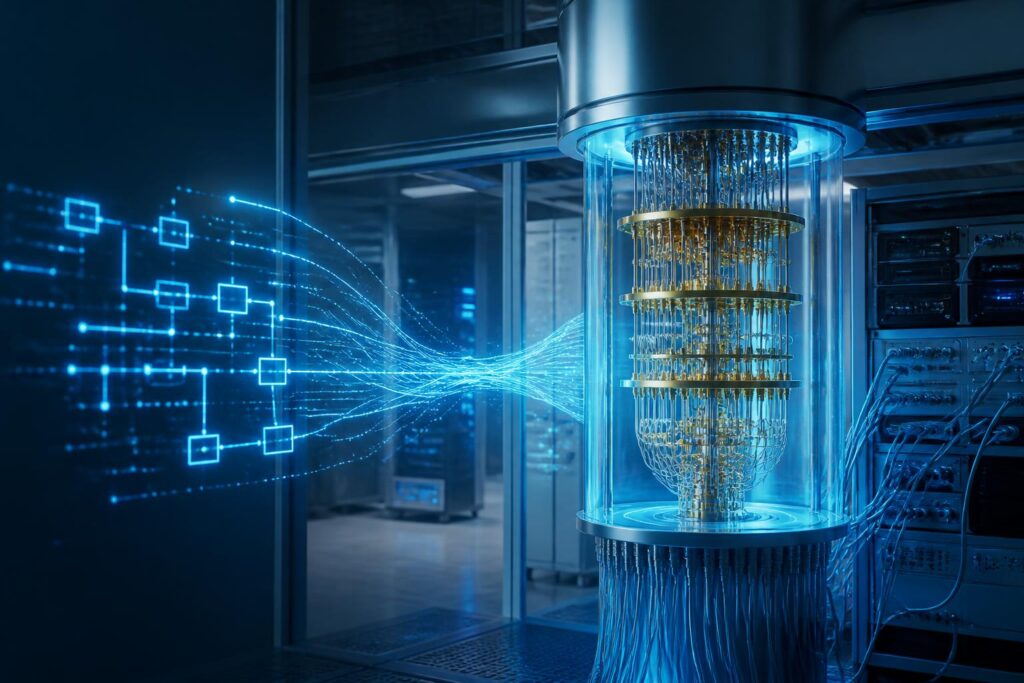
When people talk about quantum computers, they often focus on concepts such as superposition, quantum entanglement, or quantum gates. However, a quantum program does not naturally turn into a result through just a few lines of code. It must pass through many intermediate layers, including the layer that describes the algorithm, the compiler, the hardware controller, the measurement process, and the final data-processing step. Each layer has its own task, while also creating limitations that programmers need to understand.
This process also shows that a quantum computer is not simply a faster classical computer for every task. A quantum system usually works together with a classical computer: the classical computer prepares parameters, sends instruction circuits, coordinates experiments, collects results, and then analyzes the data. The quantum component handles certain specialized transformations of qubit states, while the classical component continues to play an important role in nearly the entire process.
From a Problem to a Quantum Circuit
The starting point is not a specific qubit but a problem expressed in a way that fits the quantum model. A developer may want to simulate a physical system, find a low-cost configuration, analyze a data structure, or test an optimization method. Each objective requires a different way of encoding information and interpreting the results.
In the model commonly used today, data is represented by qubits. A qubit can be prepared in a basis state, such as the state commonly denoted as 0, or in a combination of the two basis states. Quantum gates then transform this state. At the conceptual level, a quantum program is a sequence of operations arranged over time on one or more qubits.
Programmers do not necessarily have to directly control the physical signals acting on the qubits. They generally use a programming language or library to describe the circuit. A circuit may include initialization operations, gates acting on individual qubits, gates that create interactions between multiple qubits, and measurements. This abstract description makes programs easier to write, but it also makes them dependent on the capabilities of the target hardware.
What Does a Compiler Do with a Quantum Circuit?
A circuit written at the algorithmic level usually cannot be sent directly to a device. A quantum compiler must convert it into a form suited to a specific architecture. This work may include simplifying gate sequences, replacing gates unsupported by the hardware with combinations of basic gates, rearranging the order of operations, and mapping logical qubits onto the available physical qubits.
The concepts of logical qubits and physical qubits are very important. A logical qubit is the unit that an algorithm wants to use, while a physical qubit is the element actually created and controlled in the device. In current systems, the relationship between these two concepts is not always one-to-one. An algorithm may require multiple physical qubits to represent a more stable logical qubit, especially when protection and error-correction techniques are implemented at a deeper level.
Even without considering full error correction, qubit mapping is already a practical problem. Not every physical qubit can interact directly with every other one. If a two-qubit gate requires two locations that are not connected, the compiler may have to insert operations that swap the logical positions. These additional operations make the circuit longer, increase the number of control operations, and may make the result more sensitive to noise.
As a result, the same algorithm can perform differently on different devices. A short circuit on an architecture with suitable connectivity may become significantly longer on another architecture. This is why evaluating a quantum program cannot rely solely on the number of gates in the original description; it must also consider how the circuit is compiled into actual operations.
Devices Do Not Receive Quantum Gates in the Abstract Sense
After compilation, quantum gates must be converted into control signals suited to the hardware technology. Quantum computers may be based on different physical platforms, such as superconducting circuits, trapped ions, or other systems currently being researched and developed. Each platform has its own way of creating, preserving, and acting on quantum states.
At this layer, a gate in the programming model is no longer merely a mathematical symbol. It is implemented through a sequence of pulses, signals, or physical operations with specific parameters. The controller must time these signals, coordinate multiple channels, and limit unintended effects on neighboring qubits. The device must also maintain suitable environmental conditions, because quantum states can be affected by noise, fluctuations, and unwanted interactions.
This should not be understood to mean that all quantum computations take place inside a completely isolated box separate from ordinary computers. On the contrary, classical control systems are often highly complex. They may handle signal generation, time synchronization, data readout, and feedback based on measurement results. In some procedures, the classical component also updates circuit parameters after each run in preparation for the next one.
Why Must the Same Circuit Be Run Many Times?
One point that is easy to misunderstand is that the result of a quantum program is often not a single value that appears after one run. During measurement, the quantum state is converted into classical data corresponding to a specific result. If the circuit is executed repeatedly under similar conditions, the results may be distributed across different frequencies.
For example, a circuit may create a state in which multiple measurement results have a chance of appearing. Researchers will run the circuit many times, with each run often called a shot or a sample, and then count how many times each result appears. From this distribution, they estimate the quantity of interest to the algorithm. The required number of runs depends on the problem, the level of noise, and the desired degree of accuracy.
Repetition is not merely a matter of simply “taking an average.” The results may be affected by readout errors, fluctuations in the device, and changes during operation. Therefore, the experimental process often requires calibration measurements or control circuits to understand how the device is introducing deviations. The data obtained can then be processed to reduce some of the effects of noise, but this processing does not turn the results into perfect data.
The Hybrid Loop Between Classical and Quantum Computers
Many quantum programs today are organized as hybrid loops. The classical computer begins by choosing a set of parameters. Those parameters are fed into a quantum circuit, the circuit is run many times, and the measurement results are used to calculate an objective function. A classical algorithm then adjusts the parameters and sends a new circuit to the device. The loop continues until an appropriate stopping condition is reached.
This approach allows the quantum component to perform certain transformations that are difficult for the classical component to simulate directly, while the classical computer continues to handle optimization and coordination tasks. However, it also creates data-transfer costs, waiting times, and requirements for stability across multiple runs. If each iteration involves a long wait or the measurement results are too noisy, finding suitable parameters can become difficult.
For developers, this means that algorithm design cannot be separated from implementation. An elegant formula on paper may not produce a useful program if it requires too many measurements, too many gates, or a type of interaction unsupported by the hardware. The ability to observe and control the entire loop is often just as important as choosing the initial algorithm.
What Should Be Considered When Evaluating a Quantum Program?
Execution time is one criterion, but it is not the only one. It is necessary to consider circuit depth, the number of qubits used, the number of two-qubit gates, the connectivity between qubits, the number of measurement repetitions, and the stability of the results. A circuit with few qubits but many complex operations may be harder to implement than a larger circuit with a suitable structure.
It is also necessary to distinguish simulation results from results obtained from a real device. A simulator may allow the logic of a circuit to be tested under ideal conditions or with a predefined noise model. A real device, by contrast, is subject to the specific characteristics of its hardware, so the program must be tested and calibrated in a real environment. The gap between the two types of results provides important information about the maturity of both the algorithm and the system.
A reliable process generally begins by testing a small circuit, monitoring intermediate results, and changing one factor at a time instead of immediately putting a large program into operation. This approach helps identify whether a problem lies in the algorithmic idea, the compilation step, the control device, or the data-analysis stage. It also prevents every deviation from being attributed to “quantum properties” while overlooking technical errors that can be detected.
From the Technical Process to a Practical Perspective
Understanding how a quantum program passes through a computer helps place claims about the technology in the proper context. A notable result does not come solely from the number of qubits announced. It also involves the quality of connectivity, controllability, measurement accuracy, the compilation method, and the number of repetitions required to draw a conclusion.
More importantly, this process shows that a quantum computer is an interdisciplinary system. Mathematics provides the model, computer science organizes the algorithm and compiler, physics creates the qubit platform, and control engineering turns abstract operations into signals that can be executed. No single layer by itself determines the device’s overall value.
In the future, as hardware improves and quantum-information protection techniques advance, the boundary between logic circuits and physical operations may be concealed more effectively from programmers. Even so, the basic principles will remain: the problem must be converted into a circuit, the circuit must fit the architecture, the device must be controlled, and the results must be measured repeatedly and analyzed carefully. Understanding this sequence of steps is a foundation for evaluating quantum computers by technical criteria rather than relying only on the highly symbolic images associated with this technology.
