


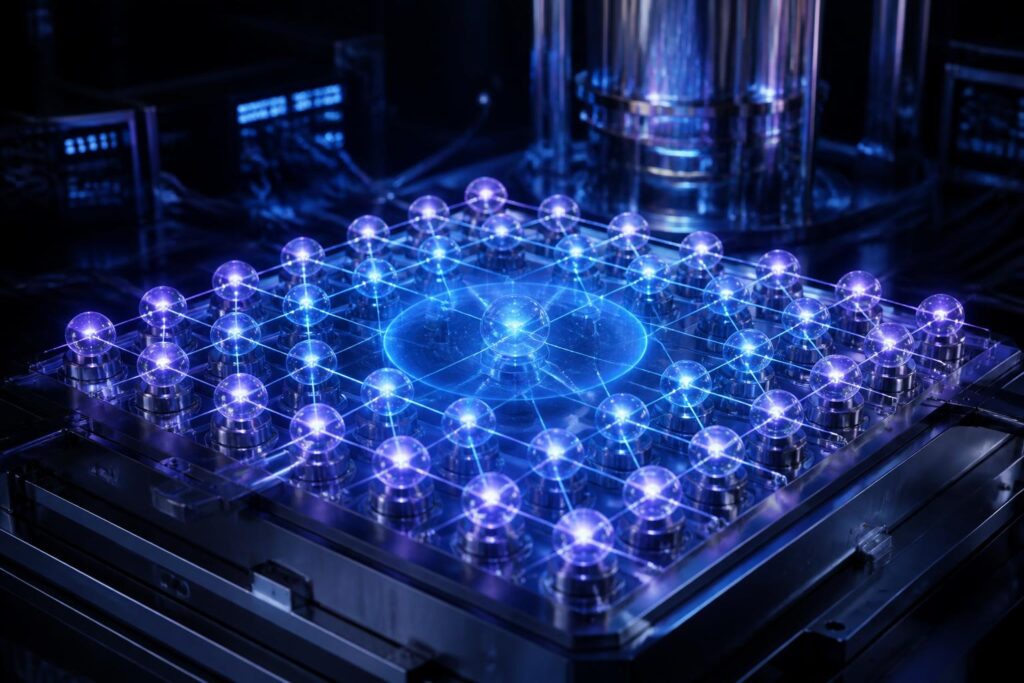
Quantum computers are often introduced through the notable properties of qubits, such as their ability to exist in superpositions and harness quantum entanglement. However, these properties only have practical significance if the system can preserve a quantum state for long enough and read the result with the necessary reliability. This is where the problem of quantum error correction becomes important.
In classical computers, a bit is usually represented by 0 or 1. If a bit is flipped by noise, the system can detect or restore it using relatively familiar redundancy mechanisms. Qubits are much more difficult to handle. They do not merely have two basic states; they can also exist in a quantum combination of those states. Directly measuring a qubit to check it can change the state that the computation needs to preserve. Therefore, quantum error correction is not simply a matter of copying data and choosing the correct copy.
Physical Qubits and Logical Qubits
A qubit that exists on specific hardware is called a physical qubit. It can be created using many different platforms, such as superconducting circuits, trapped ions, neutral atoms, or other physical systems. Each platform has its own methods of control, state readout, and noise mitigation, but no platform is completely immune to errors.
Heat, electromagnetic fluctuations, inaccuracies in control pulses, and unintended interactions with the environment can all alter a qubit’s state. A qubit can also gradually lose the quantum relationships required for a computation, a phenomenon commonly known as decoherence. In addition, quantum gate operations and measurement processes are not perfectly accurate. When a circuit consists of many consecutive operations, small errors can accumulate and make the final result unreliable.
A logical qubit is an approach for protecting quantum information by distributing that information across a group of physical qubits. Rather than trying to keep a single qubit perfect, researchers encode the state needed for computation into a larger structure. Auxiliary measurements are performed to detect signs of errors without directly measuring the quantum value being stored. The system can then apply a correction operation or adjust how the result is interpreted.
This distinction is important. A logical qubit is not a single physical component, but an abstraction created from many physical qubits and error-checking circuits. To create a stable logical qubit, a computer architecture must coordinate hardware, an error-correcting code, control circuits, and orchestration software. Therefore, progress in quantum computing cannot be assessed solely by the number of physical qubits.
Why Can’t Qubits Be Copied?
In classical computing, creating multiple identical copies of a bit is a simple operation. For an unknown quantum state, the no-cloning theorem states that it is impossible to create a perfect copy in the same way. This is why classical computer redundancy methods cannot be applied in their entirety.
Instead of copying a state, quantum error-correcting codes distribute information across the correlated states of multiple qubits. The system measures quantities designed to indicate what kind of error has occurred, without directly revealing the entire data state. The results of these checks are commonly called error syndromes. A syndrome enables the controller to infer the likely location or type of an error.
One way to picture this is that instead of directly asking, “What is the data?”, the system asks, “Are the relationships between the qubits in the code still correct?” If the relationships have been disrupted, the computer can recognize that an error has occurred and attempt to restore the encoding. This approach does not eliminate noise from the physical world, but it helps limit its impact on logical quantum information.
Error Thresholds and the Conditions for Effective Error Correction
Quantum error correction does not automatically make a system accurate. Each error-correcting code works effectively only within a certain range, depending on qubit quality, error type, connection structure, and measurement performance. If physical operations are too error-prone, adding qubits for error correction may make the system more complex without providing greater reliability.
The concept of an error threshold describes an important condition: when the error rate of physical components is below a certain level and the architecture meets the requirements of the code, increasing the scale of the encoding can reduce the error rate of the logical qubit. When the error rate is still too high, expanding the system does not solve the problem. This boundary is not a single number that applies to every quantum computer, because it varies according to the hardware model, error-correcting code, and operating procedures.
The difficulty is that the error-correction circuit itself also requires quantum gates, measurements, and connection pathways. These components can themselves experience errors. The system must also handle errors that occur while syndromes are being collected, control signals are being transmitted, and corrections are being determined. As a result, quantum error correction is a continuous chain of operations rather than a check performed once at the end of a computation.
Surface Codes and the Challenge of Hardware Scaling
One widely studied approach is the surface code, in which qubits are arranged in a structure with local connectivity and check measurements are repeated periodically. This approach is attractive because it can suit systems in which qubits are primarily connected to nearby neighbors. However, surface codes generally require many physical qubits to create a high-quality logical qubit, along with a control and readout system that is sufficiently fast.
This creates a large gap between a device with many physical qubits and a computer with enough logical qubits to run a long algorithm. A system may be able to demonstrate short computations on current hardware while still lacking the ability to perform procedures requiring large numbers of highly accurate logic gates. When evaluating claims about quantum computers, it is necessary to distinguish between the number of physical qubits, the number of logical qubits, the length of time a state can be maintained, and the error rate of each operation.
In addition to surface codes, researchers are also considering many other types of codes in order to reduce hardware costs or suit specific forms of noise. There is no single design that is certain to be suitable for every platform. The choice also depends on how the qubits can be connected to one another, how long measurements take, how far the control system can scale, and whether syndrome decoding can keep up in time.
From Error Detection to Real-Time Error Correction
A practical error-correction system needs to continuously collect data from auxiliary measurements. This data is then decoded to estimate the sequence of errors that may have occurred. If decoding is slower than the rate at which the quantum circuit generates errors, correction information will be delayed and the benefits of encoding will decline. Therefore, classical hardware, control software, and decoding algorithms play roles no less important than the quantum processor itself.
In some architectures, correction can be performed by changing how measurements are interpreted rather than immediately applying a physical operation to the qubit. This approach helps reduce the number of additional operations, but it requires the system to track the history of errors and maintain a reliable control layer. Regardless of the method chosen, the goal remains to prevent physical errors from becoming unrecoverable logical errors.
This is also why building a quantum computer requires coordination across many fields. Quantum physics helps describe states and sources of noise. Microelectronics, cryogenics, or laser control, depending on the platform, help operate the hardware. Computer science provides decoding algorithms and programming models. Only when these layers operate in sync can logical qubits become a foundation for long computations.
Implications for the Future of Quantum Computing
Quantum error correction is not an optional feature that can be left until after the hardware has been completed. It affects the arrangement of qubits, the design of connections, the selection of control gates, and the way algorithms are programmed from the outset. An algorithm may have a theoretical advantage but become impractical if it requires too many logical qubits or too many operations for the system to protect.
At present, many quantum devices still operate under noisy conditions and are often studied with the aim of exploiting hardware that is not yet fully fault-tolerant. These experiments remain valuable because they help improve measurements, clarify sources of error, and test correction procedures. However, the path from short demonstrations to fully fault-tolerant quantum computers still depends on reducing physical errors, building reliable logical qubits, and scaling systems without causing operating costs to rise too quickly.
For users and businesses, this is a reminder not to focus solely on advertised qubit counts. More important questions are how many useful logical qubits there are, how long they maintain their states, how the error rate is measured, and how deep the circuits the system can run are. These criteria more clearly reflect the gap between a research prototype and a computer capable of solving practical problems.
The Quiet Foundation of Quantum Computing
If superposition and quantum entanglement are the concepts that commonly appear when discussing the potential of quantum computers, quantum error correction is the foundation that determines whether that potential can become computing capability. It addresses a core paradox: quantum information is highly sensitive to the environment, yet useful computations require many operations performed one after another.
The road ahead is not merely about creating more qubits. It is the process of transforming imperfect physical qubits into logical units that can be controlled, monitored, and scaled. When logical errors can be systematically reduced, quantum computers will move closer to carrying out long and complex algorithms. Therefore, every advance in error-correcting codes, syndrome measurement, and real-time control may be no less important than creating a larger processor.
