


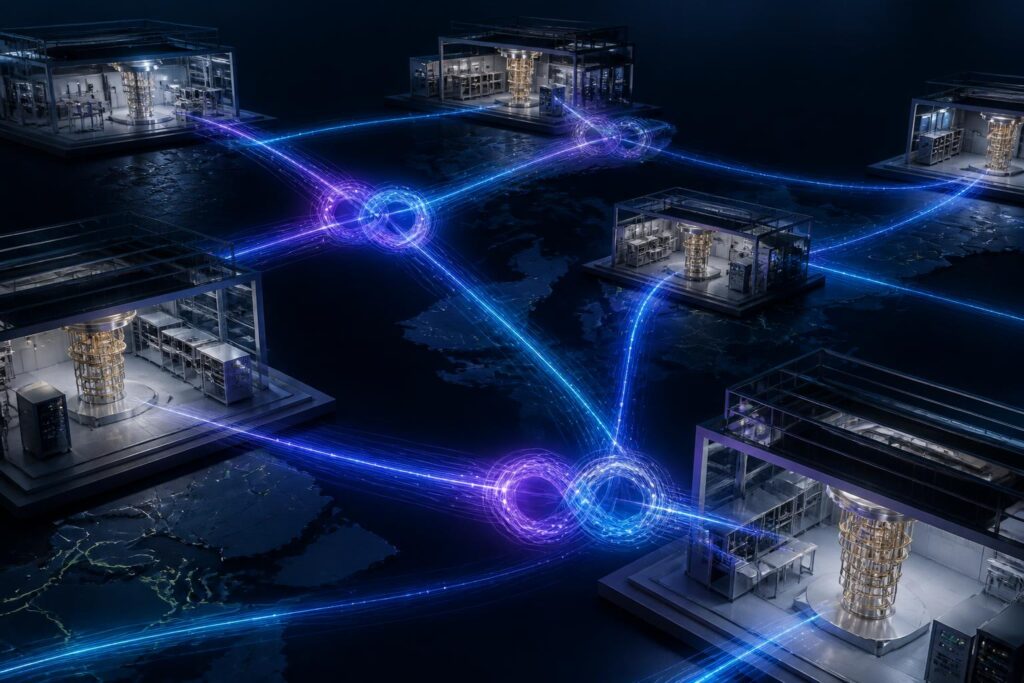
When people talk about quantum computers, most of the attention tends to focus on processors, the number of qubits, or the ability to run algorithms that classical computers handle inefficiently. However, another direction is no less significant: quantum networks. Rather than placing qubits in only one individual machine, quantum networks aim to connect quantum systems at different locations so that they can exchange states, share resources, and coordinate to perform tasks.
This concept should not be understood simply as an Internet connection with higher speed. Today’s Internet transmits bits or encoded data strings. A quantum network, by contrast, must process highly sensitive states of matter or light, in which measurement can alter the very information being transmitted. Therefore, the challenge of quantum networking lies not only in bandwidth but also in creating, maintaining, routing, and verifying quantum links.
How Is a Quantum Network Different from a Traditional Network?
In a classical computer, a bit can have a value of 0 or 1. A signal can be amplified, copied, and regenerated across multiple network nodes without fundamentally changing its content. If a signal weakens, an intermediate device can read it and transmit a new version.
A qubit operates differently. The state of a qubit can be a quantum combination of multiple possibilities, and when it is measured, the result obtained generally destroys the original state. This characteristic creates opportunities for new communication methods, but it also means that familiar classical networking techniques cannot be applied intact. A qubit cannot be copied at will for backup purposes, because copying an unknown quantum state is constrained by the fundamental principles of quantum mechanics.
In a quantum network, information does not necessarily have to be sent by moving an entire qubit from one point to another. One important method is to create entanglement between two quantum systems that are far apart. Once the two systems are entangled, appropriately designed measurements and operations can help transmit a quantum state or create a special connection between two network nodes. This process is often called quantum teleportation, but the name does not mean that matter or people are transported instantaneously. What is transferred is a quantum state, with the support of classical information and strict technical conditions.
Why Is Creating Long-Distance Quantum Links So Difficult?
The first obstacle is that qubits easily lose their quantum properties through interactions with the environment. Heat, vibrations, electromagnetic noise, material impurities, or losses in the transmission path can all degrade a state. This phenomenon is commonly described by the concept of quantum decoherence. A system may still exist physically, but it no longer retains the quantum relationships needed for computation or communication.
Light is often considered a promising medium for transmitting quantum states over long distances because photons can travel through optical fiber or free space. Even so, not every photon reaches its destination, and optical components are not perfectly efficient either. As the distance increases, the probability of maintaining a reliable quantum link generally decreases. A quantum signal therefore cannot simply be amplified like an electrical signal in a traditional system.
The next challenge is the requirement for synchronization. Network nodes must create, preserve, and measure quantum states within appropriate time intervals. If one node has lost its state before another node is ready, the entire process may fail. This requires control equipment, quantum memories, photon sources, and measurement systems to work together with a very high degree of precision.
Quantum Repeaters and the Problem of Scaling the Network
To build quantum networks over long distances, researchers often discuss quantum repeaters. In principle, the network is divided into shorter segments. Each segment creates a quantum link, after which intermediate nodes use appropriate operations to connect the links into a longer one. This mechanism involves entanglement swapping between network segments.
Unlike repeaters in conventional telecommunications networks, a quantum repeater cannot simply receive a signal, read it in full, and transmit it again. It must process the state without destroying important quantum properties. As a result, a practical system may require sufficiently stable quantum memories, highly accurate measurement devices, and complex error-checking procedures. If one link in the chain fails to meet the requirements, the quality of the final link may decline significantly.
This is why quantum networks may be deployed in stages rather than appearing immediately as a global network. Initial trials may focus on links between nodes at suitable distances, then expand as source, memory, measurement, and control-software technologies mature. Network scale is measured not only by the number of nodes but also by the ability to maintain link quality as the number of intermediate steps increases.
Expected Applications
One frequently mentioned direction is quantum key distribution. In this model, two parties can use quantum states to create a secret key and detect certain forms of interference during the exchange. If someone observes or interferes in a way that changes the state, those changes may appear in the test results. However, quantum key distribution does not mean that every cybersecurity problem is solved. A system can still be attacked through endpoint devices, control software, key-management procedures, or components that are not part of the quantum channel.
Another application is connecting quantum processors. If quantum computers at different locations can share reliable quantum links, they may coordinate on certain tasks that exceed the capabilities of a single device. This is an appealing idea, but turning it into a practical product requires many issues to be solved simultaneously: resource-allocation protocols, synchronization between systems, error handling, information protection, and performance measurement across the entire network.
Quantum networks may also support scientific experiments that require the comparison or coordination of measurement systems located far apart. In such cases, the value does not necessarily lie in transmitting a large amount of data, but in creating verifiable quantum correlations. This is an important difference between quantum networks and conventional data-transmission infrastructure.
Not a Direct Replacement for the Internet
A common misconception is that quantum networks will completely replace today’s Internet. A more realistic scenario is that the two types of networks will complement each other. The classical Internet will still be needed to transmit control commands, send measurement results, authenticate devices, and operate ordinary services. The quantum channel may handle certain specialized functions, while the classical channel provides the coordination layer that is required.
Even in a quantum teleportation protocol, classical information still plays an important role. The sender must perform an appropriate measurement and send the result to the receiver through a conventional channel. The receiver uses that result to complete the necessary operation on their system. This process does not allow useful information to be transmitted faster than the limit imposed by classical channels, and it also shows that a quantum network is not a mechanism for instantaneous communication.
Therefore, quantum networks should not be evaluated through simple comparisons such as download speed or the number of users. More appropriate criteria may include the rate of successful link creation, the duration for which a state can be maintained, entanglement quality, measurement reliability, and the ability of different nodes to coordinate. These indicators reflect the distinct nature of quantum infrastructure.
Points to Keep in Mind When Looking to the Future
The potential of quantum networks is noteworthy, but the gap between prototypes and widespread infrastructure remains large. Quantum devices often require special operating conditions, precise optical systems, and complex calibration procedures. As networks develop, maintenance, component replacement, key management, communication standards, and workforce training will be no less important than qubit fabrication.
Compatibility is also a significant challenge. Different hardware platforms may use different materials, wavelengths, storage mechanisms, and control methods. Without common protocols or suitable conversion layers, combining systems into a unified network will be very difficult. This is similar to challenges that have arisen in building large technology infrastructures, but the sensitivity of quantum states makes the technical requirements even higher.
End users also need to take a realistic view of the benefits. Quantum networks do not automatically make every application faster, completely eliminate the risk of attack, or replace basic information-security principles. Their value may be concentrated in certain problems requiring security, quantum coordination, or specialized measurement. Deployment is reasonable only when those benefits are large enough to offset the costs of equipment, operation, and integration.
Quantum networks should therefore be viewed as a new layer of infrastructure that is taking shape, rather than as a marketing version of the Internet. They open up new ways to connect quantum systems, but at the same time force engineers to rethink signal transmission, error checking, routing, and security. As fundamental problems are solved step by step, quantum networks may become a complement to computing and communication systems in the future. That path will depend not only on creating better qubits, but also on the ability to turn the fragile links between them into infrastructure that can operate reliably.
