


How Are Quantum Sensors Different from Conventional Sensors?
When quantum technology is mentioned, many people first think of quantum computers tackling complex problems and qubits being controlled in laboratories. However, another area of development that could have a more immediate impact across many fields is quantum sensing. This is a group of devices that harness the laws of quantum mechanics to measure physical quantities such as time, acceleration, magnetic fields, electric fields, gravity, or temperature.
Every sensor has the task of converting a change in the real world into a signal that can be read and analyzed. Sensors in phones detect movement, medical devices monitor the body’s activity, and positioning systems use time and location signals to determine routes. The difference with quantum sensors is that the measuring element does not rely solely on familiar macroscopic properties, but directly uses the states of atoms, ions, photons, or other quantum systems.
In the microscopic world, a system can exhibit superposition, interference, and, in some cases, quantum entanglement. These phenomena are highly sensitive to effects from the environment. That is a challenge when it comes to maintaining a stable quantum system, but it is also the basis for detecting extremely small changes. If properly controlled, a change in a magnetic field, an acceleration, or a period of time can alter a quantum state in a measurable way.
The Measurement Principle Based on Quantum States
A quantum sensor typically begins by preparing the measurement system in a known state. The system is then allowed to interact with the quantity being measured for a specific period of time. External influences will change the system’s phase, energy, spin direction, or probability of observation. Finally, the device reads the state after the interaction and infers information about the original physical quantity.
Interference is an important mechanism in this process. One can imagine a quantum state being allowed to evolve along multiple possible paths. When those possibilities come together again, they create an interference pattern. A very small influence from the environment can change the phase between the branches, thereby changing the interference result. The device does not necessarily have to “see” the quantity being measured directly; it measures the effect of that quantity on the quantum state and then uses a physical model to calculate backward.
Atomic clocks are a typical example of quantum measurement. In these clocks, transitions between atomic energy levels are used as a frequency reference. Because these transitions are highly stable, atomic clocks can produce a time standard that is much more accurate than many conventional timekeeping mechanisms. Accurate time is important not only for civilian clocks. It is also fundamental to telecommunications, positioning systems, power-grid synchronization, and many activities requiring coordination among devices separated by long distances.
Another example is a magnetic-field sensor based on atoms or other quantum systems. A magnetic field can alter the internal state of the measuring element. By observing this change, the device can detect weak magnetic fields in environments where classical sensors may struggle to achieve comparable sensitivity. Other designs instead rely on the motion of cold atoms to measure acceleration or gravity. The trajectory and phase of the atoms can reflect extremely small changes in the device’s motion.
Fields That Could Benefit
Positioning is one of the fields most often mentioned when discussing quantum sensors. Modern positioning systems generally depend on external signals, such as satellite signals. Underground, underwater, in cities with many obstacles, or when signals are disrupted, maintaining a position can become difficult. An inertial navigation system uses acceleration and rotation sensors to estimate movement, but errors can accumulate over time. Quantum sensors have the potential to reduce the rate at which errors accumulate by measuring motion with greater sensitivity, thereby supporting positioning in conditions where external signals are unavailable.
In geology and resource surveys, gravity measurements can help identify differences in the density of material beneath the surface. These changes may be related to geological structures, voids, groundwater sources, or areas requiring further investigation. Quantum sensors do not automatically produce a complete map, nor do they replace geological work, but they can provide supplementary data with a resolution and sensitivity suited to each task.
Healthcare is another notable area of application, particularly in methods for measuring the body’s electrical or magnetic activity. The activity of the brain, heart, and biological tissues generates very weak physical signals. If a sensor is sensitive enough and can operate safely near the body, it could support research into biological functions or improve certain diagnostic techniques. However, the journey from a laboratory prototype to a medical device used regularly is a long one. The device must also meet requirements for stability, calibration, safety, hygiene, and data interpretation.
In industrial maintenance, quantum sensors could help detect small changes in the magnetic fields or vibrations of machinery. These signs sometimes appear before a component fails completely. If the data is combined with an appropriate engineering model, businesses can plan inspections and maintenance earlier. Even so, practical value depends on more than the sensor’s sensitivity. The ability to integrate with operating systems, processing speed, and ease of use are equally important.
Why Are Quantum Sensors Not Yet Widely Used?
High sensitivity often comes with strict control requirements. Quantum states can be disrupted or degraded by heat, vibration, electromagnetic interference, pressure, unwanted light, and many other influences. A device may deliver excellent results in a shielded environment, but its performance will decline when it is taken into the field. Engineers therefore have to design not only the quantum element, but also the systems for isolation, control, signal readout, and calibration.
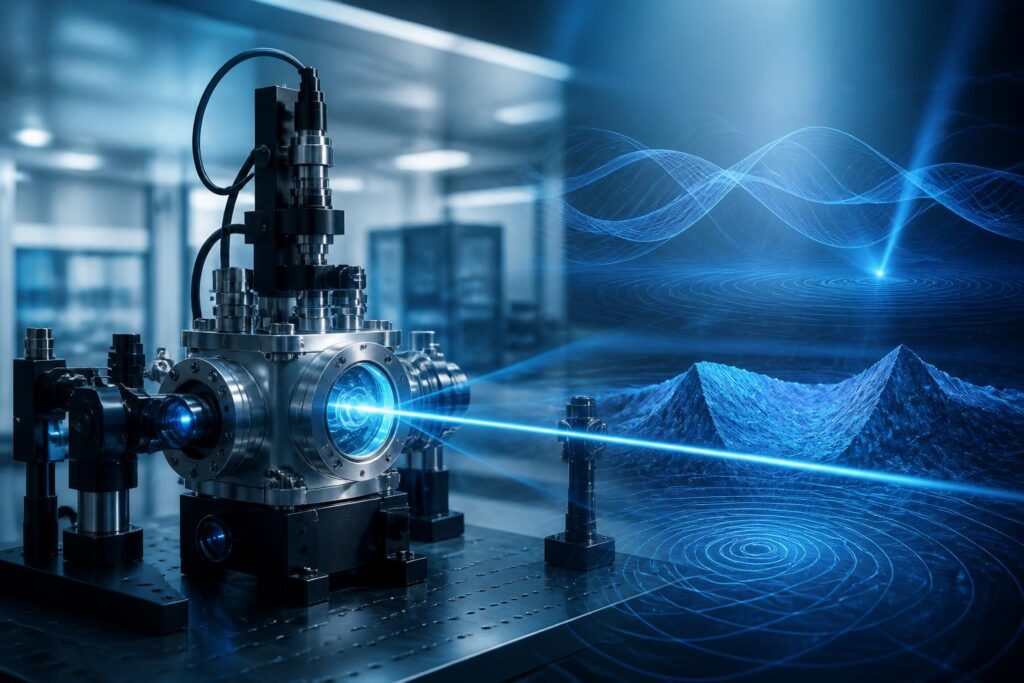
Size and energy consumption are also issues. Some prototypes require vacuum chambers, stable laser sources, cooling systems, or precision optical equipment. These components can make the device large, expensive, and difficult to maintain. For quantum sensors to be deployed widely, the technology needs to move toward designs that are more compact, robust, and less dependent on laboratory conditions. This is a complex engineering problem because miniaturizing a system often reduces the space available for isolation and noise control.
Accuracy also does not equate to usefulness in every situation. A sensor may detect extremely small changes but require a long measurement time, a specialized operator, or produce data that is difficult to interpret. In a real-world product, developers must balance sensitivity, measurement speed, reliability, cost, and ease of integration. A less sensitive sensor that operates reliably under a wide range of conditions may sometimes have greater commercial value than a device with superior specifications in a controlled environment.
Do Not Confuse Quantum Sensors with Quantum Computers
Quantum sensors and quantum computers are both based on quantum mechanics, but their goals are different. Quantum computers use quantum states to perform calculations and process information according to a special model. Quantum sensors use quantum states as a reference standard or sensing element to measure the physical world. A sensing device may not need to perform complex quantum algorithms, require a large number of qubits, or have an architecture resembling that of a quantum computer.
This distinction helps provide a more realistic view of the technology. Quantum sensors are not miniature versions of quantum computers, nor do they automatically solve every measurement problem. Their value lies in tasks where the limitations of current sensors become a clear obstacle, such as measuring very weak fields, maintaining a stable time standard, or tracking motion in environments lacking reference signals.
Prospects and How to Evaluate Them in Practice
In the coming years, progress in quantum sensing may come from several directions at once: new materials, better optical techniques, compact controllers, signal-processing algorithms, and scalable manufacturing methods. Sensors may also be combined with networks of conventional devices. In that arrangement, the quantum element handles sensitive measurement, while the classical system manages communication, storage, analysis, and alerts.
To evaluate a product in this field, one should not look only at claims about “quantum accuracy.” It is necessary to ask how long the sensor operates stably, under what conditions, how it needs to be calibrated, whether its data can be integrated with existing systems, and what the total cost of ownership is. It is also important to distinguish between results demonstrated in a laboratory and the performance of a commercial device in a real-world environment.
Quantum sensing opens up a new approach to observing the world. Rather than merely making devices process data faster, this technology seeks to help devices detect signals that were previously too weak, too small, or too difficult to separate from noise. The journey from physical principle to widely used product still involves many challenges, but its potential lies in the fundamental measurements that support positioning, healthcare, geology, industry, and science. If barriers related to durability, cost, and deployability can be overcome, quantum sensors could become an important layer of technology alongside quantum computers, changing how people collect information about their surroundings.
