


For many years, processor progress was often envisioned as a race to shrink transistors and put more and more components onto a single chip. That approach once delivered major gains in performance and power consumption, but it is no longer a simple answer to every problem. As designs become more complex, development costs rise, manufacturing times grow longer, and not every functional block needs to be manufactured using the same process technology.
Chiplets have emerged as an alternative approach. Rather than creating a huge chip die that integrates every component, designers can divide a processor into multiple smaller chips, with each chip responsible for a particular task, and then connect them within the same package. Such a system is still used as a unified processor, but internally it is made up of parts that can be developed, manufactured, and tested more flexibly.
What Are Chiplets, and How Do They Differ from Traditional Processors?
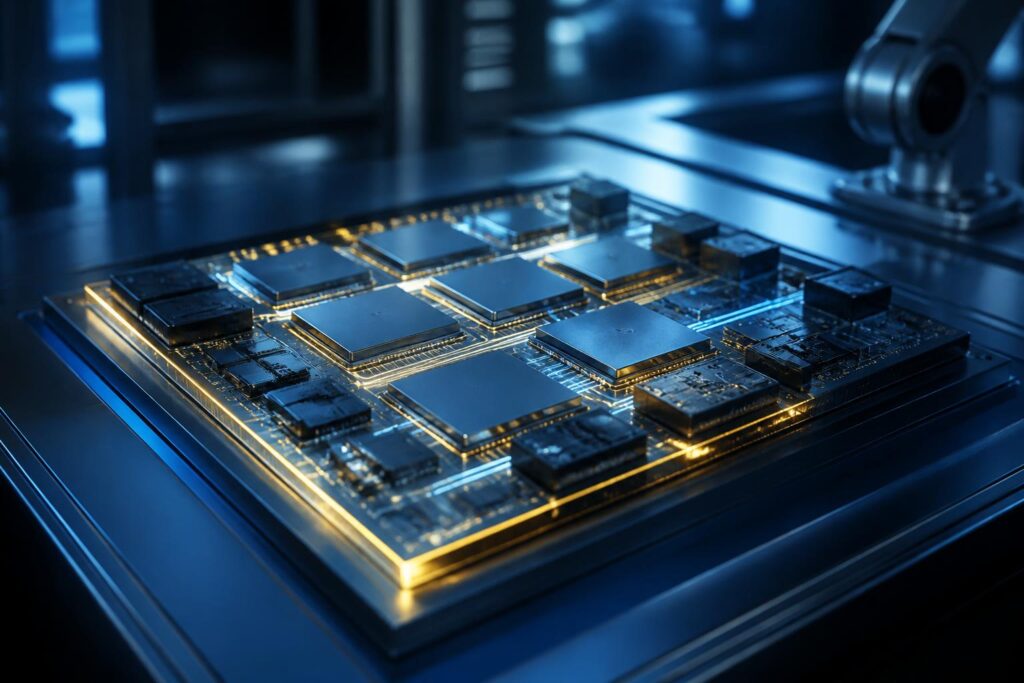
A chiplet can be understood as a relatively independent processing block designed to be combined with other blocks in a larger system. A processor based on a chiplet architecture may include a computing block, a memory-control block, a high-speed interconnect block, an accelerator for a specific type of task, or other specialized components. These blocks are placed next to one another on a package substrate and exchange data through high-speed connections.
The key difference lies in how the design is divided. In a monolithic chip, all components are generally located on the same silicon die. If only one area encounters a defect, the entire large die may be affected. In a chiplet model, each part can be optimized according to its own requirements. A block that needs high computing performance can use a more advanced process, while a communications or control block that does not require high transistor density can use a more suitable and cost-effective process.
This division does not mean that chiplets are simply discrete components assembled together. For users and software to see a unified processor, the chiplets must coordinate precisely in terms of communication, timing, power, memory, and error-handling mechanisms. Therefore, the value of this architecture lies not only in the small chip blocks themselves, but also in the interconnect and packaging platform that enables them to operate as a complete system.
Why Is the Industry Interested in Chiplet Architecture?
The first benefit is reusability. A designer can build a library of tested chiplets and then combine them into different product lines. A chiplet responsible for connectivity may appear in multiple processors, while the computing chiplets can be changed according to the market segment. This approach reduces the need to start the entire design from scratch for every new product.
Chiplets also allow manufacturing technology to be allocated more appropriately. Not every part requires the most advanced process. If an entire processor is manufactured using the same expensive process, simpler areas still bear similar costs. When the design is separated into multiple chiplets, manufacturers can select a process suited to the characteristics of each block. This creates an opportunity to balance performance, cost, and energy consumption.
Another benefit concerns chip die size. The larger the die, the more difficult it is to produce a completely defect-free product. Dividing the design into smaller dies can help reduce the impact of localized defects during manufacturing. However, this benefit depends on design quality, testing processes, and the effectiveness of packaging technology; it is not an automatic guarantee for every product.
Chiplet architecture is also well suited to the growing demand for specialization. A system serving servers, edge devices, personal computers, or embedded devices may require very different combinations of capabilities. Instead of using a single design for every situation, manufacturers can combine chiplets according to their goals. A processor can prioritize computing capability, memory bandwidth, connectivity, or energy efficiency depending on its operating environment.
Interconnects Between Chiplets Are the Central Challenge
Dividing a processor into multiple parts is useful only when those parts can exchange data sufficiently quickly and reliably. If the connection between chiplets is slow, consumes too much power, or creates high latency, the benefits of division may be diminished. This is why the interconnect system within a chip package plays a role nearly as important as the computing blocks themselves.
The interconnect must define many factors: how data is transmitted, how the chiplets synchronize timing, how the devices detect errors, and how the system continues operating under abnormal conditions. Common conventions can make it easier for chiplets from different sources to work together, but achieving practical compatibility still requires thorough testing. Designers must consider both the physical hardware interface and the protocols that software and operating systems can use.
The distance between chiplets within the same package is usually shorter than the distance between components on a circuit board. Even so, data still has to travel through interconnect layers, the package substrate, and power-distribution circuitry. Each layer can impose limits on signals, heat, and reliability. As a result, chiplet design cannot be separated from packaging design.
Advanced Packaging and Limits That Cannot Be Ignored
In a chiplet system, packaging is not merely a step for protecting the silicon after manufacturing. It becomes part of the architecture. The way chiplets are arranged determines the length of signal paths, heat-dissipation capability, the amount of power that must be supplied, and the space available for memory or additional components.
Placing many chiplets close together can create high thermal density. Powerful computing blocks often do not distribute heat evenly, while certain sensitive components may be affected if they are located too close to hot zones. Engineers must calculate placement, materials, power-delivery paths, and cooling solutions from the earliest design stages, rather than addressing thermal issues only after the design has been completed.
Reliability is another challenge. The more interconnections a processor has, the more points need to be inspected. Differences in thermal expansion between materials, the effects of the assembly process, and long-term operation can all affect the product. Individual chiplets may perform well during testing, but the entire package still needs to be evaluated as a unified system.
Impact on Businesses and Users
For businesses, chiplets can change how product-development chains are organized. Instead of building every component themselves, a company can combine internally designed blocks with chiplets from partners. This model creates more options, but it also raises questions about intellectual property ownership, warranty responsibilities, design security, and the ability to maintain a stable supply.
The ability to combine components from multiple sources can help products be adjusted more quickly, but it also makes the validation process more complex. Each chiplet has its own requirements for voltage, temperature, communication, and control software. A small change in one block can affect the performance or stability of the entire system. Consequently, simulation tools, communication standards, and cross-component testing procedures will become more important.
For users, chiplets are generally not a directly visible feature. Users do not buy a product simply because it contains multiple chiplets; they care about speed, battery life, upgradability, stability, and price. This architecture is meaningful only when it helps manufacturers create devices better suited to real-world needs. If a design is overly complex without delivering clear benefits, users will not gain much value from the change inside the device.
Chiplets Do Not Completely Replace Monolithic Design
Despite their potential, chiplets are not the optimal choice for every processor. For a small system with modest interconnect requirements and an appropriate production volume, a monolithic design may still be simpler. Adding packaging layers and communication between chiplets can increase complexity, testing costs, and power consumption.
Even when the chiplets are manufactured well, overall performance still depends on how functions are divided. If data has to move back and forth too frequently between blocks, the cost of communication can reduce the benefits of specialization. A good design must determine which parts should be separated, which should remain together, and which data needs to be processed close to other data.
Therefore, the future of chiplets will likely not involve the disappearance of monolithic processors, but rather the parallel existence of multiple approaches. Systems that need scalability, reusability, and specialization may benefit from chiplets. Products that prioritize simplicity or face strict cost constraints may still be better suited to traditional designs.
A Shift in Hardware Design Thinking
The greatest significance of chiplets lies in how they change the semiconductor industry’s basic unit of thought. A processor no longer necessarily has to be viewed as a single chip die; it can instead be an ecosystem made up of multiple functional blocks coordinated through interconnects and packaging. This approach encourages standardization, reuse, and the division of specialized expertise among designers.
For chiplets to deliver their full value, the industry must address several issues at the same time: compatible interconnects, reliable design tools, methods for testing the entire system, effective thermal management, and a sufficiently flexible supply chain. No single factor can stand alone. A powerful chiplet that is difficult to integrate will not produce a better product, just as a fast interconnect platform without adequate thermal control will struggle to meet long-term operating requirements.
Chiplets should therefore be viewed as a method for building systems, not merely as a technique for miniaturizing or assembling pieces of hardware. As computing needs become increasingly diverse, the ability to combine multiple specialized blocks may help processors adapt better to each environment. The success of this architecture will depend on achieving a balance among performance, cost, reliability, and simplicity throughout the product’s entire life cycle.
