


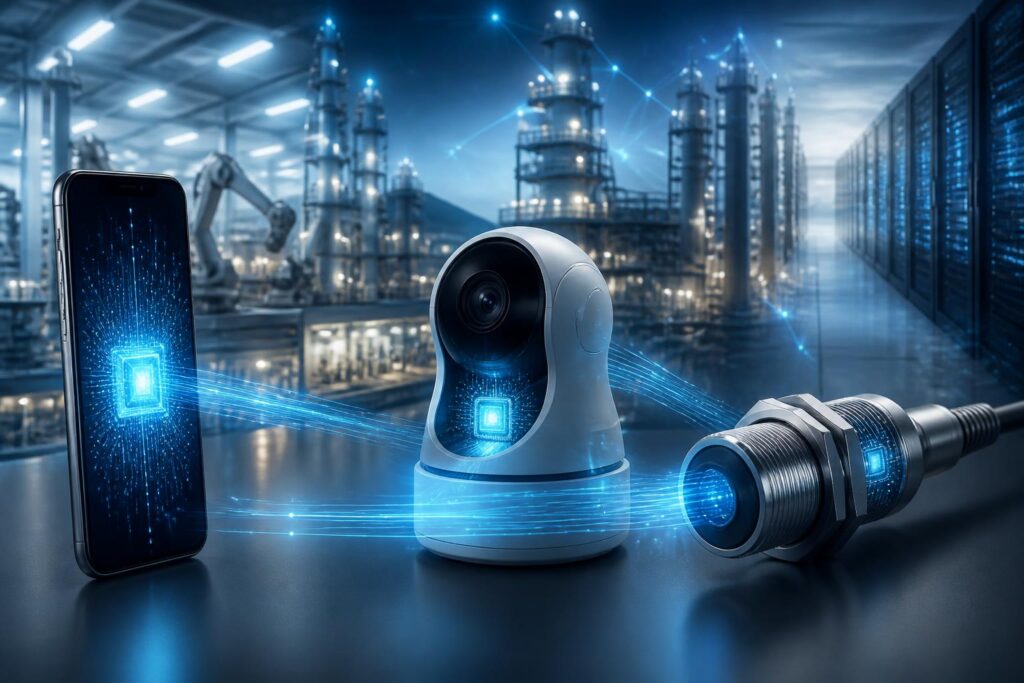
For many years, most artificial intelligence applications were envisioned according to a familiar model: users send data to a server, the system in a data center processes the request, and then returns the result to the device. This approach is suitable for large models that require considerable computing capacity, such as those used for language processing, image analysis, or content generation. However, as AI becomes increasingly embedded in phones, cameras, vehicles, industrial machinery, and household appliances, sending all data to the cloud is no longer always the optimal choice.
Edge AI, commonly called edge AI, is an approach in which part or all of a model’s inference process takes place near where the data is generated. The “edge” may be a phone, personal computer, security camera, controller in a factory, or a small server located at the place of use. Unlike an approach that depends entirely on a data center, this model brings processing capabilities closer to sensors and users.
How Does Edge AI Work?
An edge AI system usually consists of three main components: a device that collects data, an AI model deployed locally, and a connection layer to a central server when needed. For example, a camera can identify unusual movement directly on the device instead of continuously transmitting all video to a server. A phone can convert speech into text directly on the device. A production line can detect signs of defects in products in real time before sending summarized information to the management system.
This does not mean that all operations must be separated from the cloud. In practice, a common deployment approach may be a hybrid model. Simple requests that require a quick response or involve sensitive data are processed at the edge. More demanding tasks that require large models or the aggregation of data from multiple sources are still sent to the data center. The boundary between the device and the cloud thus becomes a design problem rather than an absolute choice.
For models to run on devices with limited resources, developers often have to optimize their size and computational methods. Techniques such as quantization, parameter pruning, model distillation, or the use of architectures suited to the hardware can help reduce memory and energy consumption. In return, a smaller model may be less flexible or less accurate in some situations. The important challenge is not to put the largest possible model on a device, but to find an appropriate balance for the specific task.
Key Benefits of Processing Data Locally
The most noticeable benefit is low latency. When data does not have to travel over a network to a remote server, the system can respond more quickly. This characteristic is particularly important for applications that require nearly instantaneous decisions, such as safety alerts in factories, driver assistance, robot control, or voice interaction. A slight delay may be insignificant in an entertainment application, but it can have major implications in a continuously operating process.
Edge AI also makes systems less dependent on network connectivity. Devices in areas with weak, unstable, or interrupted connections can still maintain some core functions. This is a notable advantage for sensors in the field, moving vehicles, production facilities, or places where a stable connection cannot be guaranteed. Nevertheless, the ability to operate offline does not mean that the system does not need synchronization mechanisms. Data, logs, and updates still need to be managed when connectivity is restored.
Privacy is another reason many organizations are interested in edge AI. If raw data is processed directly on the device and only the necessary results are sent onward, the amount of information that must leave the place where it was generated can be reduced. For images, audio, location, or behavioral data, this is a valuable principle. However, local processing should not be equated with absolute security. A device can still be accessed without authorization, a model can still be exploited, and intermediate data can still contain sensitive information.
From a cost perspective, reducing the amount of data continuously transmitted to a central facility can help businesses use bandwidth more efficiently. Devices can filter, classify, or summarize data before sending it. In a system with many cameras or sensors, this difference can affect network design and storage methods. However, costs do not disappear; they shift to other areas, such as specialized hardware, device maintenance, model testing, and update distribution.
Limitations That Cannot Be Ignored
The first limitation lies in computing resources. Phones, cameras, or small controllers generally do not have the processing capacity and memory of servers in a data center. Models deployed on them must meet constraints related to power, temperature, size, and battery life. A model that performs well in a server-based testing environment may not be suitable for continuous operation on a real device.
The second limitation is the diversity of usage environments. The same model may perform differently under different lighting conditions, noise levels, viewing angles, languages, or usage habits. When a model is deployed on a large number of devices, detecting and reproducing errors also becomes more complicated. Developers must not only test the algorithm but also consider the sensors, operating systems, hardware versions, and the ways users interact with the system.
Updates are a particularly important challenge. An AI model should not be treated as software that is installed once and then left unchanged. Data in everyday life changes, attack patterns change, and product requirements also change. Therefore, providers need mechanisms for securely releasing updates, verifying the origin of update packages, supporting older devices, and handling failed updates. If devices are located in places that are difficult to access, the remote maintenance plan must be designed even more carefully.
Protecting devices is no less important than protecting servers. Attackers may try to extract the model, modify the software, interfere with input data, or distort the results. For devices placed in public spaces or out in the field, the risk of physical access must also be taken into account. Measures such as secure boot, encryption, access control, integrity checks, and logging can help reduce risks, but their effectiveness depends on the overall implementation.
Designing Edge AI Should Start with the Task
A common mistake is to choose the technology before clearly defining the problem to be solved. Not every application needs AI to run locally, just as not all data should be kept on the device. Businesses need to clarify how quickly the system must respond, whether it needs to continue operating when the network is unavailable, which data is sensitive, what level of error is acceptable, and who is responsible when the results are inaccurate.
The next step is to classify the data and determine what data truly needs to be transmitted. A system may send only alerts, extracted features, or summaries instead of sending all raw data. This approach can reduce traffic, but it is necessary to assess whether the omitted data is needed for verification, incident investigation, or model improvement. Data minimization must go hand in hand with the ability to explain the processing workflow and with clear retention policies.
Evaluation must also reflect real-world conditions. The model should be tested on multiple types of devices, under different loads, and in unusual situations. In addition to accuracy, metrics such as response time, energy consumption, error rate, recoverability, and behavior when there is no network should all be monitored. A system that is fast but frequently issues false alerts can create an additional burden for operators.
The Role of Humans in Distributed Systems
Bringing AI onto devices does not eliminate the need for human oversight. On the contrary, a large number of deployment points can make management more complicated. Those responsible need to know which devices are running which model versions, where data is being processed, when system quality is deteriorating, and how to switch to a manual alternative. In fields that directly affect safety, property, or individual rights, AI should be placed within a process that allows humans to review and intervene when necessary.
Users also need to be informed clearly about whether a device uses AI, what types of data are collected, and which functions can operate offline. Transparency is not only a legal requirement in some contexts but also a condition for building trust. A camera that analyzes images locally still needs clear policies regarding the scope of observation, retention periods, and access rights.
The Outlook for Edge AI
Edge AI will likely develop alongside cloud-based AI rather than completely replacing the centralized model. Devices will increasingly handle more private, low-latency tasks that require stable operation, while the cloud will remain suitable for training, coordination, large-scale analysis, and requirements that exceed the capabilities of local hardware. Hybrid models will become a practical approach for many products.
What is noteworthy is not only more powerful chips or smaller models, but also the maturation of the entire operational chain. A good solution must combine hardware, software, connectivity, security, data governance, and accountability processes. When these elements are designed in coordination, edge AI can help technology respond more closely to users, better respect the limits of data, and adapt more effectively to environments that cannot depend entirely on data centers.
