


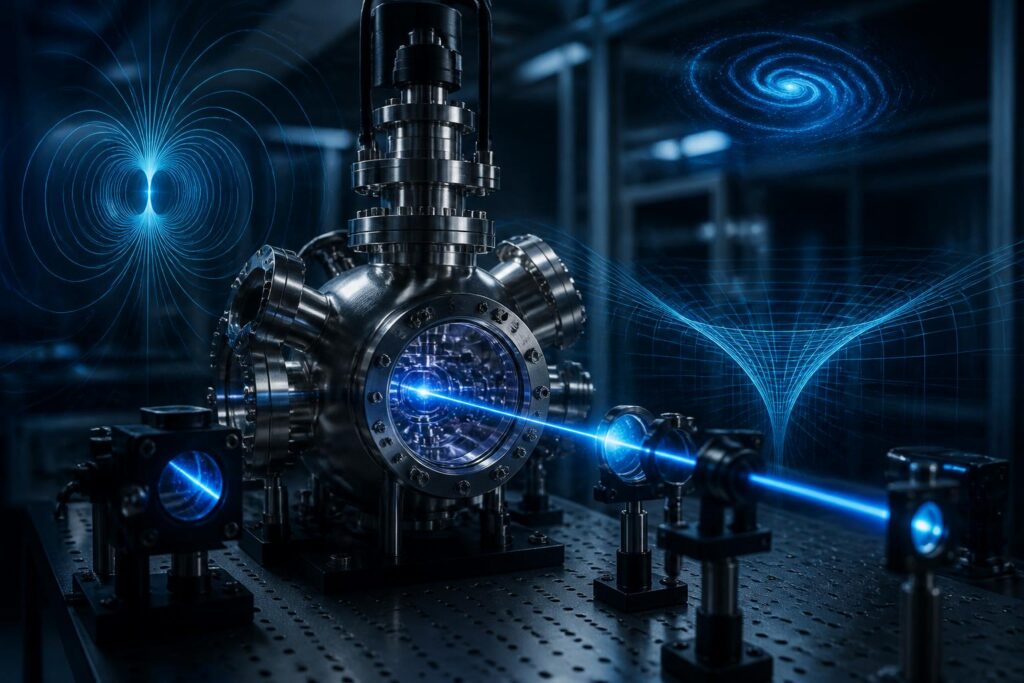
When quantum technology is mentioned, many people first think of quantum computers or communication systems capable of protecting data. However, another area of application receiving considerable attention is quantum sensing. Rather than using quantum states to perform calculations or transmit information, quantum sensors exploit the sensitivity of those states to influences from the environment. As a result, they can measure time, acceleration, magnetic fields, electric fields, temperature, or the properties of matter with a level of precision that some traditional devices may find difficult to achieve.
What is noteworthy about quantum sensors is not that they turn every measurement into an absolutely accurate one. The value of this technology lies in opening up the possibility of observing extremely small changes under conditions in which conventional methods may be limited. This gives researchers additional tools for monitoring brain activity, mapping underground structures, improving navigation systems, or examining subtle physical phenomena.
What Do Quantum Sensors Rely On?
A quantum sensor typically relies on a physical system whose state changes distinctly when subjected to the influence of the quantity being measured. That system may be an atom, ion, photon, electron, defect in a solid material, or superconducting structure. During the measurement process, the device prepares the quantum system in a particular state, allows the system to interact with the environment, and then observes the change through the output signal.
For example, if a quantum state changes phase under the influence of a magnetic field, that change can be used to infer the magnetic field’s strength or direction. If the oscillation frequency of an atomic system responds to time, that system can become the basis for a highly stable time standard. In other designs, the interference of matter or light states is used to detect acceleration and motion.
This mechanism shares a common feature with many traditional measurements: the device still needs to prepare, calibrate, acquire, and process signals. The difference is that the measuring element uses the laws of quantum mechanics to create a sensitive relationship between the quantity being observed and a signal that can be recorded. In other words, “quantum” is not a marketing label attached to an ordinary measuring device; it is the core of the operating principle.
Notable Types of Quantum Sensors
Atomic Clocks and Time Measurement
Atomic clocks use stable energy-level transitions in atoms to create a frequency standard. Because time is the foundation of many technical systems, the stability of clocks affects telecommunications, navigation, power-grid synchronization, and scientific experiments. In satellite navigation systems, accurate time measurement and synchronization are important conditions for calculating position.
Modern atomic time standards can be built in many ways, ranging from observing transitions in atoms to using more complex optical configurations. However, it should not be assumed that every atomic clock is a compact device that can immediately replace common electronic clocks. Many systems still require optical equipment, a controlled environment, and strict operating procedures.
Magnetic-Field Sensors
Magnetic fields occur in many natural and artificial processes, but they are not always easy to measure. Some quantum sensors can detect very small changes in magnetic fields because of the way the spin or energy state of a material system responds to its environment. Such devices have the potential to support materials research, geological surveys, and the observation of biological signals.
In biomedicine, the electrical activity of nerve cells generates extremely weak magnetic signals. Detecting them requires highly sensitive sensors while also reducing interference from the surrounding environment. Quantum sensors do not automatically solve this entire problem, but they can provide an additional observation method alongside the imaging and electrical measurement techniques currently in use.
Quantum Accelerometers and Gyroscopes
Accelerometers measure changes in velocity, while gyroscopes track rotational motion. In some quantum sensors, cold atoms or matter waves are used to create an interference effect. When the device moves, the interference pattern changes, making it possible to infer acceleration or rotational speed.
This capability is particularly noteworthy in situations where external navigation signals are degraded or unavailable. A guidance system can combine data from multiple sensors, with a quantum inertial sensor providing information about motion. Nevertheless, the device must maintain the appropriate physical state for a sufficient length of time while also addressing sources of interference caused by vibration, temperature, and mechanical components.
Gravity Sensors
Gravity changes according to the distribution of mass beneath Earth’s surface. Small variations may be related to geological structures, underground water systems, cavities, or the movement of matter. Quantum gravity sensors aim to measure these variations with greater sensitivity under certain conditions.
If deployed appropriately, gravity data can support geological mapping, water-resource monitoring, or the assessment of areas that are difficult to survey directly. However, this is a field that requires careful interpretation. An unusual gravity signal may arise from many different causes, so measurements generally need to be combined with geological, seismic, or field-survey data rather than treated as independent evidence.
Why Does High Sensitivity Not Yet Mean a Ready-to-Use Product?
The major challenge of quantum sensors is that the very factor that creates their sensitivity also makes the devices vulnerable to outside influences. A quantum system may respond to the quantity being measured, but it may also respond to vibration, temperature, unwanted light, electromagnetic interference, or impurities in the material. If useful signals cannot be distinguished from noise, theoretical sensitivity will not translate into measurement quality in practice.
Many systems also require special environments. Some designs must be deeply cooled, isolated from vibration, or maintained in a vacuum. Optical devices need stable light sources and precise alignment. These requirements increase size, cost, energy consumption, and maintenance complexity. For devices used outside the laboratory, resistance to impact, temperature changes, and weather conditions is just as important as sensitivity specifications.
Signal readout is also not simple. A quantum state is usually not observed directly as a number on a screen. The device must convert the information into an optical, electrical, or digital signal and then use statistical methods to estimate the quantity being measured. Therefore, sensor design always involves a balance between sensitivity, response speed, measurement range, stability, and the ability to integrate with existing systems.
Fields That Could Benefit
In medicine and neuroscience, sensitive magnetic-field sensors could help monitor biological signals without inserting devices into the body. In geology, gravity and magnetic-field sensors could supplement data used to survey underground structures. In maritime operations, aviation, and exploration, inertial sensors could support orientation when satellite signals are unreliable. In materials science, small changes in magnetic or electrical properties could provide information about the structure and state of a sample.
At the infrastructure level, precise time measurements help many networks coordinate their operations. Telecommunications, power systems, and navigation platforms all require synchronization, even though end users often do not notice its role. As quantum sensors become smaller and more consistently manufactured, they may appear as modules in specialized systems rather than existing only in laboratories.
However, application potential should not be equated with the ability to deploy a technology immediately. A device that performs well in a controlled environment may not yet be suitable for a construction site, a moving vehicle, or a medical facility. Before commercialization, developers must demonstrate reliability over time, calibration procedures, repairability, and compatibility with the regulations of each industry.
The Path from the Laboratory to Everyday Life
For quantum sensors to become widely used tools, advances in physics must go hand in hand with manufacturing engineering and product design. Researchers must find ways to make light sources, control systems, cooling systems, or detection elements more compact. Software must also turn raw data into results that are easy to understand and can be compared with data from other sensors.
Another factor is standardization. Users need to know what quantity the device measures, over what range, with what error, and under what conditions. Independent testing methods will help distinguish between sensitivity reported under ideal conditions and actual performance during operation. This is important because an extremely sensitive measurement that is difficult to reproduce has limited value in engineering processes.
In the near future, quantum sensors are likely to develop in specialized directions. Rather than replacing all existing sensors, they may take on tasks that traditional technology struggles with and then work together with cameras, navigation devices, inertial sensors, or data-analysis systems. This combined model is more realistic than expecting a single sensor to solve every measurement problem.
Conclusion
Quantum sensors show that applications of quantum technology are not limited to computation or information security. By exploiting the subtle responses of atoms, photons, and other material systems, they open up the possibility of measuring very small changes in time, motion, magnetic fields, and gravity. These capabilities could support medicine, geology, navigation, infrastructure, and fundamental research.
The path forward still involves many obstacles, from environmental noise and equipment requirements to cost and validation procedures. Therefore, the appropriate view is not to regard quantum sensors as an immediate replacement solution, but as a new layer of technology that is gradually supplementing existing measurement systems. As stability, size, and manufacturing capabilities improve, phenomena once observable only in laboratories may become practical tools for understanding and managing the world around us.
