


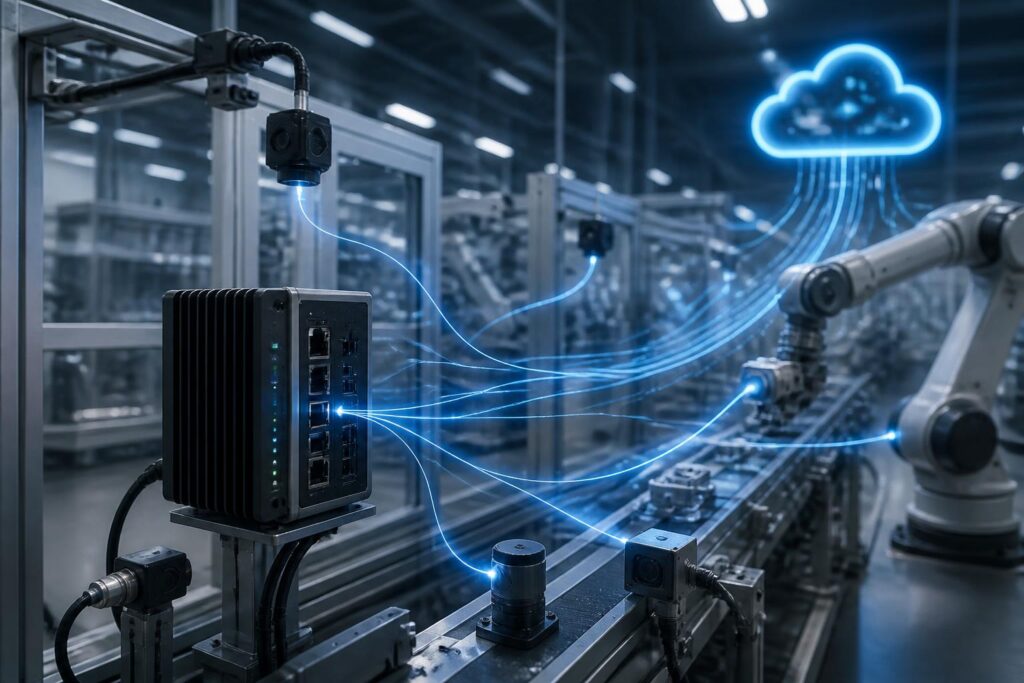
For many years, the familiar image of cloud computing has been data from phones, cameras, sensors, or computers being sent to large data centers for processing. This model provides a powerful foundation for online services, but not every problem is suited to sending all data far away. When a device needs a fast response, when the connection is unstable, or when the data is highly private, processing it right where it is generated becomes more compelling. This is the context in which edge computing is receiving increasing attention.
Edge computing is not a complete replacement for cloud computing. It is a way of redistributing some storage and processing capacity, bringing it closer to users, devices, or operating locations. Instead of sending all data to a centralized center, a system can perform preliminary analysis at a camera, controller, local server, or nearby network node, and then send only the necessary results to the cloud.
Why does the location of data processing matter?
Every time data travels across a network, latency can arise. For a task that does not require an immediate response, a few milliseconds or a few seconds usually make little difference. However, systems that monitor machinery, support traffic safety, control equipment, or detect incidents may need to respond almost instantly. If all data must pass through multiple network layers before a processing command is received, the system’s responsiveness will depend on the quality of the connection and the distance to the data center.
Edge computing addresses part of this problem by placing computing resources near the source of the data. A camera in a factory can identify signs of abnormalities on local processing equipment instead of continuously sending all video to a remote server. A warehouse management system can record sensor status on-site and synchronize only aggregated information with the central system. This approach does not eliminate the network, but it reduces the amount of data that must be transmitted and shortens the path taken by decisions that require a fast response.
How does edge computing work?
An edge computing architecture typically consists of multiple layers. The closest layer contains data-generating devices such as sensors, cameras, scanners, vehicles, or household appliances. Next may come controllers, industrial computers, routers with processing capabilities, or servers located at the operating site. Farther away is the cloud system, which handles tasks requiring large-scale storage, long-term analysis, centralized management, and model training.
The boundaries between these layers are not fixed. Some simple tasks can be processed directly on the device, such as filtering data, detecting a specific condition, or converting formats. More complex tasks can be sent to an edge server in the same building or area. Meanwhile, aggregating data over long periods, preparing reports across multiple locations, or updating policies for the entire system can still be carried out on the cloud platform.
The key point of this model is coordination. Edge devices need to know which data must be processed locally, which data needs to be forwarded, which data can be stored temporarily when connectivity is lost, and when synchronization should resume. A well-designed system must not only be fast but also remain operational under changing network conditions.
Fields that may benefit
In manufacturing, edge computing supports the monitoring of production lines and equipment in near real time. Data from sensors can be used to identify unusual temperatures, vibrations, or other operating conditions. When a sign exceeds a preset threshold, the system can issue an alert or carry out a safety procedure without waiting for the data to pass through a remote system. More in-depth analyses of performance and maintenance history can still be sent to the cloud for comparison across multiple production lines.
In retail, devices in stores can support inventory management, temperature monitoring, or equipment-status tracking. Processing at the point of sale allows stores to continue performing certain operations even when the connection is unstable. At the same time, the data sent to the central system can be aggregated rather than consisting of a continuous stream of all raw information.
In transportation and urban infrastructure, edge nodes can receive data from multiple sensors in an area to detect congestion, incidents, or unusual changes. The value of local processing lies in its ability to respond to on-site circumstances. However, applications involving people and public safety must be designed carefully, with clear rules regarding the authority of automated systems and responsibility when errors occur.
In the field of artificial intelligence, edge computing makes it possible to bring some models closer to the source of the data. Devices can perform recognition, classification, or forecasting without sending all input data outside. This can be useful when the data volume is large, connectivity is limited, or a fast response is required. However, models running at the edge often need to be optimized to match the device’s processing capacity, memory, and energy consumption.
It is not just about speed
Reducing latency is an obvious benefit, but edge computing also involves data transmission costs, the ability to operate during network outages, and control over information. When data is filtered at the source, organizations can reduce the amount of raw data that needs to be stored and transmitted. In some cases, sensitive information can be kept at the operating site, with only condensed results or results containing fewer details being sent elsewhere.
Nevertheless, local processing does not automatically mean better security. Every edge device is a potential point of attack, configuration changes, or neglect during maintenance. A system with hundreds of distributed devices will be more difficult to manage than a centralized server unless it has appropriate mechanisms for updating, authentication, and monitoring. Administrators need to know which devices are active, what software is running, what data is stored, and who has access.
Privacy issues also need to be considered from the design stage. Keeping data on-site can reduce the scope of sharing, but it cannot replace access-control policies and retention periods. Data that is no longer needed should be deleted or made less identifiable. Records used for analysis should be clearly classified to prevent excessive collection beyond the original purpose.
Challenges in implementation
The first challenge is distribution. An edge system may include many types of devices, run different software versions, and be installed under different physical conditions. As a result, implementing even a small change requires a reliable process for testing, releasing, and rolling back changes. If an update fails, the organization needs a recovery plan that does not disrupt essential operations.
The second challenge is data management. When some data is processed locally and other data resides in the cloud, ensuring consistency becomes more complicated. The system needs to determine which data is authoritative, how to handle conflicts between two records, and how to synchronize after a period of lost connectivity. This is an architectural and operational problem that cannot be solved simply by purchasing more devices.
The third challenge concerns human capabilities. Businesses need not only people who understand cloud infrastructure but also teams familiar with devices, networks, security, software, and on-site business processes. If these groups work in isolation, the system can easily end up with each area using a different standard, making it difficult to monitor and expand.
A practical approach for organizations
Edge computing should begin with a specific problem rather than being deployed as a trend. An organization can choose a process currently affected by latency, data transmission costs, or unstable connectivity. It should then measure its actual requirements: which data needs an immediate response, which data can be processed later, the required level of availability, and privacy limitations.
The pilot phase should be small enough to control while still reflecting real operating conditions. In addition to testing performance, it should test scenarios involving network outages, power failures, device replacement, unsuccessful software updates, and abnormal data. A system that performs well only in a testing environment may not necessarily be suitable for an environment with dust, changing temperatures, or actions by multiple groups of employees.
In the long term, an edge architecture should be built to support observability and centralized management. Each device should have its own identity, minimum necessary permissions, a secure update channel, and appropriate activity logs. Local processing rules should also be documented so that people can inspect, explain, and adjust them when necessary.
The outlook for distributed processing
Edge computing reflects a major change in how digital infrastructure is viewed: data does not have to be completely centralized in order to create value. As devices become more powerful, networks become more diverse, and applications demand faster responses, distributing processing capabilities across multiple locations will continue to be considered. The cloud will retain an important role in management, storage, and large-scale analysis, while the edge will help systems respond flexibly to local circumstances.
The value of edge computing therefore does not lie in replacing one model with another. Its value lies in finding the right combination of devices, servers near the data source, and data centers. When designed with clear objectives, security controls, and well-defined operating procedures, edge computing can turn data that was previously merely recorded into input for decisions that are faster and better suited to reality.
