


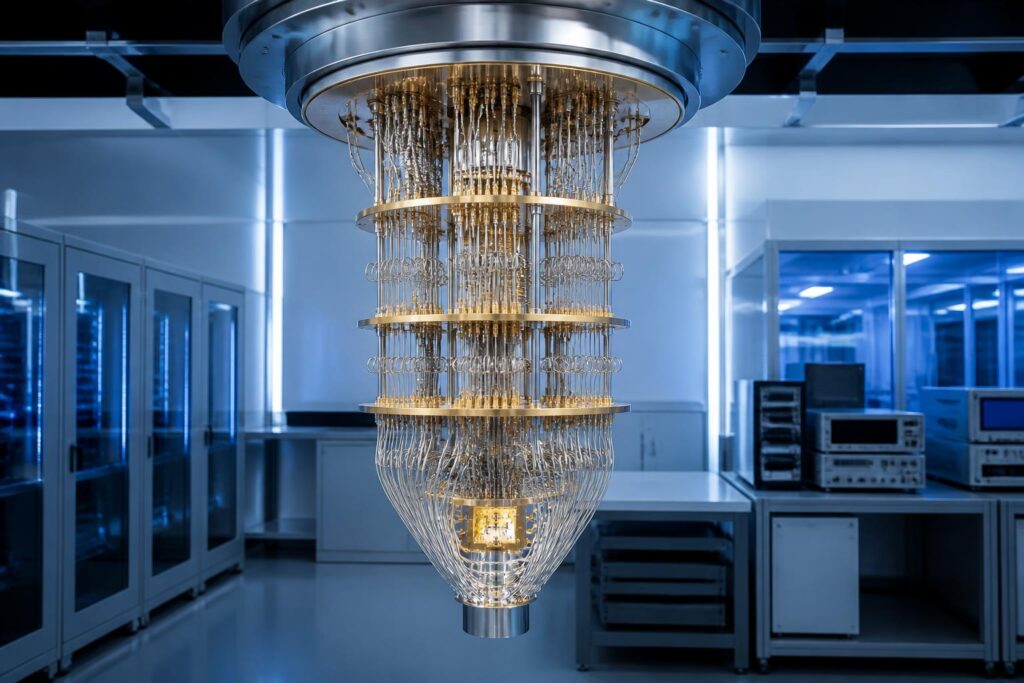
When imagining quantum computers, many people tend to focus on qubits, quantum gates, or the ability to solve problems that conventional computers struggle with. However, behind these concepts lies a less-noticed but decisive requirement: the operating environment must be controlled extremely strictly. For some common architectures, quantum computers need to be placed in cooling systems capable of lowering the temperature to near absolute zero.
This does not mean that every quantum computer must operate under the same conditions. Systems using trapped ions, neutral atoms, photons, or other platforms have their own environmental requirements. Even so, the issue of temperature highlights an important reality: a quantum computer is not simply a faster version of today’s computer. It is a special physical device in which information is stored in states that are highly sensitive to external effects.
How Sensitive Are Qubits to the Environment?
In classical computers, a bit is usually represented by one of two states, such as a low or high voltage level. These states can be affected by noise, but circuit design and checking mechanisms help the system distinguish between them relatively clearly. Qubits are different. They can exist in a superposition, simultaneously carrying the characteristics of multiple possibilities before a measurement is performed. Qubits can also become linked to one another through the phenomenon of quantum entanglement.
Superposition and quantum entanglement form the foundation of quantum computing’s potential, but they also make quantum information easy to destroy. A thermal fluctuation, an unwanted electromagnetic field, or mechanical vibration can interact with a qubit. When that happens, the quantum state changes before the calculation is complete. This process is commonly called quantum decoherence. Once decoherence occurs, the system no longer retains all the information needed for the algorithm.
The higher the temperature, the more vibrational energy the particles in matter have. This level of motion can create unwanted interactions with qubits. Cooling does not completely eliminate every source of noise, but it helps reduce thermal energy and creates a more stable environment. For qubits made from superconducting circuits, this is especially important.
What Role Does a Dilution Refrigerator Play?
Many superconducting quantum-computing systems use a large device called a dilution refrigerator. This device is not like a household refrigerator. It is not used to preserve items, but to create multiple temperature levels within a structure isolated from the environment. The important components of the quantum processor are placed at the coldest stage, while cables, filters, and amplifying equipment are arranged at stages with higher temperatures.
A dilution refrigerator uses the physical properties of a mixture of helium isotopes to carry heat away from the area containing the qubits. The system usually has multiple layers of shielding and components designed to reduce noise. The goal is not only to reach a low temperature, but also to maintain a stable temperature while the machine is operating. Even a small amount of heat entering the coldest region can affect the ability to control the qubits.
In appearance, these refrigerators often have a multilevel structure resembling stacked metal plates suspended within a large frame. From the outside, an observer can see many cables passing through different levels to connect the processor with control equipment outside. This structure reflects a complex balancing problem: signals must enter to control the qubits and leave to read the results, but the connections can also carry heat and noise.
Colder Does Not Automatically Mean Everything Works Better
Lowering the temperature is essential for many superconducting qubits, but it is not the only solution to every problem. A system must also contend with electrical noise, radiation from the environment, errors in control pulses, and the limitations of measurement equipment. If attention is focused only on cooling while other sources of noise are ignored, overall performance may not improve correspondingly.
Extremely low temperatures also make the system more complex. Engineers must design materials, cables, and filters that can operate across multiple temperature zones. They need to control the amount of heat emitted by electronic components, limit vibrations transmitted to the processor, and protect the equipment from unwanted radiation. Each additional connection can help transmit more signals, but at the same time increases the requirements for insulation and shielding.
This is why a quantum computer in a laboratory is usually accompanied by a massive support system. The quantum processor itself may be very small, but the cooling equipment, microwave controls, signal-measurement devices, and environmental-control systems take up much more space. This disparity shows that today’s quantum computers remain specialized research systems, not devices that can easily be placed in an office or home.
Different Architectures Have Different Temperature Requirements
Quantum computers should not be equated solely with the superconducting-qubit platform. In trapped-ion systems, ions are held in a high vacuum and controlled using electric fields and lasers. The vacuum environment helps limit collisions with external molecules, while specialized cooling methods are used to reduce the ions’ motion to a level suitable for quantum operations. This platform’s requirements differ from those of superconducting circuits, although both require very strict environmental control.
Neutral-atom quantum computers also rely on controlling atoms with lasers and electromagnetic fields. Photon-based platforms, meanwhile, can use particles of light and generally do not depend on dilution refrigerators in the same way as superconducting qubits. Some other approaches may operate at higher temperatures, but they present their own challenges involving material fabrication, control, signal detection, or the preservation of quantum states.
This diversity has major implications for the future of the field. There is no single architecture that is certain to be suitable for every problem. One platform may be easy to scale in terms of qubit numbers but difficult to connect, while another may have more stable qubits but face challenges involving operation speed or equipment requirements. Temperature is only one of many criteria used to evaluate quantum architectures.
Operating Costs and the Scaling Challenge
As the number of qubits increases, maintaining a cold and clean environment becomes more difficult. The system must bring additional control wires, readout equipment, and support components into a space already limited by insulation requirements. The heat generated by the components also increases, while cooling power at the lowest stage is very limited.
For this reason, scaling a quantum computer is not simply a matter of placing more qubits on a chip. Developers must also solve the problems of delivering signals to each qubit, reducing the number of physical wires, integrating control equipment, and maintaining operating quality as the system grows. Solutions such as control systems located close to the processor, integrated specialized electronics, or the development of new connections are all aimed at reducing the burden on the cooling system.
This requirement also affects how users access quantum computers. In the near future, most users may not own a quantum device on-site. Instead, they will send programs to systems housed in research centers or specialized data centers through remote-computing services. This model allows users to take advantage of complex hardware without having to invest in their own cooling, vacuum, and control systems.
Low Temperature Does Not Guarantee a Useful Quantum Computer
A common misconception is that once an extremely low temperature is achieved, a quantum computer will automatically have superior capabilities. In reality, temperature merely creates favorable conditions for qubits to operate. The system also needs high-quality qubits, accurate quantum gates, reliable measurements, and suitable error-control methods. If these components do not yet meet the necessary requirements, a low temperature will not turn an experimental device into a practical quantum computer.
Moreover, the benefits of quantum computing depend on the type of problem and the algorithm being used. Not every task is suitable for a quantum computer, and a system with more qubits is not necessarily more useful than one with fewer qubits but better control. Assessing capability therefore requires looking at the entire chain, from hardware and software to the ability to maintain quantum states throughout the computation.
It is worth noting that research into quantum cooling does not serve the computer industry alone. Techniques for controlling heat, noise, and signals at extremely low levels can also support precise physical measurements, specialized sensors, and experiments involving matter. However, these applications still depend on the specific objective and the maturity of each technology.
A Technical Barrier but Also a Direction for Innovation
The requirement to operate in conditions close to absolute zero shows just how large the gap can be between a quantum concept and a finished product. To turn qubits into a stable computing tool, developers must address fundamental physics, cooling engineering, chip fabrication, control electronics, software, and system operation at the same time.
However, this very barrier also drives many avenues of innovation. The goal is not only to make devices colder, but also to make qubits less sensitive to the environment, reduce the number of connections needed, bring controllers closer to the qubits, and find architectures that can be scaled at a reasonable cost. In some cases, choosing a platform that operates at a higher temperature may offer deployment advantages, even if it involves trade-offs in other areas.
Quantum computers should therefore be viewed as a technical ecosystem, not as a single chip. Dilution refrigerators, vacuum systems, lasers, pulse generators, measurement equipment, and software all help determine the final result. Understanding the role of temperature gives readers a clearer picture of why developing quantum computers takes so much time and why claims about this technology’s capabilities must be considered in the context of specific hardware.
Along the path toward larger and more reliable systems, keeping qubits away from heat and noise remains one of the fundamental tasks. As researchers find ways to maintain quantum states for longer, control them more precisely, and scale systems more effectively, the machines currently housed in laboratories may have a chance to move closer to practical applications.
