


From Data Centers to Where Data Is Generated
For many years, the familiar model for digital systems was to send data from user devices to a data center or cloud platform for processing. Phones upload photos to servers, cameras transmit entire video streams over networks, and sensors in factories continuously send information to a central system. This approach provides substantial storage and computing capacity while helping businesses manage infrastructure centrally. However, as the number of devices grows rapidly and more data is generated, sending all information elsewhere for processing is not always efficient.
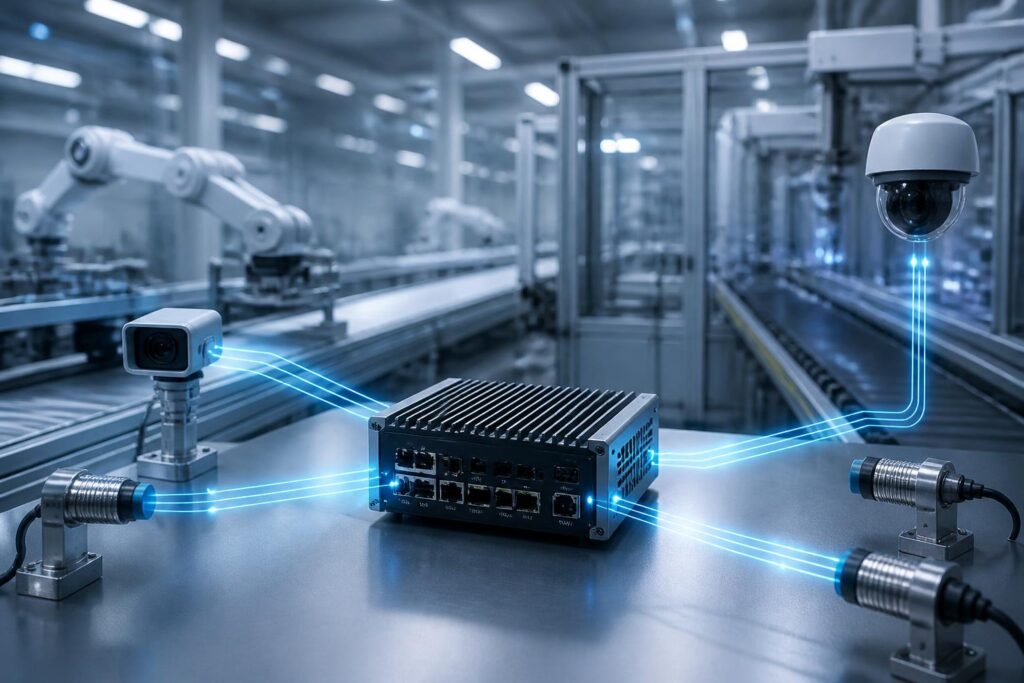
Edge computing emerged to address part of this challenge. Instead of relying entirely on remote servers, this model brings some computing, storage, and analytical capabilities closer to where data is generated. A small server in a factory, a gateway device in a store, a processor integrated into a camera, or infrastructure located near a telecommunications station can all serve as an edge computing node.
Edge computing does not eliminate cloud computing. The two models often complement each other. Tasks that require fast responses can be processed at the edge, while aggregated data, operational history, or jobs requiring substantial resources can still be sent to a data center. This division allows systems to use resources suited to the nature of each type of task.
Why Has Latency Become an Important Issue?
Latency is the amount of time between when a system receives data and when it produces a response. For some applications, being a few seconds slower may not have a significant impact. Users can wait for a web page to load more content or for a file to finish syncing. But in situations that require an almost instantaneous response, having data pass through multiple network points to reach a remote server can reduce service quality.
Imagine a production line with cameras monitoring products. If every frame is sent to a data center for analysis before a result is returned, the system may face significant latency and transmission costs. When a processor is placed directly in the factory, the cameras only need to send data to a nearby edge node. The system can detect anomalies, classify products, or send alerts to employees without waiting for the entire process of transmitting data over a long distance.
Edge computing is also useful in environments with unstable connectivity. If a remote facility loses its connection, core functions can continue operating within the permitted scope. When connectivity is restored, the necessary data can be synchronized with the central system. This is a notable benefit for sectors that operate continuously, where relying entirely on external connectivity can create risks.
Applications That Are Easy to See
In manufacturing, edge computing is often associated with monitoring machinery and inspecting quality. Sensors can record temperature, vibration, pressure, or equipment operating status. An on-site processing node analyzes these signals to detect unusual signs. Businesses can still send aggregated data to the cloud to monitor long-term trends, but they do not necessarily have to transmit all raw data continuously.
In retail, edge devices can support monitoring the condition of store shelves, controlling in-store equipment, or handling certain image-analysis tasks. The goal is not necessarily to collect as much data as possible, but to generate an appropriate response at the location where it is needed. This approach can help reduce the amount of data that must be transmitted and shorten processing times.
In transportation, systems located near cameras, sensors, or vehicles can analyze road conditions, identify incidents, and support coordination. Decisions that require a rapid response can be made at the edge layer, while data can be stored centrally for planning, performance evaluation, or training analytical models in the future.
In healthcare, edge computing can support processing data close to monitoring devices or specialized equipment. The main benefits are the ability to respond quickly and the reduced need to transmit all sensitive data over a network. However, this is also a field that requires strict control procedures. An edge-processing system cannot be considered secure simply because the data does not leave the facility. Devices, software, access rights, and synchronization processes all need to be managed closely.
Edge Computing Changes How Data Is Processed
The value of edge computing lies not only in placing servers closer to devices. This model forces organizations to rethink the data life cycle. Which data needs to be processed immediately? Which data only requires the result to be stored? Which data can be deleted after a task is completed? Which data must be retained for audits or long-term analysis? By answering these questions, businesses can design a more streamlined data flow that better fits their operational goals.
Instead of transferring an entire video stream from a camera system, an edge device may send only important events, such as an alert or a relevant segment of data. Rather than continuously transmitting every machine parameter, an edge node can calculate metrics, identify trends, and synchronize the necessary results. This can reduce pressure on bandwidth, but it does not mean that costs will automatically decrease in every case. Businesses still have to invest in equipment, software, power, connectivity, and operations personnel.
Another important difference is that edge systems are generally more distributed than centralized systems. When dozens or thousands of devices are located in many places, updating software, monitoring status, replacing hardware, and checking configurations become more complicated. A small device overlooked within the network can become a security weakness. Therefore, remote management and operational automation must be taken into account from the design stage.
Security Cannot Rely Solely on the Device’s Location
Bringing data closer to where it is generated does not mean that the data is automatically safer. An edge node may be located in a factory, store, building, or outdoors, where physical conditions are more difficult to control than in a data center. Devices may be accessed without authorization, lose power, be damaged, or connect to untrusted networks. Every new node added to the system also expands the area that needs to be protected.
An edge computing architecture needs to clearly establish the identities of devices, users, and services before allowing them to exchange data. Important data must be protected both in transit and at rest. Software on devices must have mechanisms for secure updates, logging, and detecting unusual behavior. Access rights should also be restricted according to actual needs, rather than allowing every component on the network to access every other component.
Businesses must also consider privacy. A camera or sensor system may generate data related to employees, customers, and internal activities. Processing part of the data on-site can reduce the need to transmit raw data, but organizations still need to define the purpose of collection, the retention period, and the scope of use. Technology does not replace internal regulations or the responsibility to govern data.
Not Every Problem Requires Edge Computing
Before deployment, businesses should start with a specific problem rather than chase a technology buzzword. If an application does not require a fast response, connectivity is stable, and data transmission costs remain manageable, a centralized model may be simpler. Edge computing is more suitable when latency, the ability to operate locally, bandwidth limitations, or requirements to process data on-site are genuinely issues.
Deployment can begin on a small scale, such as with one production line, one store, or a group of devices. The pilot phase should measure specific factors such as response time, uptime, the amount of data transmitted, the number of failures, and the operational effort required. These results help organizations identify practical benefits rather than relying only on expectations.
The architecture should also be designed to continue operating when connectivity is lost, while ensuring that data is not lost or duplicated when synchronization resumes. Businesses need plans for replacing devices, backing up configurations, and restoring services. If a system works well only under ideal conditions, it is not ready for a real-world environment.
A Step Toward a Distributed Model
Edge computing reflects a major change in how digital infrastructure is built. Data is no longer viewed only as something that must be sent to a central location for processing; it can be classified and used right where it appears. This approach is particularly well suited to a world filled with sensors, smart devices, and services that require fast responses.
Even so, edge computing is not a complete replacement for the cloud or data centers. Its value lies in distributing workloads appropriately: processing at the edge whatever requires speed and locality, and sending to central systems whatever requires scale, long-term storage, and aggregated analysis. When designed together with security, data governance, and a clear operational plan, this model can help digital systems respond more quickly while maintaining the ability to be managed at scale.
