


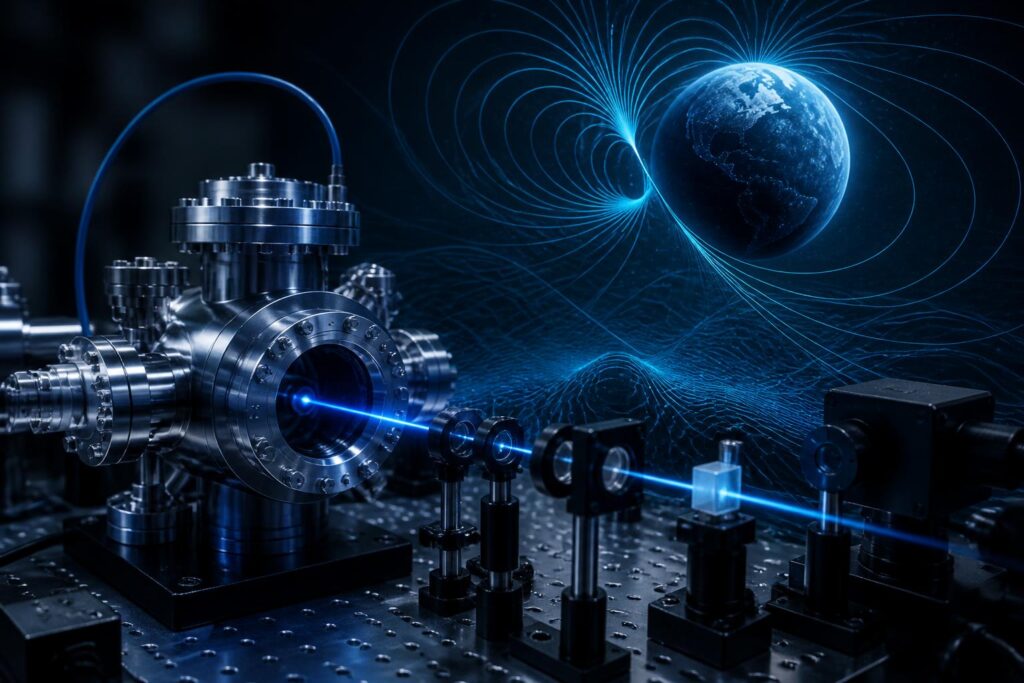
When quantum technology is mentioned, most attention tends to focus on quantum computers or quantum communication networks. However, another area of development that is no less practically significant is quantum sensing. Rather than using quantum effects to process problems or transmit information, quantum sensors exploit the subtle properties of matter and light to observe physical quantities with very high sensitivity.
These quantities may include magnetic fields, acceleration, time, temperature, gravity, or rotational motion. In many cases, sensors do not need to create an entirely new type of measurement, but instead significantly improve the ability to detect very small variations compared with conventional devices. It is precisely this ability to detect weak signals that has drawn interest to quantum sensors in many fields, from fundamental research to healthcare, navigation, resource surveying, and infrastructure monitoring.
What Do Quantum Sensors Operate On?
Conventional sensors can also achieve high accuracy, but quantum sensors use special quantum states as the foundation of measurement. In the microscopic world, atoms, ions, electrons, or photons can exhibit phenomena such as superposition and interference. When affected by a force field or an environmental change, their quantum states will change. These changes can be converted into signals to infer the quantity being measured.
For example, a cold-atom system can be prepared in a controlled state and then undergo interaction with gravity or acceleration. The change in the phase of the quantum state carries information about the motion experienced by the system. Similarly, some quantum magnetic sensors monitor changes in the spin states of particles or defects in materials. The ultimate goal remains to measure a physical quantity, but the underlying mechanism is based on rules different from those of conventional electronic sensors.
“Quantum” should not be understood to mean that every sensor of this kind has absolute accuracy. Theoretical sensitivity is only one part of the problem. Environmental noise, mechanical vibrations, temperature, laser quality, control systems, and signal-processing methods can all reduce a device’s effectiveness. Therefore, the value of a quantum sensor must be assessed under specific conditions of use, rather than based solely on figures presented in a laboratory.
Notable Groups of Quantum Sensors
Time and Frequency Sensors
Atomic clocks are one of the most mature examples of applying quantum phenomena to measurement. These devices use the frequency of atomic energy-level transitions as a stable time reference. Accurate time standards play a role in synchronizing telecommunications networks, positioning systems, scientific measurement, and many other technical infrastructures.
In the future, smaller atomic clocks may be incorporated into systems that are unsuitable for bulky equipment. However, miniaturization is not merely a mechanical problem. Developers must maintain the operating environment, the ability to control atoms, and the stability of the light source within acceptable limits. A smaller device that is strongly affected by temperature or vibration is not necessarily more useful in practice.
Magnetic-Field Sensors
Magnetic fields occur in many natural and man-made systems. The activity of the brain and heart, electric motors, magnetic materials, and certain geological structures can all produce magnetic signals. Quantum sensors can help detect small variations in magnetic fields without requiring direct contact with the object being measured.
In biomedicine, recording magnetic signals produced by bodily activity can supplement information from other measurement methods. Even so, the equipment must operate in an environment with many sources of noise, ranging from electrical devices to patient movement. A more sensitive measurement system does not automatically produce a better diagnosis; the data still need to be collected according to the proper procedures, processed carefully, and interpreted by qualified professionals.
Acceleration, Rotation, and Gravity Sensors
Quantum inertial sensors can measure acceleration or rotational motion based on how atoms respond to applied forces. If deployed reliably, they could support navigation in environments where satellite signals are weak or interrupted. This is an area of interest in maritime operations, aviation, underground surveying, and systems that need to maintain positional information over long periods.
Gravity sensors can also detect small differences in the gravitational field caused by changes in the density of underground matter. In principle, this data could support geological-structure mapping, groundwater monitoring, or surveys of underground spaces. However, inferring a specific structure from variations in gravity is often a complex problem. The results need to be combined with geological models and other surveying methods; a single measurement cannot be regarded as sufficient evidence.
Why Does This Technology Have Potential?
The appeal of quantum sensors lies in their ability to turn very small changes into data that can be analyzed. In some situations, a device does not need to send a strong signal toward an object, but can simply observe the system’s natural response. This can be useful when the object is deep underground, far away, difficult to access, or needs to be monitored without affecting it.
The technology also opens up a new approach to navigation problems. Satellite navigation systems depend on signals from outside and may encounter difficulties indoors, underwater, underground, or in obstructed areas. A highly stable inertial sensor will not completely replace satellite navigation, but it can serve as a supplement during periods when signals are interrupted.
In Earth science, data from quantum sensors could help monitor geophysical changes in greater detail. This information could support research into volcanoes, tectonic movements, groundwater fluctuations, or changes in subsurface structures. The value of a sensor lies not only in its sensitivity but also in its ability to make repeatable measurements over time, thereby creating a data series for identifying trends.
Barriers from the Laboratory to the Product
The first challenge is environmental control. Many quantum systems need to be isolated from vibrations, electromagnetic interference, or temperature variations. Some devices use vacuum chambers, lasers, and complex control systems. These components increase size, cost, and maintenance requirements. A prototype may perform well in a laboratory but may not necessarily withstand the vibration, dust, humidity, or temperature changes found in the field.
The second challenge is reliability. A sensor used to monitor infrastructure, support navigation, or collect medical data must deliver stable results over long periods. Calibration, fault detection, and performance maintenance are no less important than initial sensitivity. If a device is sensitive enough to detect unrelated fluctuations as well, the processing system behind it will have to handle a very large amount of noisy data.
The third challenge is data interpretation. A quantum sensor may measure a subtle signal, but that signal is often affected simultaneously by multiple factors. A change in a magnetic field may come from a power source, surrounding materials, or a biological phenomenon. A variation in gravity may be related to multiple underground structures. Therefore, practical deployment requires modeling software, verification procedures, and cooperation among different disciplines.
In addition, not every application needs a quantum sensor. Traditional equipment may be cheaper, easier to repair, and already sufficient for the requirements. Technology selection should be based on specific measurement benefits, total cost of ownership, and operating conditions, rather than on chasing the “quantum” label as an automatic guarantee of quality.
Impact on Business and Society
In the short term, quantum sensors are likely to develop first in fields with specialized measurement needs. Laboratories, surveying organizations, the aviation industry, the energy sector, and biomedicine may be among those willing to accept high costs in exchange for data that conventional equipment has difficulty providing. As components become smaller and manufacturing processes more stable, the new technology may expand into mobile systems or distributed sensor networks.
This development also creates demand for an interdisciplinary workforce. Quantum engineers need to understand optics, atomic physics, and control; systems engineers must pay attention to mechanics, electronics, software, and reliability; and application specialists need to know how to turn measurement signals into meaningful information. If attention is focused only on hardware while operational and analytical procedures are lacking, even a highly sensitive device will struggle to create commercial value.
Socially, more sensitive measurement systems could benefit environmental research, infrastructure management, and healthcare. However, they also raise questions about privacy if used to monitor biological activity or collect data in sensitive spaces. The more powerful measurement technology becomes, the more important clear purposes of use, data protection, and independent oversight become.
Understanding Quantum Sensors Correctly
Quantum sensors are not magical devices that can see through everything or completely eliminate the limits of measurement. They are a group of technologies based on special physical principles that offer advantages for certain specific problems. Their usefulness depends on the fit among the sensor, the environment, the processing algorithm, and the decision-making process.
In the coming years, notable progress may come from making quantum systems more robust, compact, and easier to integrate. At that point, the important question will no longer be only how sensitively a sensor can measure, but also where it can operate continuously, how reliably it can produce data, and which problems it can solve better than existing alternatives.
From this perspective, quantum sensing is a development path worth watching because it connects fundamental physics research with highly specific measurement needs. The technology’s value will be established not by grand claims, but through applications that can be verified, operate reliably, and produce useful information in real life.
