


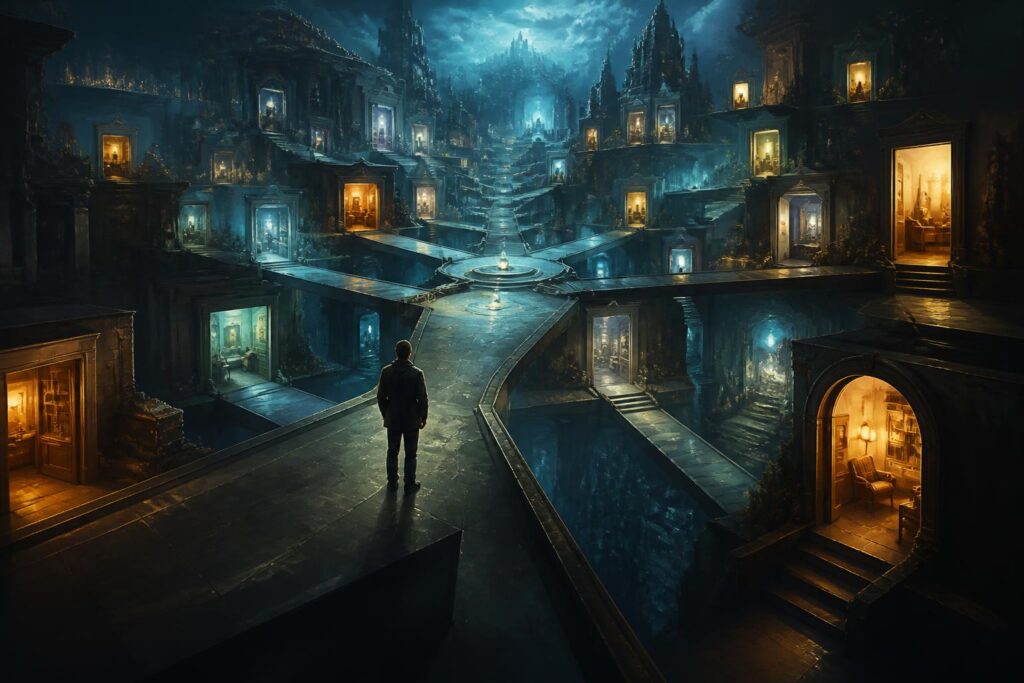
In a traditional story, readers or viewers usually follow a path arranged from beginning to end. Events follow one another, characters appear according to the author’s intentions, and information is revealed at a relatively steady pace. Virtual worlds change that model. When entering a space that can be explored, users no longer simply sit in front of a completed story. They move, observe, interact, and sometimes decide for themselves which parts of the story will be seen.
This approach is often called nonlinear storytelling. The concept does not necessarily mean that a story has no beginning, development, or ending. It mainly refers to the fact that the components of a story are not received in one single order. Users may encounter a character before learning about their past, see traces of an event before understanding its cause, or miss a detail during their first experience and return to explore it later. In virtual worlds, the user’s path becomes part of how the story is formed.
From Recipient to Participant
The most important difference lies in the role of the audience. With a book, readers can imagine the space and actions based on what the text describes. With a film, the camera angle largely determines what is seen. In a virtual world, however, users often have the power to choose their viewpoint, where they stand, and when they interact. They may enter a room they are not required to visit, stop in front of a small object, or follow a character instead of continuing along the main quest line.
Those choices do not always change the ending. Many experiences still lead to several common points designed in advance. Even so, a sense of participation can emerge when the consequences of a choice lie only in the information discovered, the order in which events are understood, or the emotional connection formed with a character. Someone who walks through a ruined marketplace will understand the world differently from someone who goes straight to the central building, even though both eventually encounter the same event.
Freedom Requires a Subtle Structure
Nonlinear storytelling is easily misunderstood as giving users as much freedom as possible. In reality, too many unexplained choices can make an experience exhausting. If they do not know which locations are important, which objects can be interacted with, or which actions will reveal new information, users may feel that they are moving through a vast space without a sense of purpose.
Therefore, designers need to build a structure that is clear enough to keep users from getting lost, but flexible enough that they do not feel they are being pulled along a set track. This structure can be created through changes in lighting, architectural arrangements, ambient sound, natural directions of movement, or details repeated throughout the space. A half-closed door, footprints on the ground, an object placed out of alignment with its surroundings, or an unusual empty space can all serve as invitations to explore.
These signals do not need to be explained directly. When used consistently, they help users form hypotheses of their own. They are not merely searching for answers provided by the system; they are also asking questions about what happened before. This is when space becomes a storytelling medium rather than merely a backdrop for dialogue and quests.
The Memory of Space and the Feeling of Discovery
A virtual world with strong storytelling often makes users remember locations by their meaning, not just by their appearance. A bridge may be associated with an unexpected encounter, a room may evoke a difficult choice, and a narrow road may mark the moment when a user realizes something about a character. When a story is told through space, a location becomes part of personal memory.
This also creates a difference between being told something and discovering it oneself. If a character says that an event once took place somewhere, the user receives the information on a rational level. But if they find an abandoned object for themselves, notice a change in the arrangement of a space, or discover a passage leading to an old trace, that information may be remembered more deeply. The experience of discovery gives users the feeling that they have helped piece the story together.
However, discovery has value only when information is distributed appropriately. If the pieces are too scattered, users cannot connect them into a meaningful picture. If every detail is explained immediately, the feeling of discovering something independently disappears. Balancing ambiguity and clarity is one of the greatest challenges of this storytelling approach.
Choices and the Responsibility of Design
In experiences that allow users to make decisions, choices should not merely be buttons that appear different but lead to the same response. A meaningful choice can change relationships between characters, open up a new perspective, or force users to live with the consequences of an earlier action. The consequences do not necessarily have to be large or dramatic. Sometimes, it is enough for a character to no longer appear in a familiar location for users to realize that their choice has left a mark.
What matters is that the system gives users the opportunity to understand their choices in the appropriate context. If a consequence appears too late or has no apparent connection, users may regard it as random. Conversely, when the world responds consistently, users feel that their actions carry weight. The sense of responsibility then comes not from a judgmental notification, but from seeing changes in the space and in relationships.
Designers must also be careful about turning every interaction into a moral test. Not every choice needs to be divided into right and wrong. Someone may choose out of curiosity, fear, a desire to protect another character, or simply because they do not yet have enough information. The variety of motivations makes the experience closer to the way people make decisions in everyday life, while also avoiding the imposition of a single message on users.
The Challenges of a Story with Multiple Paths
As the number of choices increases, maintaining consistency becomes more difficult. A character cannot both know and not know about the same event in the same circumstances. A location that has been changed should not appear as though nothing ever happened, unless the world has a clear reason to explain it. Small contradictions in logic can weaken users’ trust in the entire experience.
For this reason, nonlinear storytelling requires careful planning. Designers need to envision the different states of the world, the information users may know at each point, and the changes that may occur after every choice. This is not only the work of the scriptwriter. The design of the space, interface, sound, pace of interaction, and the way progress is saved all affect how users understand the story.
Another challenge is the difference between people’s experiences. Some enjoy searching for every clue, some only want to follow the main path, and others spend a great deal of time observing the scenery without taking part in the quests. A good story does not necessarily have to serve every style in the same way, but it should anticipate common behaviors and avoid punishing users simply because they explore at a different pace.
Virtual Space as a Form of Co-Creation
When users choose the order in which they explore, each person may take away a different version of their memory of the same world. One person remembers a conversation with a character, another remembers the path leading to a secret, while someone else is impressed by a moment that was not considered central to the script. These differences do not strip the story of its identity. On the contrary, they expand the work’s life through the ways each person interprets its signs.
This aspect of co-creation does not mean that users completely replace the role of the author. Authors and designers still create the rules, setting, characters, and boundaries of the world. Users operate within that framework, but the specific path they take and the connections they make between details are formed through their actions. The story therefore ceases to be merely a fixed sequence of content and becomes an encounter between design intentions and the attention of the person experiencing it.
For that encounter to be meaningful, a virtual world needs to respect users’ time and curiosity. Not every detail has to lead to a reward, but every important detail should contribute to atmosphere, understanding, or emotion. When exploration serves only to extend the duration of an experience, users will quickly recognize the emptiness behind the superficial choices.
The Future of Immersive Storytelling
Nonlinear storytelling in virtual worlds is still expanding, and there is no single formula for it. Some experiences focus on exploring the environment, some use choices to reflect personality, and others allow users to create events together that can never be repeated in exactly the same way. What they have in common is that the story no longer exists only in dialogue or text. It is distributed across space, actions, waiting time, and the way the world responds.
What matters is not how many story branches a virtual world can create, but whether each branch provides a meaningful experience. A story with few choices but a carefully constructed structure can make a stronger impression than a complex network that lacks direction. Freedom becomes valuable only when users understand what they are free to do, why that choice matters, and how the world will remember it.
With this approach, users do not merely enter a story that already exists. They enter a space filled with traces, possibilities, and gaps for them to fill with their own attention. Nonlinear storytelling is therefore not simply a matter of dividing a story into multiple paths. It is the art of designing a world consistent enough to be trusted, broad enough to be explored, and flexible enough for every journey to become a distinct way of understanding.
