


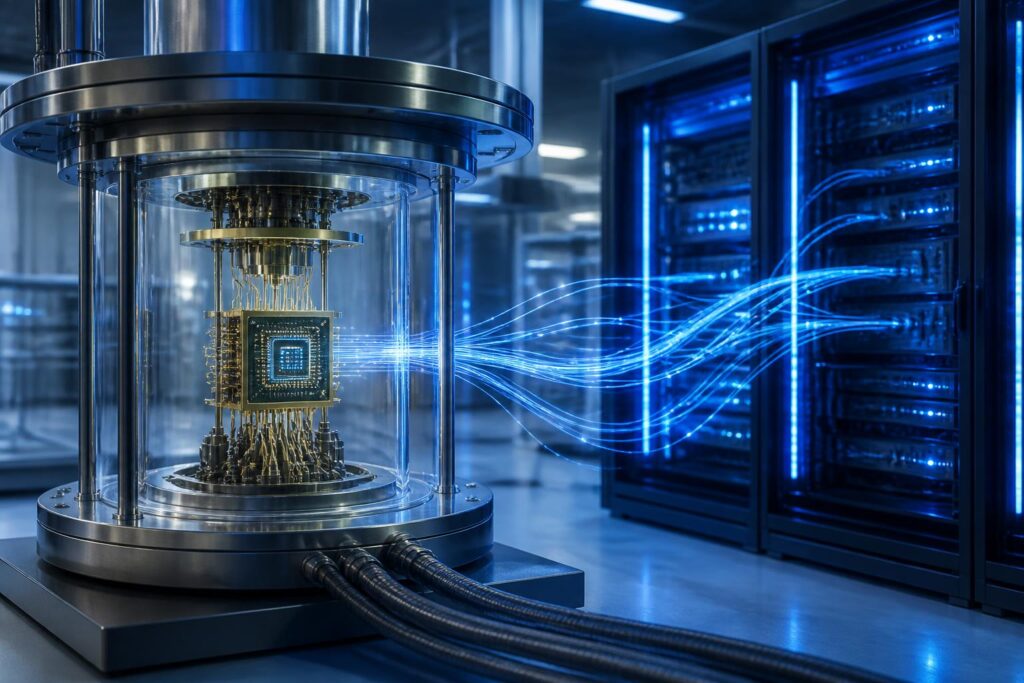
When quantum computers are mentioned, many people imagine a device capable of replacing today’s computers and solving every problem faster. In reality, things do not work that way. At the present stage, a useful quantum system generally does not operate independently, but works closely with a classical computer. This model is known as hybrid quantum computing.
In a hybrid architecture, the classical computer handles most familiar tasks, such as preparing data, controlling the process, optimizing parameters, storing results, and interpreting outputs. The quantum processing unit, commonly called a QPU, performs only the parts of the computation designed to exploit quantum states. This division reflects an important reality: quantum technology is not yet a complete independent platform, but is being built as a specialized component within a larger computing system.
How does hybrid quantum computing work?
A hybrid process usually begins on a classical computer. The user describes the problem, encodes the data appropriately for a quantum circuit, and then creates a circuit with parameters that need to be adjusted. This circuit is sent to the QPU for repeated execution. Each run produces a probabilistic measurement result from the quantum system. The classical computer collects these results, calculates an objective function, and determines how to change the parameters for the next iteration.
The process is repeated until a stopping condition is reached, such as when the objective value no longer improves significantly or the number of iterations reaches its limit. In other words, the QPU does not find the entire solution by itself. It acts as a component that evaluates quantum configurations, while the classical optimizer guides the next trial.
This architecture can be imagined as a team made up of two types of capabilities. Classical computers are good at coordination, precise numerical computation, processing large amounts of data, and running optimization algorithms. QPUs can represent and manipulate quantum states, but they have difficulty storing results directly, are easily affected by noise, and cannot yet run very deep circuits reliably. When combined properly, the two complement each other rather than competing to replace one another.
Why is the hybrid model suitable for the current stage?
Quantum hardware still faces many technical limitations. Qubits can lose their state through interactions with the environment, measurement changes the state being observed, and imperfect quantum gates can accumulate errors at each step of a circuit. These limitations make it difficult to run very long and complex quantum algorithms.
Hybrid methods often use relatively short circuits, then rely on multiple measurements and classical optimization to derive a result. This approach does not eliminate noise, but it helps limit circuit depth and make use of the hardware currently available. Rather than waiting until fully fault-tolerant quantum machines appear, researchers can experiment with algorithms on devices that have not yet reached that stage.
Another benefit is that the hybrid model is easier to integrate with existing computing infrastructure. Data can be prepared on a server, sent to the QPU through a control layer, and then returned for further processing. As a result, businesses do not necessarily have to replace their entire existing systems to begin researching quantum applications. They can treat the QPU as a service or a specialized accelerator, similar to how many systems today combine CPUs with other processors.
Representative algorithm groups
Variational algorithms
Variational algorithms are one of the clearest examples of hybrid quantum computing. In this process, the quantum circuit contains adjustable parameters. After each run, the measurement results are used to calculate a loss function or objective function. The classical optimizer then updates the parameters to steer the result toward the desired value.
The advantage of this method is that the quantum circuit can be kept at a relatively limited depth, while the task of finding the parameters is assigned to familiar classical algorithms. However, optimization is not always simple. The objective function may have many extrema, measurement results are random, and some circuit structures make the guiding signal for the optimizer weak. Therefore, circuit design, the choice of objective function, and the sampling method all have a major impact on the result.
VQE and chemistry problems
The variational quantum eigensolver, commonly known by its abbreviation VQE, is used to find the low-energy state of a modeled quantum system. In chemistry and materials problems, the energy of the system is an important quantity for studying the structure or properties of a molecule.
VQE does not mean that a quantum computer can immediately simulate every molecule with practically useful accuracy. Representing the chemical system, mapping it onto an appropriate number of qubits, reducing circuit complexity, and handling noise are all separate challenges. Even so, VQE demonstrates how a QPU can participate in a simulation process while the classical computer retains the primary role in coordination and analysis.
QAOA and optimization problems
The quantum approximate optimization algorithm, commonly called QAOA, also relies on a loop between a classical computer and a QPU. A combinatorial optimization problem is converted into an objective-function form, after which the quantum circuit generates candidate states. The classical computer evaluates the results and adjusts the circuit parameters.
This group of problems may involve scheduling, resource allocation, or selecting options under conditions with many constraints. However, whether an algorithm with a quantum structure can clearly outperform a classical method depends on the specific problem, data, and hardware. Not every optimization problem should automatically be considered suitable for QAOA.
The bottleneck lies in communication between the two systems
Hybrid quantum computing creates a challenge that purely classical systems encounter less often: the loop between the classical processor and the QPU must be organized efficiently. If sending a circuit, executing it, and receiving the result each involve significant latency, communication wait time can outweigh the benefit of the quantum computation.
To reduce this problem, the system needs to manage circuit batching effectively, allocate the number of measurements, and process results close to where the QPU operates. Some parts of the loop can be moved to a lower-latency control layer, while heavier analysis continues to run on a classical server. The specific arrangement depends on the type of hardware, the programming interface, and the application’s requirements.
Data is also an issue that requires consideration. Loading large amounts of classical data into a quantum state is not a cost-free operation. If the cost of encoding and transmitting data is too high, the benefit from the quantum computation step may be significantly reduced. Therefore, a suitable problem needs not only a quantum algorithm, but also a reasonable way to represent the data and a transfer process that does not become a bottleneck.
Combining them does not automatically make things faster
Hybrid quantum computing is often presented as a practical path forward, but it is not evidence that quantum computers have already delivered a universal advantage. To evaluate an application, the entire process must be compared with the best available classical method, including data-preparation time, circuit-transmission time, the number of measurements, noise processing, and the cost of analyzing the results.
An experiment that runs quickly only in the quantum core but takes a long time in the supporting steps cannot yet be considered to have a complete advantage. Similarly, seemingly good results on a small dataset are not enough to demonstrate scalability. Comparisons need to clearly state the experimental conditions, the required accuracy, and the resources used by both sides.
This is especially important for businesses. Before investing, they should determine whether the problem has a suitable structure, what level of error is acceptable, and which business process will use the quantum result. In many cases, a more reasonable initial step is to build a prototype, test integration capabilities, and train a team, rather than immediately expecting a system that replaces existing computers.
The outlook for hybrid architectures
As quantum hardware improves, the role of the hybrid model may change, but it is unlikely to disappear completely. Even a large and stable quantum computer will still need classical computers to manage data, schedule tasks, monitor system status, and present results. The difference in the future may lie in the distribution of work: the QPU will handle larger and more specialized circuits, while the classical computer will continue to serve as the coordination layer.
In the short term, the value of hybrid quantum computing lies in its ability to help the community test ideas early, develop programming tools, and gain a clearer understanding of the conditions required for practical applications. It also creates a more cautious approach: rather than describing a quantum computer as a device that replaces an entire computing infrastructure, it can be viewed as a new component that needs to be placed in the right position.
Quantum computing will become meaningful only when algorithms, hardware, control software, and operating processes all advance together. The hybrid model does not solve every limitation, but it demonstrates a viable path for combining the two worlds. While the technology is still developing, this cooperation itself may provide the foundation for turning quantum experiments into systems that can be tested and gradually put to practical use.
