


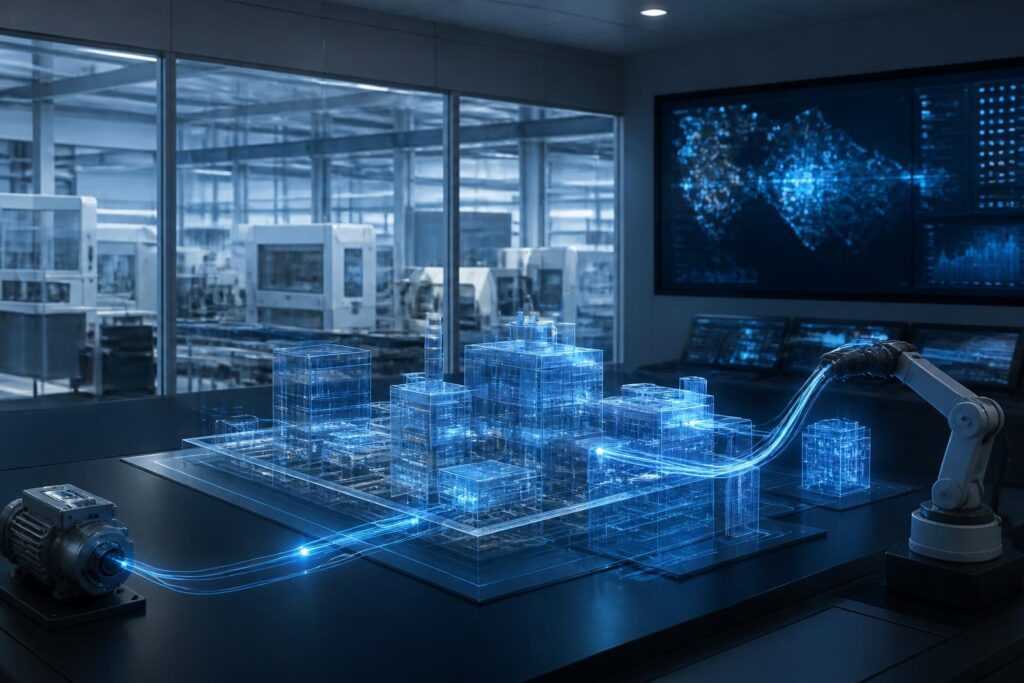
For many years, operational data was typically recorded after an event had already occurred. When a production line stopped, a building consumed too much electricity, or a transportation system developed a bottleneck, managers would only then begin examining reports to find the cause. This approach remains necessary, but it is not enough in environments where every delayed decision can lead to significant costs. Digital twins are attracting attention because they can move data from a recorded state to a state of simulation and prediction.
A digital twin is not simply an attractive three-dimensional model on a screen. It is a digital representation of a real-world object, process, or system, linked to operational data throughout the object’s life cycle. Depending on the purpose, the twin may describe a machine, a building, a factory, a vehicle fleet, an energy network, or a service process. The technology’s main value lies in helping people ask, “What would happen if this were changed?” before making the actual change.
From Static Models to Systems That Reflect Reality
A technical design or traditional simulation model is usually created for a specific point in time and a particular purpose. When the real-world object changes, the model can quickly become outdated if it is not updated. Digital twins are built to maintain a more continuous connection between the physical world and the digital environment. Sensors, management software, maintenance logs, and data from various devices can provide information about the object’s current state.
This connection does not necessarily mean that all data must be transmitted in real time. In some cases, periodic data is sufficient for tracking trends. In others, the system needs to respond quickly because safety, quality, or automated control is involved. Therefore, building a digital twin should begin with the question of which decision needs support, rather than with the collection of as much data as possible.
For example, a business seeking to reduce equipment downtime can use a digital twin to monitor equipment condition, compare current operations with normal periods, and test maintenance options. The digital model does not replace technicians. It provides additional context so technicians know which component to inspect, what level of priority to assign, and when stopping the machine would have less impact on overall operations.
The Technology Layers That Make Up a Digital Twin
The first layer consists of data describing the object. For an industrial machine, this might include design specifications, component configurations, repair history, and operating conditions. For a building, the data may include spatial structure, air-conditioning systems, lighting equipment, room usage levels, and operating rules. The clearer the initial data, the stronger the foundation the model has for representing the real-world object.
The next layer is connectivity. Sensors and software systems must transmit data in a stable way, using suitable formats and providing sufficient traceability. This is often more difficult than building a display interface. An organization may own many devices from different generations, use different protocols, and store data in systems that are not interconnected. If this fragmentation is not addressed, the digital twin can easily become an attractive dashboard that lacks reliable information.
On top of the data, analytical and simulation models help identify relationships among variables. A model can predict energy consumption when operating schedules change, estimate the impact of a maintenance plan, or simulate how a process responds to increased demand. In complex systems, simulation results should be presented together with their level of uncertainty so users understand which forecasts have a solid basis and which scenarios require caution.
Applications Extend Beyond Factories
Manufacturing is a field where the benefits of digital twins are easy to see because machinery, processes, and product quality are closely connected. Businesses can create models of production lines to assess equipment layouts, test changes to the order of operations, or examine the effects of a bottleneck. Testing on a digital model reduces the need to intervene directly in an operating production line, although all results still need to be verified under real-world conditions.
In construction and facility management, a digital twin can connect design data with the way a facility is used after completion. Managers can monitor equipment, maintenance schedules, energy consumption, and the condition of different areas within the same environment. This approach encourages a shift from repairing things after they fail to condition-based maintenance, while also supporting assessments of the effects of changes in function or occupancy density.
For transportation and urban infrastructure, digital twins can help simulate traffic flows, construction plans, space allocation, or how a network responds to an incident. However, a city is not a machine that can be predicted completely. Travel habits, weather, unusual events, and human decisions always create variation. The most appropriate role for a model is therefore to support planning and scenario comparison, not to provide an absolute assertion about the future.
In the energy sector, this technology can support the monitoring of generation equipment, storage systems, distribution networks, and consumption needs. As increasingly variable energy sources are incorporated into the system, simulating multiple operating conditions becomes more important. A digital twin can help identify areas requiring investment, assess load-adjustment options, and detect abnormal signs before their effects spread more widely.
The Biggest Barrier Is Data Governance Quality
Many digital-twin projects fail not because they lack simulation software, but because their input data is inconsistent. Different equipment names used by different departments, unsynchronized timestamps, uncalibrated sensors, or missing maintenance histories can all reduce the model’s reliability. A digital twin is useful only when users know where the data came from, when it was updated, and what its limitations are.
Security issues also need to be considered from the outset. When a digital model reflects the operations of a factory, building, or critical infrastructure, the data it contains may reveal sensitive operational information. Access rights should be assigned by role, connections must be protected, and important changes should be recorded in audit logs. Putting too much data into a centralized platform without clearly defining its purpose will increase risk rather than create efficiency.
Data ownership can also become a point of dispute when multiple suppliers, operators, and partners participate in the same system. Businesses need to clarify who owns which data, who is allowed to use it, how long it will be retained, and whether it can be transferred to another platform. These questions are directly related to a project’s ability to scale, because a model locked into proprietary technology will struggle to serve an organization as its needs change.
Do Not Start with an Overly Ambitious Goal
Effective digital-twin implementation usually requires a specific, measurable problem with clear ownership. Rather than simulating the entire business from the outset, an organization can select a piece of equipment with a major impact on operations, an area with high energy consumption, or a process that frequently produces errors. A smaller scope allows the team to test data quality, determine how to measure results, and adjust the model before expanding it.
People remain the decisive component. Operations staff should be involved from the design stage to ensure that the model accurately reflects actual work. If an interface provides too many alerts without helping users understand what to do next, the system will quickly be ignored. Conversely, when a digital twin is integrated into familiar workflows and provides information at the right time, it can become a shared layer of knowledge among engineering, management, and planning teams.
It is also important not to confuse simulation capability with accurate predictive capability. Models always rely on assumptions, historical data, and a defined scope. When real-world conditions change significantly, the results may deviate from reality. Therefore, every important recommendation should be accompanied by verification mechanisms, approval thresholds, and a plan for returning to a safe state. The more deeply technology participates in decision-making, the more important explanation and human oversight become.
A Foundation for More Proactive Operations
A digital twin is not a standalone product but a combination of data, sensors, connectivity, models, and governance capabilities. When built around the right objectives, it helps an organization see the relationship between today’s decisions and the results that may emerge later. Its greatest value does not lie in visual displays, but in its ability to reduce trial and error, detect problems early, and create a common language for groups that typically work with different sources of information.
In the period ahead, organizations may take a more practical approach to digital twins, starting with small problems directly linked to cost, safety, or service quality. Success will not be determined by how complex the model is, but by whether the data is reliable, the results are actionable, and the process ensures accountability. When these conditions are met, a digital twin can transform an operating system into an environment capable of learning and preparing more effectively for changes that have not yet occurred.
