


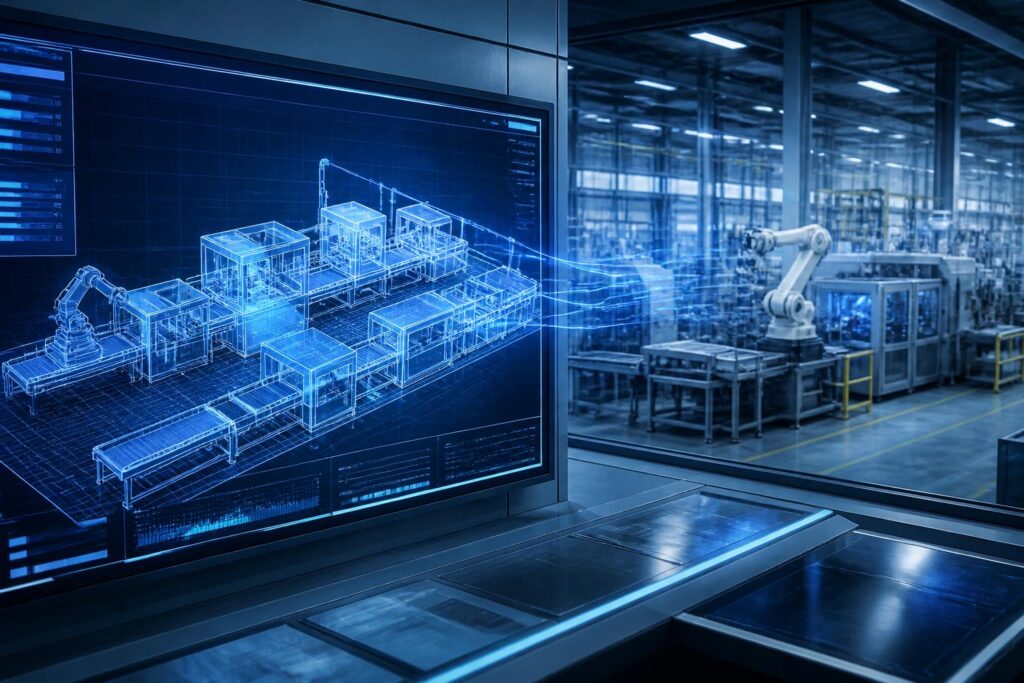
In many fields, a decision that seems simple can entail significant costs if implemented directly on an operating system. Changing the layout of a production line, adjusting the operating mode of a machine, renovating a building, or testing a new maintenance schedule can all create difficult-to-predict risks. Digital twins are being developed to address part of this challenge: creating a digital model that reflects an object, process, or system in the real world, and then continuously connecting that model to operational data.
The important point about a digital twin does not lie in an eye-catching three-dimensional image. A visual model only truly becomes a digital twin when it has a reliable connection to a real-world object. Data from sensors, management software, measuring devices, or technical records can be fed into the model to describe the current state. Conversely, the model can help people test scenarios, detect signs of abnormality, and consider the impact of a change before applying it.
How Is a Digital Twin Different from an Ordinary Simulation Model?
Simulation modeling is not a new concept. Engineers have long used mathematical models and simulation software to study designs, forecast performance, or test load-bearing capacity. Digital twins build on that foundation but add an important element: a connection to the real-world object throughout its operational life cycle.
A computer-based design can show how a system is expected to operate. A digital twin, meanwhile, can receive data showing how the system is actually operating, how environmental conditions have changed, and whether real-world parameters still match the initial assumptions. This two-way relationship makes a digital twin a tool for supporting operations, rather than merely documentation used during the design phase.
However, not every 3D model or data dashboard is a digital twin. A visual representation that is not updated from the real system is merely an illustration. A data table that displays only isolated indicators is also not enough to become a replica of an entire process. The value of the technology lies in its ability to connect the data, context, and behavior of an object over time.
Notable Applications in Practice
In manufacturing, a digital twin can simulate a single machine, a production line, or an entire factory. Depending on the type of equipment and measurement system deployed, businesses can monitor indicators such as temperature, vibration, operating speed, and energy consumption. When data is placed in the right context, technicians have a stronger basis for distinguishing between normal conditions and signs that require inspection.
The technology also supports the testing of changes. For example, before changing the sequence of operations or increasing the capacity of a production line, an operations team can use a model to examine points that may become bottlenecks. Simulation results do not completely replace on-site inspections, but they help narrow the scope of testing and prepare safer approaches.
In construction and facility management, a digital twin can combine design data, information about materials, maintenance schedules, and the condition of systems such as electricity, water, or air conditioning. A building monitored through a digital model can help managers see the relationship between space utilization, environmental conditions, and equipment operation. When repairs or replacements are needed, a centralized record helps reduce the fragmentation of information across multiple departments.
For urban infrastructure, digital twins can be used to simulate traffic, drainage, lighting, or resource allocation. Such models do not automatically provide a perfect answer for a city, because social factors and human behavior are highly complex. Nevertheless, they can create a testing environment in which authorities compare options and identify potential consequences before implementation.
In energy and transportation, digital models can support the monitoring of high-value assets, maintenance planning, and assessments of operational efficiency. Equipment does not necessarily have to wait until it fails before being inspected. If data shows that performance is gradually declining or that a parameter is deviating from its usual trend, staff can investigate the cause earlier. This is the foundation of predictive maintenance, although digital twins and predictive maintenance are not completely identical concepts.
Data Is the Foundation, Not an Add-On
The biggest challenge in building a digital twin often does not lie in creating an attractive interface, but in the quality and connectivity of the data. A model is reliable only when its input data has a clear origin, is measured using appropriate methods, and is updated at a frequency that meets the needs of the problem. Slow, incomplete, or inconsistent data can cause the model to reflect a reality that has already passed.
Businesses also need to determine the necessary level of detail. Not every system needs a complex digital twin with thousands of parameters. An oversized model that does not serve a specific decision will increase storage, integration, and maintenance costs. Conversely, an overly simple model may overlook factors that determine the outcome. The appropriate approach is to begin with a clear operational problem and then identify the minimum data needed to solve it.
Interoperability between systems also plays an important role. Data is often spread across many different software systems, from asset management systems to equipment monitoring platforms. If the systems cannot exchange data consistently, the digital twin will quickly become an isolated information repository. Therefore, businesses need to pay attention to data structures, access rights, connection standards, and update responsibilities from the design stage onward.
Safety and Control Cannot Be Overlooked
When a digital twin is connected to a real system, cybersecurity risks also need to be taken seriously. The model may contain information about a plant’s structure, equipment performance, operating schedules, or the vulnerabilities of an infrastructure system. If accessed without authorization, this data could affect business operations or operational safety.
Access permissions should be designed according to roles and work requirements. Users should see or modify only the data necessary for their tasks. Connections between sensors, data platforms, and control systems also need to be protected. In particular, allowing a digital model to affect real-world equipment in reverse must be tightly controlled, with approval mechanisms and a plan for returning the system to a safe state.
In addition to security, businesses need to clarify responsibility when a model produces an inaccurate forecast. A simulation result is only a basis for supporting a decision, not a guarantee of the future. People still need to assess real-world conditions, check assumptions, and consider factors that the data cannot yet reflect. Giving a model complete decision-making authority may create new risks instead of eliminating old ones.
A Practical Approach to Implementation
A digital twin project should begin with a specific objective, such as reducing machine downtime, improving maintenance planning, or testing a new layout option. The clearer the objective, the easier it is for a business to identify the relevant data, equipment, and departments. The initial phase may focus on just one asset or one process with clear value, rather than attempting to model the entire organization.
Once an initial model is available, the team needs to compare its results with real-world data and record discrepancies. This is an important step in understanding the model’s limitations. A digital twin should not be viewed as a product completed once and for all, but as a system that needs to be calibrated as equipment changes, processes are updated, or operating conditions shift.
Human factors also determine implementation effectiveness. Technicians, operators, and managers must understand what the model is used for, where the data comes from, and when the results need to be checked again. If a digital twin is built solely by a technology team without being integrated into daily work processes, it risks becoming a demonstration tool rather than a value-generating tool.
From a Simulation Tool to a Decision-Making Platform
A digital twin is not a magical solution that can replace industry expertise or eliminate all uncertainty. Its value depends on data quality, the suitability of the model, and how people use the results. A model that is accurate under one set of conditions may still produce unreliable results when the environment changes or the initial assumptions are no longer valid.
Even so, the technology is creating a noteworthy approach: bringing experimentation and analysis closer to actual operations. Instead of merely reacting after a problem occurs, businesses can observe trends, compare scenarios, and prepare options earlier. When implemented with a clear purpose, a digital twin helps narrow the gap between data and action, while encouraging evidence-based decisions rather than decisions based solely on intuition.
In the coming years, digital twins will likely continue to develop alongside sensors, cloud computing, artificial intelligence, and analytics platforms. However, the fundamental foundation will remain unchanged: understanding the object to be simulated, collecting reliable data, and maintaining human control. These are the factors that determine whether a digital twin becomes a long-term operational capability or remains only a short-lived technology project.
