


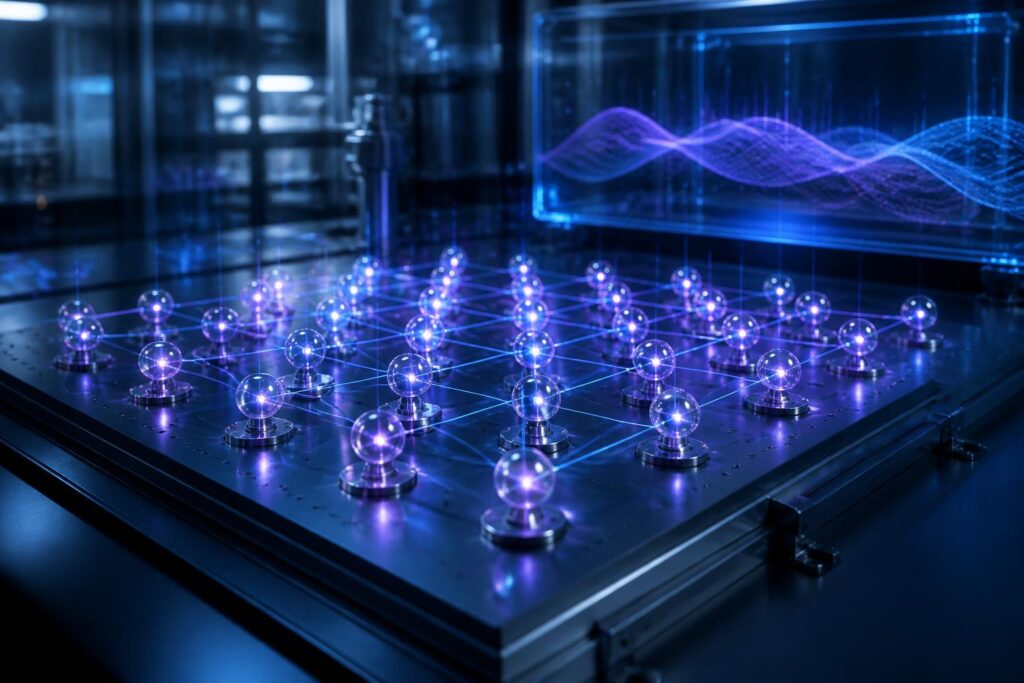
A quantum computer may rely on computational principles that differ fundamentally from those of a traditional computer, but it must also contend with a familiar problem: errors. The difference is that errors in quantum systems are far more difficult to detect and correct. A conventional bit can exist only in the state 0 or 1, whereas a qubit can exist in a state of superposition and become linked to other qubits through quantum entanglement. Even a minor disturbance from the environment, an imprecise control pulse, or a deviation in the device can alter the state that must be preserved.
That is why quantum error correction is not an optional feature added after a machine has been built, but a foundation that determines how well a quantum computer can operate in practice. Without effective error control, a system can perform only short computational circuits before noise overwhelms the result. With effective control, physical qubits can be organized into more stable logical qubits, opening the way to long computations and applications that demand high accuracy.
Why Are Qubits Prone to Errors?
A qubit is a specific physical system, such as a superconducting circuit, a trapped ion, a neutral atom, or another structure capable of representing two energy levels. To perform computations, the system must control these levels using highly precise signals. However, a qubit does not exist in complete isolation from its environment. Heat, vibrations, electromagnetic noise, fluctuations in components, and unintended interactions can all degrade quantum information.
One type of problem is the loss of quantum coherence, commonly known as decoherence. A superposition state or the entangled relationship between qubits gradually disappears as the system interacts with its environment. When this happens, the computer can no longer maintain the state required by the algorithm. Another type is control error, which occurs when a quantum gate fails to transform a state by exactly the expected amount or for the expected duration. The readout can also be wrong, even when the preceding operations have taken place with relative accuracy.
These errors do not necessarily appear as an obvious malfunction. In a traditional computer, a bit flipped from 0 to 1 can be checked by comparing it with a copy. With a qubit, directly measuring it usually changes the state and destroys the superposition information being processed. Therefore, an error-correction method must detect signs of an error without directly measuring the entire quantum state.
Qubits Cannot Be Copied for Redundancy
In a traditional system, data can be copied many times. If a bit becomes corrupted, the circuit can use the majority principle to recover the original value. For example, information representing 0 can be stored as three bits, 000. If one bit flips to produce 010, the other two bits still indicate that the intended value was 0.
This approach cannot be applied directly to qubits because the no-cloning theorem states that an unknown quantum state cannot be copied perfectly onto another qubit. This is not a limitation caused by current technology being insufficient, but a fundamental feature of quantum mechanics. Even if one attempts to create multiple similar copies, the system may still lose the superposition or quantum entanglement that needs to be protected.
Instead of copying the state, quantum error correction distributes the information of a logical qubit across multiple physical qubits through a quantum code. The physical qubits do not hold independent copies in the conventional sense. Together, they form a structured state space in which special measurements, called syndrome measurements, can indicate where an error occurred or what type it was without directly revealing the quantum value being stored.
Physical Qubits and Logical Qubits
A physical qubit is an element that actually exists in the hardware. It may be a circuit, an ion, an atom, or another platform. A logical qubit is an information unit encoded using multiple physical qubits in order to reduce the impact of errors. This distinction is important because the number of qubits announced for a system does not by itself fully indicate that system’s capacity for reliable computation.
A machine with many physical qubits that quickly lose coherence may still be capable of performing only short circuits. Conversely, a system may need to use many physical qubits to create a higher-quality logical qubit. This additional resource is not wasteful in the simple sense. It is a necessary cost of detecting, tracking, and reducing errors during operation.
During a computation, the controller may continuously measure the code’s error syndromes. These measurements do not reveal whether the logical state is 0 or 1, nor do they directly disclose the amplitudes of the superposition state. They provide only information about inconsistencies among the physical qubits. From the sequence of syndromes, a classical system can infer the likely errors and choose an appropriate correction operation, or record that information for decoding at the end of the circuit.
Surface Codes and the Error-Threshold Principle
One widely studied approach is the surface code. In this arrangement, qubits are organized in a two-dimensional structure and linked to repeated syndrome measurements. The goal is to turn local errors, such as an error occurring on a qubit or a connection, into signs that can be tracked across space and time.
Surface codes are attractive because they can be implemented using local interactions, making them compatible with the requirements of many hardware architectures. However, they do not automatically make a quantum computer immune to errors. The code’s effectiveness depends on qubit quality, gate accuracy, readout capability, the speed of syndrome measurements, and the way the decoder processes the data. A practical system must also deal with correlated errors, in which multiple elements are affected at the same time, rather than with entirely independent errors.
The concept of an error threshold is commonly used to describe the conditions required for fault-tolerant computation. If the error rate of basic operations is below a certain level and the assumptions about errors are consistent with the model, expanding the code can reduce the error rate of logical qubits. Conversely, when physical errors are too high, adding qubits only makes the system more complex without producing more reliable logical qubits. This threshold is not a single number that applies to every machine, because it depends on the type of code, the architecture, the noise model, and the control process.
The Challenge Is Not Only the Number of Qubits
In discussions of quantum computers, the number of qubits often receives attention because it is easy to compare. But evaluating progress in error correction requires looking at many factors at the same time. A logical qubit needs a sufficiently long coherence time, a low error rate, accurate measurements, and the ability to perform logic gates without damaging the code. The system must also have a controller that operates quickly, because slow measurement and feedback can allow errors to continue spreading.
The ability to connect qubits is another factor. An error-correction code may require specific interactions between neighboring elements. If the hardware does not support those connections, the machine must use additional intermediate operations, making the circuit longer and increasing the chances of errors occurring. Similarly, data input and output must be designed to work appropriately with the code, rather than being treated as steps separate from the computation.
The resource burden also comes from software. The decoder must convert error syndromes into correction decisions within an appropriate time. As the system grows, the amount of syndrome data increases, and processing it can become demanding. This creates a need for coordination among code design, control hardware, classical electronic circuits, and decoding algorithms.
From Small Experiments to Fault-Tolerant Machines
The path to building a fault-tolerant quantum computer usually does not proceed through a single leap. Development teams must successively demonstrate that qubits can be manufactured consistently, that quantum gates can operate with low error, that syndrome measurements can be repeated, and that increasing the size of the code genuinely improves the quality of logical qubits. Each stage may reveal a new form of noise that small-scale experiments had not exposed.
It is important to distinguish between demonstrating error correction and operating a fully fault-tolerant machine. An experiment may show that a code has detected certain errors or that a logical qubit performs better than a physical qubit under a particular set of conditions. But a truly fault-tolerant machine must maintain that advantage over many cycles, support universal logic gates, and scale without allowing resource costs to rise beyond the system’s capabilities.
Positive results in this field therefore need to be considered alongside the experimental conditions. An improvement in the lifetime of a logical qubit is an important signal, but it does not mean that every useful quantum algorithm is ready. There remains a significant gap between a high-quality logical qubit and a computer with enough logical qubits to solve large problems.
Why Does Quantum Error Correction Matter to Users?
End users may not directly see the error-correction codes, but they will benefit from more reliable results. Problems such as simulating physical systems, analyzing chemistry, or performing optimization may require a large number of consecutive operations. If each operation increases the probability of an error, the final result will quickly lose its value. More stable logical qubits help extend computational circuits and reduce the need to guess or correct results using uncertain methods.
Error correction also affects how quantum software is developed. Developers must not only find algorithms that can run on a current device, but also account for the cost of encoding, the number of physical qubits, and the circuit depth. Algorithms suited to a machine without complete error correction may be very different from algorithms intended for a fault-tolerant machine of the future.
In the long term, progress in error correction may be a more practical measure of quantum-computing capability than simply increasing the number of physical qubits. A smaller system that produces stable, scalable logical qubits would have greater technical significance than a system with many qubits but poor error control.
Conclusion
Quantum error correction is the central problem connecting quantum theory with a machine that can operate reliably. Qubits are sensitive, cannot be copied in the conventional way, and are easily affected by both the environment and control hardware. Quantum codes, syndrome measurements, logical qubits, and decoders form a multilayered system intended to keep information from being lost too quickly.
Success in this field will not be determined by a single qubit count. It depends on reducing physical errors, demonstrating benefits as codes are scaled up, building controllers and decoders that are fast enough, and ensuring that the entire architecture can grow in scale. When these conditions are met, quantum computers will have a chance to move from limited demonstrations to long, complex computations with practical value.
