


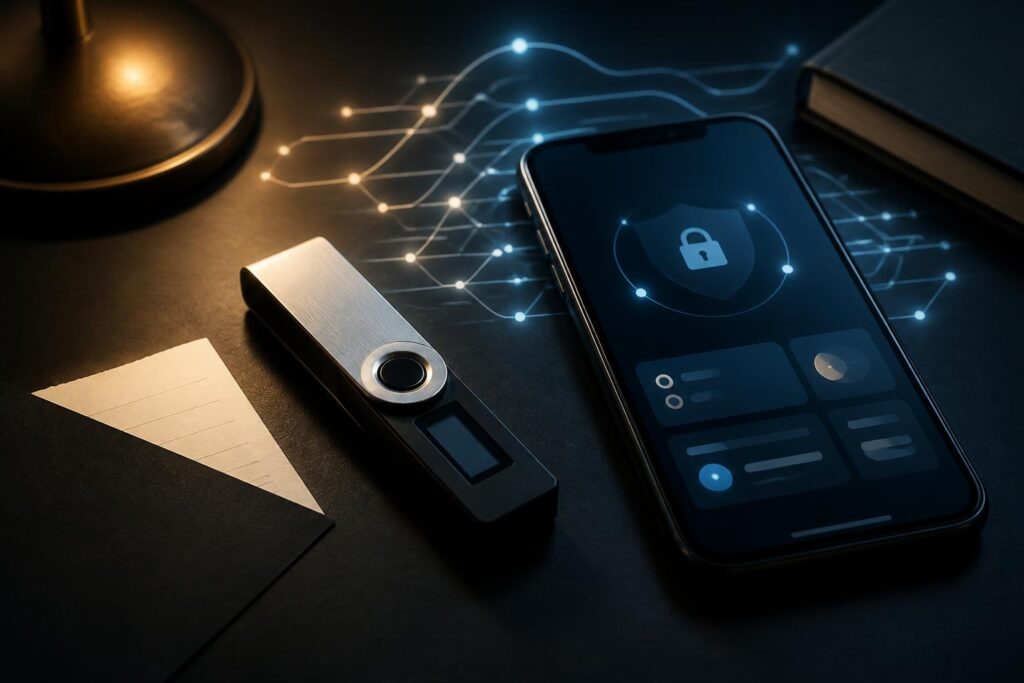
In the blockchain ecosystem, the phrase “cryptocurrency wallet” often leads newcomers to imagine a place where coins are stored in much the same way as in a physical wallet. This image is convenient but not entirely accurate. Assets on a blockchain are recorded as data by the network, while a wallet is primarily a tool that helps users create addresses, sign transactions, and prove control over those assets. Therefore, what matters most is not the application open on a phone or the hardware device sitting on a desk, but how cryptographic keys are created, protected, and used.
Understanding this mechanism correctly helps users avoid several common misconceptions. Losing a phone does not necessarily mean losing assets if the recovery information remains protected. Conversely, an application continuing to display a balance does not mean the assets are certainly safe if the private key has been exposed. In practice, many risks arise from users granting malicious parties the authority to sign transactions, storing sensitive information in unsuitable places, or failing to distinguish official wallets from counterfeit software.
What Does a Blockchain Wallet Actually Do?
Each blockchain wallet typically creates or manages a pair of pieces of information consisting of a private key and a public key. From the public key, the system can generate an address for receiving assets. This address can be shared when receiving funds, similar to providing account information so that someone else can transfer money. However, knowing the address does not allow another person to move the assets out at will. The authority to conduct transactions lies with the corresponding private key.
When a user sends assets, the wallet creates a transaction and uses the private key to generate a digital signature. The network verifies that signature before accepting the transaction. This mechanism allows the blockchain to determine that the sender has the right to use the assets without revealing the private key to other nodes. In other words, the wallet does not send the private key to the blockchain. The wallet uses the key to prove control, while the network records the result of the transaction after the transaction meets the necessary conditions.
This explains why access to a wallet can be restored on another device if the user still has the appropriate recovery information. The application is merely an interface for accessing the keys and data on the network. However, this does not mean that all recovery procedures are the same across wallet types. Users should read the instructions for the wallet they are using carefully and should not enter a recovery phrase into another application simply because they are asked to do so in an unexpected notification.
Private Keys and Recovery Phrases Are Not Ordinary Information
A private key is a string of confidential data capable of creating signatures for transactions. Anyone who possesses a private key can generally control the assets associated with that key, depending on the rules of the network and the type of asset involved. Therefore, a private key should not be sent by email, text message, online form, or support chat. A legitimate support employee also does not need a user to provide a private key to check a balance or handle an ordinary issue.
Many modern wallets use a recovery phrase consisting of a group of words generated when the wallet is set up. This phrase can help recreate keys within the same wallet structure, but users should not assume that every phrase can recover every type of wallet. Recovery also depends on the standard used by the wallet, the supported network, the order of the words, their exact spelling, and sometimes an additional setting chosen by the user. A small mistake when recording the phrase can cause the recovery process not to lead to the original address.
A recovery phrase should be recorded in a way that allows it to be checked without creating unnecessary additional copies. Saving a screenshot, putting it in cloud storage, or pasting it into a note-taking application may allow the information to be accessed through an online account, malware, or a compromised device. Writing it on paper is not an absolute solution either, because paper can be lost, damaged by water, or seen by someone else. The goal is to create a storage method that balances resistance to unauthorized access with the ability to recover in the event of a problem.
Three Common Approaches to Using Wallets
Software wallets on phones or computers are often convenient for everyday transactions. They are easy to install, make it easy to check balances, and are suitable for funds that users need to access regularly. In return, the keys may be affected by the security of the device, operating system, browser, and other installed applications. An unlocked phone, a computer infected with malware, or the accidental installation of a fake extension can all increase risk.
Hardware wallets store keys in a specialized device and typically require users to confirm actions directly on the device. This approach can reduce dependence on the computer or phone environment, but it does not eliminate risk entirely. Users can still be tricked into signing a transaction with unfavorable terms, downloading associated counterfeit software, or exposing their recovery phrase. A hardware device is only one layer of protection, not a guarantee that replaces careful checking habits.
Wallets managed by third parties allow users to log in and transact through a platform. In this model, users may not directly hold the private keys. The advantage is that the process is usually simpler and may include additional account support and recovery mechanisms. The disadvantage is that access to the assets depends on the platform, verification procedures, service availability, and terms of use. Users need to clearly distinguish between holding assets on a platform and managing the keys themselves, because the two models involve different levels of responsibility and risk.
Risks Often Begin with Transactions, Not Only with Lost Devices
Many people focus on protecting their recovery phrase but overlook another risk: signing the wrong transaction. In blockchain applications, users may be asked to connect their wallet to a service, allow a smart contract to perform certain actions, or transfer assets to an address. An attractive interface and a familiar project name are not enough to prove that a request is safe. A fake website can cause users to sign something entirely different from their original intention.
Before confirming, users should check the domain name, the connected application, the receiving address, the type of asset, the amount, and the permissions being granted. If they do not understand a request, they should not sign merely because a notification says that the transaction is about to expire or that the account is experiencing a problem. Messages that create a sense of urgency often cause users to skip the checking process. When they discover that an access permission is no longer needed, users can learn about the appropriate revocation mechanism for the network and application they are using, rather than continuing to leave that permission in place indefinitely.
Blockchain addresses also need to be checked carefully. Copying an address from transaction history can cause confusion if the device has been tampered with or if the user looks only at part of the beginning and end of the character string. For important transactions, the entire address should be compared on the sending and receiving screens, and a small test amount should be sent first if circumstances permit. Blockchain transactions are often difficult to reverse once confirmed, so a few seconds of checking can be far more valuable than the effort required to deal with the consequences.
Establishing Wallet Management Principles for Families and Individuals
New users should begin by identifying their purpose for using a wallet. Funds intended for frequent transactions can be separated from funds that need to be held for a longer period. This separation reduces the likelihood that an incident during everyday activity will affect all assets. Each wallet should also have a clear name and scope of use so that users do not accidentally connect a wallet containing important assets to unverified services.
Devices used to manage wallets should be updated, protected with sufficiently strong passwords, and equipped with appropriate security layers. Applications should be downloaded from official sources announced by the provider, but users should still carefully check the developer’s name and any unusual signs. Do not install remote-control software at the request of someone claiming to be support staff. Nor should you enter a recovery phrase into a website simply because it uses familiar images or brand names.
Families can agree on an incident-response process without publicly sharing sensitive information. This process may include how to identify the primary device, where recovery records are stored, who is allowed to access them in an emergency, and how to check the integrity of the information. For significant assets, consulting a legal professional or an independent security adviser may help a family consider issues involving inheritance, authorization, and management responsibilities. These decisions depend on specific circumstances and should not be handled with a single template for everyone.
Control Comes with Responsibility
Managing keys yourself provides greater control, but it also shifts most of the responsibility for protection to the user. No help desk can reissue a private key that has been deleted, and not every mistaken transaction can be canceled. This does not mean users must avoid blockchain entirely; rather, it shows that the technology should be approached with the same caution used when managing an important financial account.
A practical approach is to learn through small transactions, document the process, check each step, and increase the level of use only after understanding the basic operations. A blockchain wallet should not be judged solely by the number of features or the attractiveness of its interface. A suitable tool is one that helps users recognize what they are signing, control their recovery information, and maintain a reasonable backup plan. When users understand the relationship between addresses, private keys, signatures, and transactions, they will have a stronger foundation for protecting themselves in a system where control is always tied to personal responsibility.
