


In discussions about quantum computers, attention often focuses on the number of qubits, processing speed, or the problems these machines may solve in the future. However, a more fundamental question determines the development potential of the entire field: how can quantum information be kept from becoming corrupted before a computation is complete?
This is a particularly difficult challenge because qubits, the basic units of information in quantum computers, are highly sensitive to their surroundings. Heat, vibrations, electromagnetic noise, inaccuracies in control pulses, and unintended interactions with measurement devices can all alter a qubit’s state. At the same time, directly observing a qubit to check for errors can destroy the very quantum state that the system is trying to protect. Quantum error correction emerged from this paradox: protecting information without measuring it in a way that destroys the information.
Why Are Qubits More Error-Prone Than Classical Bits?
In conventional computers, a bit is represented by 0 or 1. Digital circuits can be designed to withstand a certain level of noise, while checking and backup mechanisms help detect or restore corrupted data. A qubit can also be measured to produce 0 or 1, but before measurement, it can exist in a superposition of these two possibilities. Many quantum systems also rely on entanglement between qubits to perform computations.
The very properties that give quantum computers their power also make error correction difficult. A small environmental disturbance can degrade superposition, causing a phenomenon commonly known as quantum decoherence. Qubits can also experience different types of errors during initialization, control, state transfer, or result measurement. Even a slightly inaccurate quantum gate can propagate deviations into subsequent steps.
The problem cannot be solved by simply copying a qubit exactly and using a backup copy, as in many classical systems. The fundamental principles of quantum mechanics do not allow an unknown quantum state to be copied arbitrarily. Researchers must therefore encode information into a group of physical qubits in a way that allows signs of errors to be detected without requiring knowledge of the entire stored state.
Physical Qubits and Logical Qubits
A physical qubit is an element that is actually created and controlled in hardware, such as a superconducting circuit, a trapped ion, or another physical platform. These qubits directly carry out computations, but every qubit has some probability of experiencing an error. Their stability depends on fabrication technology, control-system design, the operating environment, and calibration methods.
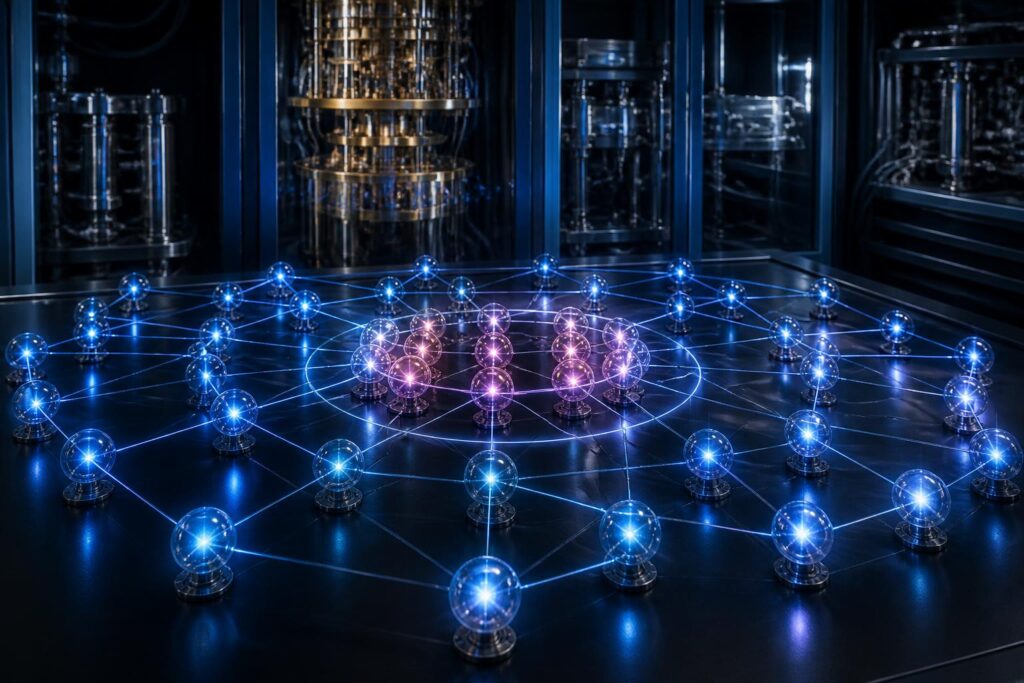
A logical qubit is quantum information encoded across multiple physical qubits. The core idea is to distribute a quantum state across the group and then measure check quantities to determine whether an error has occurred. These measurements are not intended to reveal the secret value of the logical qubit. They provide a type of indicator, often called an error syndrome, showing how the encoded structure has been disrupted.
From the error syndrome, the control system can infer an appropriate correction operation. Correction may sometimes be performed by acting directly on the qubits, but it can also be handled at the software and control-system level by tracking the history of errors. The goal is not to make every physical qubit perfect, which is nearly impractical, but to make the error probability of a logical qubit lower as the scale of the encoding increases.
How Do Quantum Error-Correcting Codes Work?
There are many ways to construct quantum error-correcting codes, each with different requirements for the number of qubits, hardware connectivity, and measurement capabilities. Some codes distribute information across a network of qubits, with check measurements repeated over time. The results of these measurements form data for a decoder to analyze, allowing it to estimate the likely location or type of error that has occurred.
An important point is that a syndrome measurement does not necessarily reveal whether the logical state is 0 or 1. It only checks relationships among the qubits in the code. This can be understood as checking the consistency of a system rather than opening up all of its internal contents. If those relationships change, the system can detect signs of an anomaly while preserving the quantum information at the logical level.
In practice, errors do not occur only on individual qubits. Errors can arise in gates, measurements, initialization processes, or across multiple related qubits. Therefore, an error-correcting code must be evaluated together with the entire operating sequence, rather than by looking only at a single accuracy figure for an individual qubit. The decoder is also an important component. If syndrome data cannot be analyzed quickly or accurately enough, error detection will not keep pace with the computation.
Error Thresholds and the Challenge of Scaling
The concept of an error threshold is commonly used to describe the condition under which increasing the scale of encoding can make logical qubits more reliable. If errors in the physical components remain within a suitable range and the assumptions of the code are satisfied, adding more error-correction resources can reduce the probability of logical errors. This is the foundation of the idea of a fault-tolerant quantum computer.
However, an error threshold is not a promise that all problems will disappear once a particular number is reached. Theoretical results are often based on specific assumptions about error types, the degree of correlation between errors, connection structures, and controller capabilities. Real hardware may exhibit correlated errors, time-varying errors, or phenomena that have not been fully modeled. As a result, demonstrating error-correction capability in a specific experiment requires more than a single measurement with a favorable result.
Resource costs are also a major barrier. A logical qubit may require many physical qubits along with control lines, cooling systems, measurement equipment, and decoding software. When an algorithm needs many logical qubits and performs numerous gates, hardware requirements can increase very rapidly. This is why the reported number of qubits cannot, by itself, indicate how close a quantum computer is to practical applications.
From Experimental Demonstrations to Useful Systems
At the current stage, the development of quantum error correction is advancing simultaneously at multiple levels. At the physical level, research groups are seeking to build more stable qubits, reduce noise, and improve measurement accuracy. At the architectural level, they are designing ways to connect qubits so that the necessary checks can be performed without requiring overly complex hardware. At the algorithmic level, developers are studying methods that use resources more efficiently and reduce the number of unnecessary gates.
A reliable system also needs mechanisms for continuous operation. Error correction is not a step performed only once before or after a computation; it generally has to take place throughout the storage and processing of information. This creates requirements for data-reading speed, controller response time, and coordination between quantum hardware and classical computers. Classical computers can handle syndrome analysis, control scheduling, and monitoring of the system’s state.
When evaluating the technology, it is important to distinguish between creating a logical qubit, demonstrating that it is more stable than a physical qubit, and building a system capable of running a long algorithm. These three goals are related but not identical. An experiment showing the ability to reduce errors is an important signal, but many further steps are still needed to achieve a system with sufficient scale, speed, and reliability for complex problems.
Implications for the Future of Quantum Computing
Quantum error correction is not an auxiliary feature added after the hardware is complete. It affects the choice of qubit platform, the arrangement of connections, the design of the control system, and the development of software from the outset. A qubit technology with high accuracy but difficult connectivity may face different limitations from a technology with many qubits but greater error-correction requirements.
For users and businesses, this also serves as a reminder that quantum computers should not be evaluated merely through the image of a machine that is faster than today’s computers. Their value depends on the ability to perform quantum computations that are sufficiently long while still producing reliable results. If errors accumulate too quickly, the theoretical advantage of an algorithm will not translate into useful outcomes.
In the long term, a fault-tolerant quantum computer could expand the range of problems being studied, from simulating quantum systems to certain optimization or cryptographic problems. But those applications will also depend on many other conditions, such as algorithm design, input data, operating costs, and the ability to verify results. Error correction is a foundational requirement, not the only guarantee of success.
Conclusion
Quantum computers can become reliable computing tools only when quantum information is protected better than any individual physical qubit can provide on its own. By encoding a logical qubit into multiple physical qubits, tracking error syndromes, and coordinating hardware with decoders, error-correction technology is seeking to transform a sensitive system into a scalable platform.
This path still presents many challenges, from reducing physical errors and handling correlated errors to controlling resource costs. Nevertheless, quantum error correction has established an important standard for assessing progress in the field: the question is not only how many qubits a machine has, but how many logical qubits it can keep operating accurately, for how long, and with what level of resources.
