


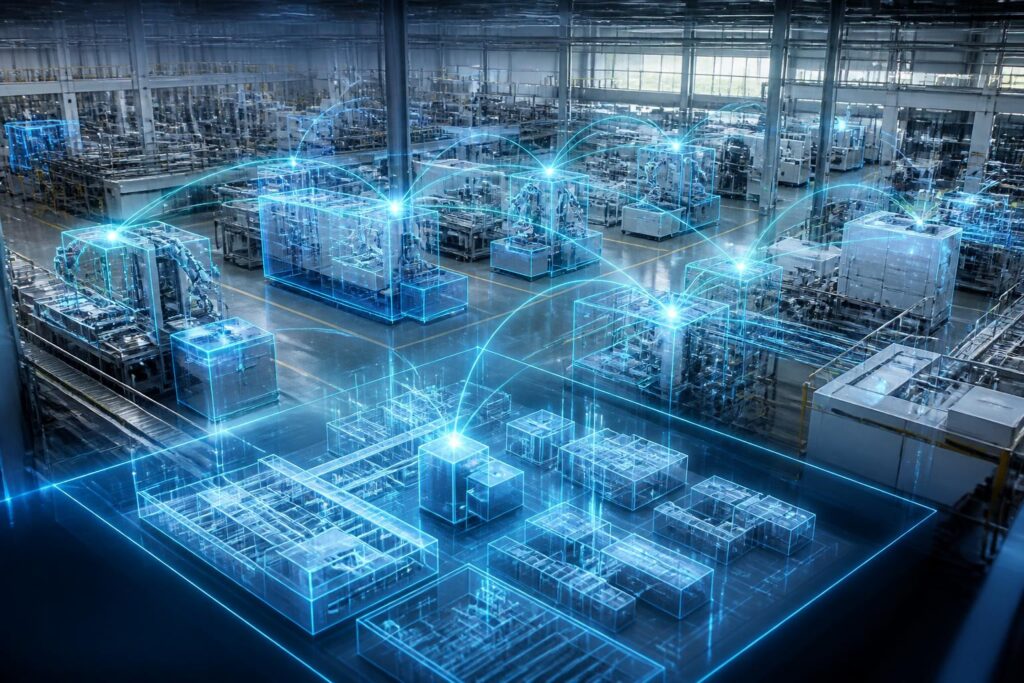
For many years, businesses and regulatory agencies have had to rely on reports, drawings, spreadsheets, or on-site inspections to understand how a factory, building, or infrastructure system is operating. These methods remain necessary, but they usually provide only a snapshot at a particular moment. As operations become more complex, the need for continuous monitoring and for testing options before intervening in a real system is becoming increasingly clear. This is the context in which digital twins have attracted attention.
A digital twin is not simply an attractive three-dimensional model on a screen. Essentially, it is a digital model linked to a real-world object, process, or system through data. The model may reflect the current state, operating history, and, in some cases, the ability to respond to different scenarios. This gives users an additional space in which to observe, analyze, and make decisions without necessarily having to act immediately on the real asset.
How Is a Digital Twin Different from a Conventional Simulation Model?
A conventional digital model can be built in advance to describe the structure of a machine, building, or process. It is useful for design and training, but it is not necessarily updated when the real-world object changes. Digital twins are distinguished by their continuous or periodic connection to real-world data. Sensors, management systems, maintenance logs, and operational data sources can provide information that allows the model to reflect a more up-to-date condition.
This connection does not mean that a digital twin always perfectly matches the real world. Data may be incomplete, sensors may be inaccurate, and a model must always simplify part of reality in order to be processed. Therefore, a digital twin should be viewed as a tool for understanding and predicting a system, not as an absolute replica. Its value depends on data quality, how the model is built, and the user’s ability to interpret it.
Applications in Factories
In manufacturing environments, digital twins can be built at multiple levels. A business may start with a critical piece of equipment and then expand to a production line or an entire process. Depending on the type of machine and management objectives, the model may receive information about operating time, temperature, vibration, energy consumption, or repair history.
One frequently mentioned application is predictive maintenance. Instead of repairing equipment only after it breaks down or replacing components according to a fixed schedule, a business can monitor unusual signs and assess the risk of deterioration. When a piece of equipment shows behavior that differs from its normal operating state, the technical team can inspect it earlier. This approach does not eliminate the need for direct inspections, but it makes inspections more focused and reduces reliance on guesswork.
Digital twins also support the testing of process changes. For example, before adjusting the speed of a stage or rearranging the movement of materials, an operations team can simulate scenarios in a digital environment. Simulation results are not an absolute guarantee, but they can help identify bottlenecks, resource conflicts, or unexpected impacts before a change is implemented in the factory.
During the design stage, a digital model can also help engineering teams communicate using a shared source of information. Design, production, maintenance, and management departments can see different aspects of the same system. If the data is well organized, the handover from design to operations can also be clearer, especially for assets with long life cycles.
From Buildings to Urban Infrastructure
The scope of digital twins does not stop at factories. In construction, a building information model can provide a foundation for tracking an asset throughout its life cycle, from design and construction to operation. When combined with data on electricity consumption, air conditioning, elevators, or equipment condition, the model can help managers identify areas operating inefficiently and consider adjustment options.
At the urban scale, the problem becomes more complex because multiple systems are interconnected, including transportation, water supply and drainage, energy, public facilities, and the environment. A digital urban model can help authorities visualize the effects of planning or operational options. For example, a change in traffic organization can be considered together with its effects on neighboring roads, rather than being assessed only on a single road segment.
However, it should not be assumed that simply creating a three-dimensional map means a city has a digital twin. An operationally valuable model requires updated data, connectivity standards between systems, and mechanisms for determining which data is reliable. It also needs clearly defined limits: what issues the model is used to monitor, what decisions it supports, and what conclusions it must not be used to draw beyond the capabilities of the data.
Conditions That Determine Effectiveness
The first condition is that the objective must be specific. A project that begins with the question “Can we build a digital twin?” can easily become focused on collecting large amounts of data without knowing what it will be used for. A more practical question is whether the business wants to reduce downtime, improve energy consumption, shorten inspection processes, or support design. The clearer the objective, the easier it is to control the scope of the data and model.
The second condition is connectivity. Data within an organization is often spread across multiple systems with different formats and rules. Older equipment may not have been designed to transmit data continuously, while newer software may use its own organizational approach. If data sources cannot exchange information or cannot be reconciled, the digital twin will quickly lose consistency.
Data quality is no less important than quantity. A large volume of unchecked data can lead users to draw incorrect conclusions. It is necessary to know when the data was generated, which equipment it came from, what units of measurement were used, and whether there were any interruptions. Data governance processes must therefore accompany the project from the beginning, rather than being added only after the system is already operating.
The human factor is often underestimated. Technical staff need to understand what the digital twin is reflecting, which alerts deserve attention, and when an on-site inspection is required. Managers must also avoid treating every model prediction as an automatic command. Technology creates value only when it is placed within an appropriate workflow, with someone responsible for verification and with feedback mechanisms for improving the model.
Risks Related to Data and Operational Safety
Connecting multiple devices and systems increases the attack surface that needs to be protected. Operational data may reveal information about production capacity, maintenance schedules, or the condition of infrastructure. If access rights are not allocated appropriately, people without relevant duties may still be able to view or alter important data. A digital twin therefore needs to be designed together with authentication, authorization, logging, and backup measures suited to the sensitivity of the system.
Another risk comes from excessive dependence on the model. If input data is faulty but no warning is issued, a digital twin may create a false sense of accuracy. In activities related to safety, final decisions should be based on multilayered inspection procedures. A digital model should help people detect problems earlier, rather than become a reason to overlook inspection regulations or on-site experience.
Start Small Instead of Beginning Too Big
For many organizations, a reasonable approach is to select an asset or process with clear value for a pilot project. The initial project may focus on connecting data, checking sensor reliability, and establishing a feedback process. After the practical benefits have been identified, the organization can expand the model to other areas.
A phased implementation helps reduce costs and avoid building an overly complex system before users understand how to operate it. It also creates an opportunity to standardize terminology, data standards, and responsibilities across departments. As the project expands, experience from the smaller project will help the organization determine what can be reused and what needs to be designed specifically.
The Outlook for Digital Twins
Digital twins are becoming a layer connecting data, engineering models, and operational decisions. In the future, the value of the technology may lie less in visual displays than in its ability to help teams see relationships among multiple variables, compare scenarios, and detect unusual signs earlier. This is especially useful for systems in which changes are costly or difficult to test directly.
Even so, a digital twin is not an automatic solution to every problem. It cannot compensate for unreliable data, weak processes, or unclear objectives. Success requires coordination among sensor technology, software, data governance, and specialized knowledge. When built with an appropriate scope, clear controls, and a connection to practical needs, a digital twin can help factories and cities operate more proactively while creating a foundation for evidence-based decisions rather than decisions based solely on reactions after incidents occur.
