


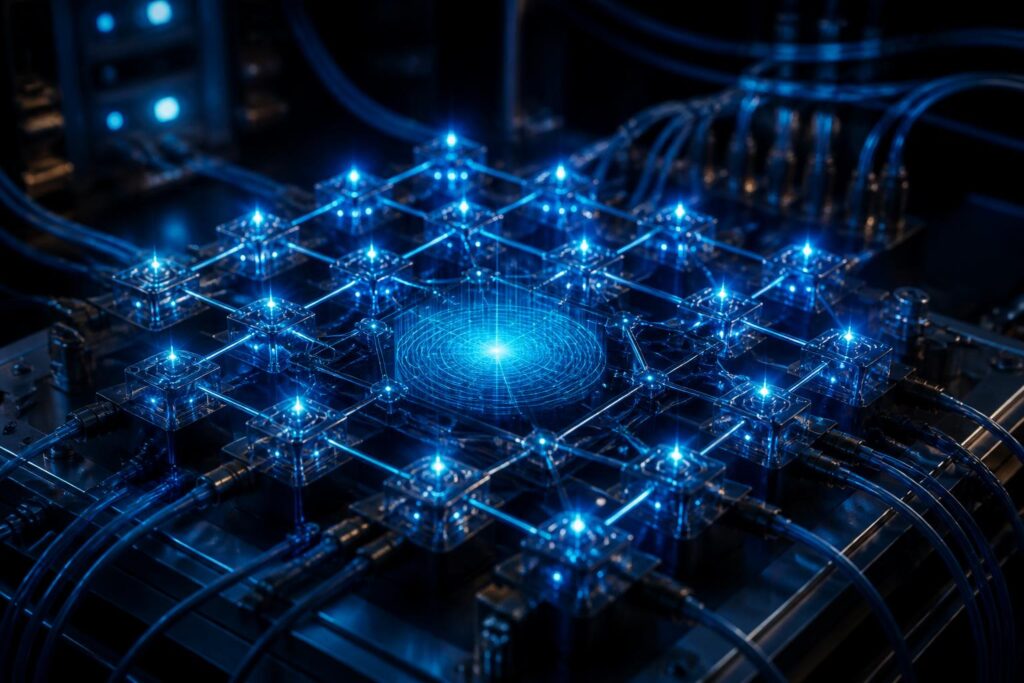
In discussions about quantum computers, attention often focuses on the number of qubits, processing speed, or the problems that a future system might solve. However, a more fundamental question determines how far quantum computers can go: how can quantum information be kept from being corrupted throughout the computation process?
A qubit, the unit of information in a quantum computer, is not like a classical bit that can only take the value 0 or 1. It can exist in a state of superposition and become linked to other qubits through the phenomenon of entanglement. These characteristics create special computational potential, but they also make qubits vulnerable to environmental effects, control inaccuracies, and errors that arise during measurement or the execution of quantum gates. Therefore, quantum error correction is not an additional feature to be added at the final stage, but a part of a quantum computer’s architecture from the beginning.
Why are quantum errors more difficult to handle than classical errors?
In classical computers, data can be copied into multiple versions. If a bit is flipped from 0 to 1, the system can use the copies to check and restore the original value. This approach cannot be directly applied to qubits. The no-cloning theorem in quantum mechanics states that it is impossible to create a perfect, independent copy of an unknown quantum state.
The difficulty also lies in the fact that a quantum error is not merely a qubit being flipped from 0 to 1 or vice versa. A qubit’s state can undergo a phase change, destroying the relationship needed between the components of a superposition state. A system can also experience multiple types of errors simultaneously, including errors affecting amplitude, phase, or the connections between qubits.
Directly observing a qubit’s state to find an error is also not simple. Measuring a qubit usually changes its state and can also destroy the information being stored by the computation. Quantum computers therefore need an indirect method: measuring auxiliary information about errors without reading out all of the quantum data.
From physical qubits to logical qubits
An important concept in quantum error correction is the distinction between physical and logical qubits. A physical qubit is an actual element created using a specific hardware technology, such as superconducting circuits, trapped ions, neutral atoms, or other platforms. It is directly affected by heat, vibration, radiation, electromagnetic noise, control-pulse errors, and the limitations of measurement equipment.
A logical qubit is a unit of information encoded across multiple physical qubits. The goal of this encoding is to allow the system to detect and correct certain errors without exposing the logical state being protected. In other words, a logical qubit is not a single component. It is an information structure distributed across multiple physical elements, together with check measurements and error-processing procedures.
This creates a clear trade-off. To obtain a more stable logical qubit, a system may need many physical qubits, additional control circuitry, and more time for rounds of checks. The number of qubits therefore cannot be assessed using only a single total. A machine with many physical qubits but a high error rate does not necessarily provide more useful computational capacity than a smaller system with better error control.
How do quantum error-correcting codes work?
A quantum error-correcting code typically distributes information across a group of qubits and adds qubits for checking. These check measurements are not intended to answer whether the logical state is 0 or 1. Instead, they indicate whether a certain relationship between the qubits remains valid. The results of these measurements are called error syndromes, helping the controller infer the likely location or type of error that has occurred.
This process must be repeated because errors can arise at any time. The system performs checks, collects the results, analyzes the sequence of syndromes, and applies a correction operation or updates how the data is interpreted. In some architectures, error correction does not necessarily require immediately reversing the state. The machine can track information about the error and then incorporate that information into subsequent processing steps.
One family of codes frequently discussed in research is the surface code. This code arranges qubits in a lattice-like structure and uses local checks between neighboring elements. The advantage of this approach is that it is compatible with hardware whose connections are close together, although it still requires a substantial number of qubits, measurements, and control capabilities. The surface code is not the only solution, but it clearly illustrates how quantum information can be protected through redundancy without directly copying the state.
Error thresholds and the significance of scaling
In quantum error-correction theory, an important idea is the error threshold. If the error rate of basic operations is below a certain level and suitable technical conditions are met, increasing the size of the code can reduce the error rate of logical qubits. Conversely, if the hardware is too noisy, adding physical qubits may not improve the system and may instead make the control process more complex.
The error threshold is not a single number that applies to every quantum computer. It depends on the type of code, the error model, the way qubits are connected, measurement quality, calibration capabilities, and the method used to implement the algorithm. Therefore, the claim that surpassing a particular hardware milestone is all that is needed to build a fault-tolerant quantum computer is an overly simple view. The practical challenge is to maintain a coordinated technical ecosystem in which operations, measurements, and controllers all meet the requirements of the code being used.
Obstacles beyond increasing the number of qubits
The first obstacle is qubit quality. A qubit can lose its coherence after a finite period, while a computation may require many consecutive steps. Two concepts that are often considered are coherence time and the accuracy of quantum gates. A qubit with a long coherence time can still cause errors if its control gates are inaccurate; conversely, excellent gates are not enough if the state deteriorates too quickly to support deep circuits.
The second obstacle is measurement. Error correction requires knowledge of the error syndrome, but measurements must be fast and accurate enough without creating too much additional noise. If measurement results are incorrect, the decoder may make the wrong correction decision. As the number of qubits increases, the amount of monitoring data also grows, requiring data-processing and data-transmission hardware with low latency.
The third obstacle is connectivity. Many error-correcting codes work most effectively when qubits can interact according to a particular pattern. In real hardware, creating long-range connections or controlling many qubits simultaneously can increase design complexity, wiring requirements, and sources of noise. Engineers must balance the code architecture, chip geometry, cooling or qubit-trapping systems, and the ability to scale production.
Finally, there are the control software and the decoder. Error correction is not solely a matter of quantum physics. The system needs algorithms for analyzing syndromes, control schedules, correction mechanisms, and resource-allocation methods. If the decoder processes data more slowly than new data is generated, the computer may be unable to keep up with the very process intended to protect it from errors.
Why does error correction change how quantum computers are evaluated?
In the early stages, a quantum system may be evaluated by its ability to execute short circuits on a given number of qubits. Such experiments have research value because they help test hardware and software. However, to solve practical problems with great depth, a machine must preserve information through a very large number of steps. At that point, the question is no longer whether the system can run a short circuit, but how long logical qubits can be stably protected and at what cost.
This perspective also changes how announcements about technological progress should be read. The number of physical qubits is a necessary indicator, but it is not sufficient. It is necessary to consider the error rates of gates and measurements, connectivity, coherence time, the number of logical qubits produced, the quality of the checks, and whether the system can already perform fault-tolerant logical operations.
For businesses and users, this means that the broad commercial impact of quantum computers may depend more on advances in reliability than on isolated demonstrations. A system with fewer logical qubits that operates stably may be more practically significant than a larger system whose results are difficult to reproduce.
Outlook and a realistic perspective
Quantum error correction does not promise to eliminate every mistake completely. The practical goal is to control errors at a level that allows the system to execute long algorithms with an acceptable probability of success. To achieve this, researchers must improve materials, qubit design, control techniques, measurement, error-correcting codes, and decoding software simultaneously.
This path may unfold in stages. First, the hardware must reach a sufficient level of quality for error-correcting codes to be effective. Next, the system must demonstrate that increasing the code size improves rather than degrades the quality of logical qubits. After that, logical qubits must be connected and operated as circuits useful for algorithms. Each step has its own requirements and cannot be replaced by a single promotional number.
For this reason, quantum error correction should be regarded as a measure of the maturity of the entire platform, not merely as a supporting technique. It shows that quantum computers are moving from demonstrating physical phenomena to building a computing machine that can operate reliably. Until this problem is solved at an appropriate scale, the potential of qubits will remain largely at the experimental level. When logical qubits can be protected effectively, the gap between theoretical promise and practical application will truly begin to narrow.
