


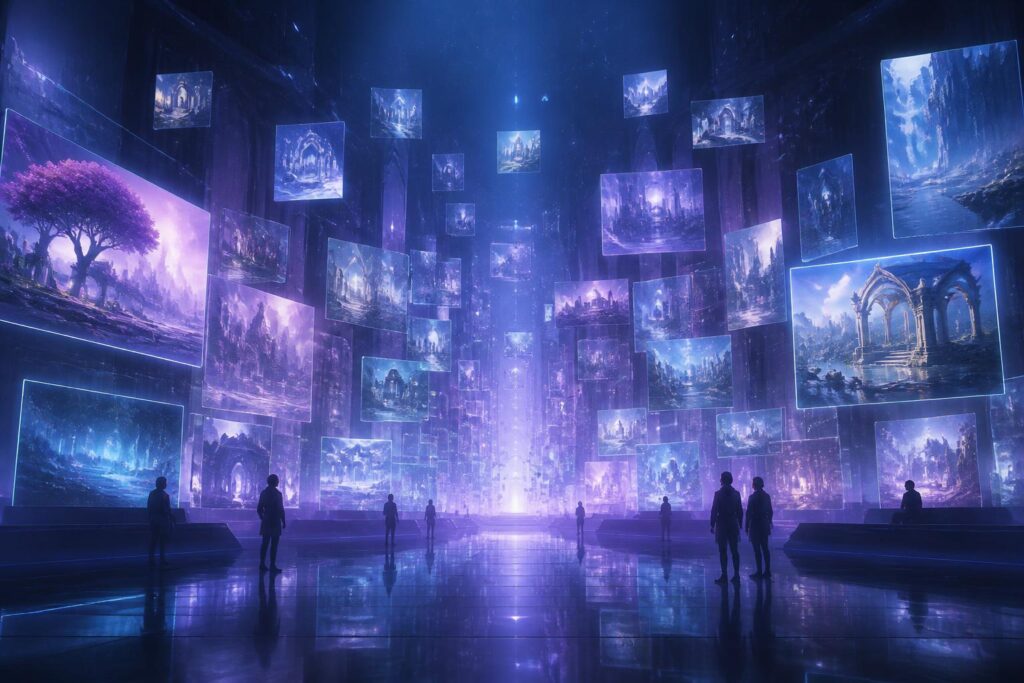
In the physical world, an old house, a photograph, a diary, or a familiar object can help people recover a part of the past. In digital environments, memories are often stored as accounts, images, audio recordings, virtual items, and interactive spaces that users once created together. They may seem easier to copy than everyday objects, but that does not necessarily mean they will exist longer. A single policy change, a server shutting down, or a platform closing can cause an entire community to lose the place where it kept its shared experiences.
This issue is particularly noteworthy in virtual worlds. They are not merely places that display three-dimensional images or allow users to control avatars. A virtual space can become an exhibition hall, a classroom, a stage, a meeting place for friends, or the site of events that participants consider meaningful. As part of life moves into such environments, the question “Who owns digital memories, and how can they be preserved?” is no longer a distant hypothetical.
When an Experience Is Not Contained in Just One Data File
On the surface, preserving a virtual world may seem like backing up a folder. However, the experience within it is often made up of many different layers. One layer consists of user data, such as character models, items, images, or structures they have created. Another belongs to the platform, including the operating software, interaction rules, account systems, and databases. Yet another is created by the community, such as communication language, meeting rituals, ways of organizing events, and stories understood only by participants.
If only an image of a virtual plaza is preserved, people may know what the place looked like but still not understand how it was used. A performance in a virtual environment consists of more than the stage and the characters appearing on it. The experience also lies in how the audience moved, talked, reacted, took photographs, and returned after the event. Therefore, preserving a virtual world is not simply a matter of keeping what is visible. It is also an effort to record the rules, behaviors, and relationships that gave the space meaning.
Dependence on a platform makes the problem even more complicated. A person may own the images or content they created, but they do not always have access to the source code, servers, or tools needed to recreate the entire setting. When a service changes its format or moves to a new system, old data may no longer function as it did before. A virtual item may still exist as a file, but without software that can read the correct format, it becomes little more than a difficult-to-use trace.
Barriers to Preserving Virtual Worlds
The first barrier is the interdependence of data. A virtual space is often connected to login systems, image servers, audio tools, payment mechanisms, and services provided by multiple entities. If just one link stops working, the overall experience may be disrupted. Copying part of the data to another location therefore does not necessarily create a functional replica.
The second barrier concerns ownership and privacy. A space built collectively by a community may contain content contributed by many people. It may include images, voices, designs, conversations, or personally identifying information. Long-term storage requires distinguishing between data that can be made public, data that may be used only within the community, and data that must be deleted upon request. Preservation cannot become a reason to retain everything without considering the rights of those who created or appeared in it.
The third barrier is the pace of technological change. Devices, browsers, and interaction protocols are constantly being updated. An experience that once worked reliably may become difficult to access on newer hardware. Even when the data file remains intact, the way light, sound, movement, or interaction is represented may also change. This creates a difficult choice: should efforts be made to recreate an old environment exactly as it was, or should it be converted to new technology so that more people can continue to access it?
Finally, there are the issues of funding and responsibility. Maintaining servers, checking data, updating formats, and supporting users all require resources. A project may be built with high expectations but have no long-term plan after the founding team steps away. If it is not clearly determined who is responsible for storing the material and for how long, spaces that were once highly active may quietly disappear.
What Should Be Preserved: Data, Experience, or Story?
The answer depends on the purpose of preservation. If the goal is to study the history of technology, original files, design documents, and software versions may be very important. If the goal is to help the community continue meeting, an interactive copy may be more valuable. If the aim is to record participants’ memories, personal accounts, event images, and materials about relationships within the space may need to be prioritized.
These three approaches are not mutually exclusive, but they require different plans. Archiving original data helps protect authenticity, but it is often difficult to access. Converting it to a new format increases usability, but may eliminate some original characteristics. Recording the community’s story is more accessible to the public, but cannot fully replace direct experience. A careful plan should combine multiple layers of material rather than place all expectations on a single copy.
In practice, those who build virtual spaces can begin with relatively basic steps. They need to catalog important components, record software versions, describe how the system operates, and determine who owns which data. Major events should be preserved in multiple forms, such as video recordings, photographs, program content, and accounts from attendees. These materials will not keep the virtual world intact, but they will help others understand how it was created.
The Role of the Community in Digital Memory
A platform may provide the infrastructure, but the meaning of a virtual world is often formed by its community. Users name places, establish codes of conduct, organize rituals, and create their own ways of communicating. Therefore, preservation should not be decided solely by the service provider. The community needs to participate in determining what is worth preserving, how the context should be described, and how open the archive should be.
This participation also helps avoid an overly simple view of digital history. A platform may preserve prominent structures while overlooking the small activities that take place every day. Informal conversations, groups that support newcomers, or the ways users help one another solve problems may not be considered important data at the present time. Later, however, these very details may show how a community formed and maintained its identity.
The community also needs to be clearly informed about how data is stored. Participants should know whether their content may be copied, made public, transferred to another system, or kept in a long-term archive. Options such as conditional permission for use, anonymization, or the ability to request deletion can help balance the common good with individual control.
From Virtual Worlds to Cultural Responsibility
When people talk about heritage, they often think of architectural structures, artifacts, or paper documents. Virtual worlds expand that concept to places that do not exist in physical form but still have social and emotional value. An online exhibition hall, a neighborhood built by users, or a stage that once brought many people together may not be made of bricks and stone, but their disappearance can still create a real sense of loss.
This does not mean that every virtual space must be preserved forever. Not all data has long-term value, and some platforms need to close to ensure safety, efficiency, or privacy. What matters more is that the ending process be handled responsibly. Users need to be informed sufficiently early, given the opportunity to download appropriate content, and told how the data will be handled. A platform cannot promise to exist indefinitely, but it can be transparent about its limitations.
For users, treating all online content as permanently available also carries risks. Important experiences should be preserved through methods independent of any single platform. However, personal backups cannot replace the provider’s responsibility, because many components of a virtual world are meaningful only when placed within the context of shared interaction. Individual initiative and an organization’s long-term policies need to complement each other.
A Future That Does Not Depend Solely on Servers
Virtual worlds are often described through images of the future, but the question of digital memory is connected to a very familiar need: people want to preserve what matters to them. Technology can create spaces that are vast, vibrant, and flexible, but it does not automatically ensure that those spaces will be remembered. Without archiving procedures, clear access rights, and community participation, a virtual world can disappear much faster than many physical structures.
Preserving digital memory is therefore not only the task of engineers or archival specialists. It is a story about ownership, privacy, community culture, and how society views experiences that do not take place in physical space. When designing a virtual world, developers should also think about the platform’s eventual end. When participating, users should understand that access today does not mean permanent existence tomorrow.
What remains after a platform may not be a perfect copy of every building or avatar that once appeared there. It may be a carefully preserved body of data, stories retold by participants, and principles that help future generations understand why the space once mattered. In virtual worlds, the most enduring memory may not lie in keeping everything unchanged, but in passing on the meaning of what people created together.
