


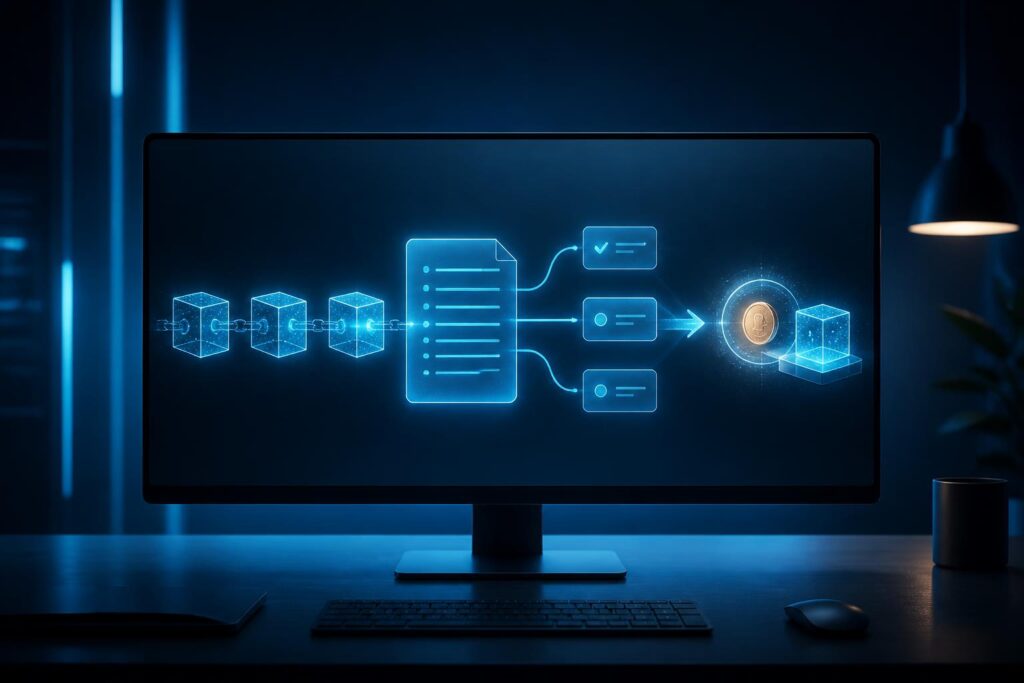
Smart contracts are one of the concepts often mentioned when discussing blockchain. The name can easily create the impression that they are a type of contract capable of thinking for themselves or completely replacing the law. In reality, a smart contract is a computer program deployed on a blockchain network and designed to carry out a set of actions when predetermined conditions are met. Its value lies in its ability to automate execution, not in intelligence in the conventional sense.
In traditional systems, a transaction often requires an intermediary to verify conditions, record the state and process the outcome. Smart contracts move part of that process into source code. When a user submits a valid request, the network checks the data according to the programmed rules. If the conditions are met, the program performs the corresponding action; if they are not, the transaction may be rejected. This mechanism opens up many new applications, but it also makes the quality of the source code and input data especially important.
How do smart contracts work?
Smart contracts can be viewed as a set of automated rules stored on a blockchain. These rules can specify who is allowed to perform an action, what conditions must be met, how assets are transferred and how the system’s new state is recorded. Once deployed, the program generally has its own address that users or other applications can interact with.
For example, a contract may stipulate that a digital asset can be transferred from the sender to the recipient only after a valid transaction has been confirmed. In an exchange application, the contract may receive assets from one party, check the conditions for matching an order and then process the exchange according to a predetermined formula. In a fundraising system, the program may record contributions and establish a refund rule if the target is not reached within a specified period.
Each interaction with a contract creates a transaction on the blockchain. That transaction must be processed by the network and usually incurs a cost for using computational resources. Once confirmed, the result is recorded in the blockchain’s state. Depending on the design of each network, the data may be inspected by anyone through a transaction-monitoring tool or blockchain explorer. However, the ability to observe a contract does not mean that its source code is always easy for ordinary users to understand.
Automation does not mean that people are unnecessary
A key strength of smart contracts is that they reduce the number of manual processing steps. Once conditions have been encoded, the program can perform an action without an employee having to review each case. This makes processes faster, easier to repeat and potentially less dependent on a single intermediary. The rules are also recorded publicly on the network if the contract is deployed on a blockchain that allows data access.
Even so, people continue to play an important role at many stages. Programmers must define the rules, write the code, test it and handle exceptional situations. Application developers must decide how to present information so that users do not accidentally confirm an unintended action. Users must check the contract address, the permissions they are granting and the transaction details before signing. If the original rules are incorrect or incomplete, automated execution may cause errors to occur more quickly rather than prevent them.
Smart contracts also cannot know that an event in the real world has occurred unless there is a mechanism for bringing that data onto the blockchain. For example, a program cannot independently observe the weather, verify that goods have been delivered or know how a match ended. It needs data from an external source, commonly called an oracle. When this data source is inaccurate, manipulated or unreliable, the contract’s outcome may be wrong even if the source code has not changed.
Source code and input data determine risk
The risks of smart contracts do not come only from the blockchain; they also come from the programmed logic itself. An error in calculation, access control or data processing can have major consequences. Problems such as allowing an account to perform an unauthorized action, failing to check conditions fully or updating the state in the wrong order can all alter the outcome of a transaction.
Another issue is the difference between the published source code and the program code actually running on the network. When the source code has not been verified or the application interface provides insufficient information, users may find it difficult to know exactly which function they are interacting with. Even when the source code is public, reading and evaluating it still requires technical knowledge. Therefore, seeing that a contract has a clearly identified address is not enough to conclude that it is safe.
Source-code audits can help identify some weaknesses before deployment, but they are not an absolute guarantee. An audit depends on the scope of work, the time at which it is conducted and the assumptions used. Even a small subsequent change can create new risks. In addition, attacks sometimes exploit the way multiple contracts interact with one another, meaning that evaluating one program in isolation may not reflect the system’s full range of risks.
Are smart contracts legal contracts?
It is important to clearly distinguish between smart contracts and legal contracts. A smart contract is computer code that can execute on a network. A legal contract is an agreement governed by a legal system, typically involving provisions concerning rights, obligations, evidence, liability and dispute resolution. A smart contract may help carry out an agreement, but its name does not automatically determine its legal status in every country or situation.
This becomes important when an error or dispute occurs. The program may have correctly executed the written instructions, yet the result may still conflict with the user’s intention. From a technical perspective, the blockchain generally records the action that took place; from a legal perspective, the parties may still need to consider the circumstances, the parties’ legal capacity, the terms of the agreement and applicable regulations. These two perspectives do not always coincide.
Therefore, projects using smart contracts for high-value activities need to consider both technical design and the legal framework. Simply relying on the idea that the code will execute automatically is not enough to resolve issues concerning ownership, consumer protection, taxation, fraud prevention or liability when the system encounters a problem.
What should users check before interacting?
First, users should determine whether they are interacting with the correct application and the correct contract address. Interfaces with similar names, fake links or misleading advertisements can lead users to an entirely different program. The appearance of a transaction in a wallet should not be treated as evidence that the transaction is safe.
Next, users need to carefully read the access permissions requested by the application. Some actions allow the transfer of only a specific amount of assets, while others may grant the contract broader usage rights. Users should understand which permissions are being granted, whether they are necessary and whether they can later be revoked or adjusted. If the interface does not provide a clear explanation, pausing to investigate is a more cautious choice than confirming out of habit.
Users should also consider basic information about the project: whether the development team has published the source code, whether the contract has undergone an independent review, how the governance mechanism is designed and whether it includes pause or upgrade functions. These functions are not inherently good or bad. They may help address incidents, but they also indicate that some control remains in the hands of an individual or governance group. Users need to know who holds that power and what limits apply to it.
Potential and limitations in practice
Smart contracts are well suited to processes with clear conditions, verifiable data and outcomes that can be expressed as computer rules. They can support the issuance of digital assets, conditional exchanges, access-rights management, payment distribution or the recording of certain application states. In these cases, the blockchain provides the storage and verification layer, while the smart contract provides the automated logic layer.
Conversely, smart contracts are not the ideal choice for every process. Activities that require flexible judgment, the handling of complex exceptions or reliance on difficult-to-verify data may face significant limitations. Transaction costs, processing speed, upgradeability and dependence on external data sources must also be considered. A system built on a blockchain may still have a centralized interface, intermediary servers or a governance group with significant authority to make changes.
Understanding these limitations helps avoid two common extremes: viewing smart contracts as a solution to every problem or completely dismissing their value because the code can still be wrong. A more practical approach is to evaluate each application based on its purpose, level of transparency, control mechanisms and the consequences if an error occurs.
Conclusion
Smart contracts are automation tools built on blockchain, not entities capable of independent reasoning and not automatic replacements for legal contracts. They carry out exactly what has been programmed within the scope of the data the system receives. Therefore, the quality of the source code, the reliability of the input data, the design of access controls and the way users confirm transactions are all decisive.
For newcomers, what matters is not memorizing every technical term but developing the habit of checking before interacting. Identify the application, read the access permissions, consider the value that could be lost and do not treat automation as an absolute guarantee of safety. When used in the right context, smart contracts can make many processes more transparent and efficient. When misunderstood, their very speed and automation can make mistakes difficult to reverse.
