


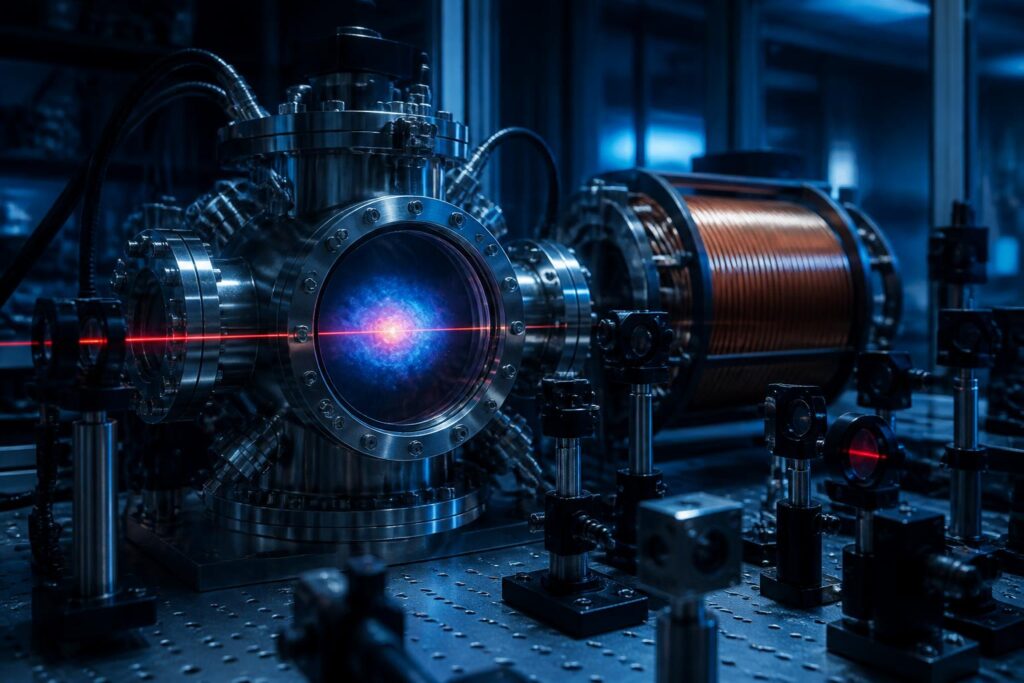
When people talk about quantum technology, most attention tends to focus on quantum computers and their ability to process problems that classical computers struggle to handle. However, another branch that is moving closer to practical applications is quantum sensing. Rather than using quantum states to perform calculations, quantum sensors exploit properties such as superposition, interference, spin, or highly sensitive interactions between matter and electromagnetic fields to measure quantities in the environment.
These quantities may include time, acceleration, temperature, magnetic fields, electric fields, gravity, or distance. In principle, a quantum sensor does not turn every measurement into an absolutely precise one. Its value lies in its ability to detect extremely small changes that conventional equipment might overlook, thereby opening up new ways of observing the world in healthcare, positioning, geology, navigation, fundamental research, and industry.
What Do Quantum Sensors Operate On?
At the microscopic level, atoms, ions, electrons, and photons obey rules that differ from the intuitions formed from everyday life. A quantum system can exist in a combination of multiple states before it is measured. Those states can also interfere with one another, meaning that the probability of observing the final result depends on how they combine. If an external influence changes the phase, energy, or spin of the system, that change can be converted into a measurement signal.
The basic process usually consists of three parts. First, the device creates and prepares a quantum state with suitable properties. Next, this state is allowed to interact with the quantity being measured, such as a magnetic field or acceleration. Finally, the system reads out the change and uses electronic circuits, software, or processing algorithms to infer the value of that quantity.
High sensitivity does not come solely from using a single quantum system. Many designs repeat the measurement numerous times, control sources of noise, and combine the results using statistical methods. Therefore, a quantum sensor remains a combination of physics, optics, electronics, precision mechanics, and signal processing. The quantum component cannot solve every problem by itself if the system as a whole operates unstably.
Representative Types of Quantum Sensors
Atomic Clocks
Atomic clocks use the frequency of atomic energy-level transitions as a time standard. Because these transitions are highly stable, atomic clocks can create a measure of time that is much more accurate than that provided by many clocks based on mechanical oscillations or conventional electrical circuits. They play an important role in satellite positioning systems, telecommunications networks, and many scientific experiments.
In a positioning system, location is calculated based on the time it takes a signal to travel from a satellite to a receiving device. Even a very small timing error can produce a significant error in position. Therefore, clock stability is not a minor detail but the foundation of the entire positioning method. New development efforts are seeking to make atomic clocks more compact, less power-hungry, and suitable for mobile devices or vehicles operating outside familiar positioning infrastructure.
Quantum Accelerometers and Gyroscopes
Quantum accelerometers can track the motion of ultracold atoms in a vacuum chamber. When the atoms are subjected to acceleration, their trajectories and phases change. By observing this change, the device can infer acceleration without necessarily relying on moving mechanical components.
A similar principle is also being studied for gyroscopes, devices that measure rotational motion. If made smaller and more robust, these sensors could support inertial navigation for ships, aircraft, underwater vehicles, or equipment operating in places where satellite signals are weak and unstable. However, the distance from an experimental device to a commercial product still depends on the ability to reduce size, shorten startup time, and maintain accuracy in vibrating environments.
Quantum Magnetometers
Quantum magnetometers measure magnetic fields by tracking the spin state or energy changes of a material system. Some designs are based on atoms, while others use special defects in solid materials. Color centers in diamond, commonly known as nitrogen-vacancy centers, are one area of interest because they can operate under conditions closer to ordinary environments than some quantum systems that require extremely low temperatures.
Highly sensitive magnetometers can be used to map geological structures, detect changes in materials, study brain activity, or support nondestructive testing in industry. However, measuring weak signals in an environment with many electrical and magnetic noise sources requires very careful shielding, calibration, and data analysis. A sensor’s theoretical sensitivity does not equate to effective measurement under every field condition.
Quantum Gravimeters
Quantum gravimeters use the free fall or motion of atoms to measure gravitational acceleration. Gravity in a given area is affected by the density and structure of the material beneath the surface. Consequently, small variations in gravitational acceleration can provide information about geology, underground water systems, cavities, or changes in ice masses and natural resources.
Unlike exploration methods based solely on drilling or direct surveying, gravity measurements can help build an initial picture of the area under investigation. Nevertheless, gravitational signals are often extremely small and easily affected by vibrations, terrain, tides, vehicle movement, and many environmental factors. To turn measurements into useful information, the data must be combined with geological models and other survey methods.
Medical Applications and Biological Research
Healthcare is one promising field for quantum sensors. The electrical activity of the heart and brain generates very weak electromagnetic fields. Sensitive enough measuring devices could help record these signals without inserting electrodes into the body. Systems for measuring the magnetic fields of the brain or heart have been studied for a long time, but advances in quantum sensors could help make the equipment smaller, more flexible, and easier to bring into clinical environments.
Quantum sensors could also be used to study biological processes at the cellular scale. When a sensor can detect small changes in magnetic fields, temperature, or chemical concentrations, it can help researchers observe interactions between cells and their environment. However, this should not be understood to mean that every quantum sensor is already ready to replace current medical equipment. In healthcare, a new technology must also demonstrate safety, repeatability, reliability, and diagnostic value in actual procedures.
Why Are Quantum Sensors Not Yet Widespread?
The first challenge is noise. Quantum states are highly sensitive to their environment, but that very sensitivity also makes sensors vulnerable to vibrations, temperature, unwanted light, electromagnetic fields, and instability in the power supply. A system may achieve impressive results in a laboratory but operate much less reliably when placed on a vehicle, at sea, or in a factory.
The second challenge is operational infrastructure. Some sensors require high vacuum, stable lasers, cooling equipment, or vibration-isolation systems. These requirements increase size, cost, and maintenance complexity. Miniaturizing a device is not simply a matter of manufacturing a smaller version of a prototype. Optical components, control sources, software, and calibration systems must also be redesigned to suit the operating environment.
The third challenge is turning sensitivity into a specific economic or social benefit. A more accurate measurement is meaningful only when it helps detect problems earlier, reduce surveying costs, improve safety, or produce information that older methods cannot provide. In many cases, quantum sensors will not completely replace traditional sensors but will operate alongside them, handling specialized measurements and adding data to existing systems.
The Prospects for Quantum Sensing Technology
The prospects for quantum sensing do not necessarily lie in a single device capable of solving every problem. A more practical direction is the development of many specialized sensors, each suited to a particular quantity and environment. Quantum clocks may serve timing applications, magnetometers may support biomedical or geological surveys, while gravimeters and accelerometers may be aimed at positioning, mapping, and exploration.
For the technology to advance, research groups and businesses need to improve several factors at the same time: stability, size, energy consumption, mass-production capability, and analytical software. Common measurement standards are also important, because users need to know how well a sensor performs under specific conditions, rather than relying only on specifications from the laboratory.
For the public, it is important to distinguish between potential and mature products. Quantum sensors have a clear scientific basis and many applications are being studied, but the pace of commercialization will vary among different types of devices. A cautious approach can help avoid both extremes: viewing the technology as a miraculous solution for every measurement, or assuming that it is meaningful only in fundamental research.
Quantum sensors show that quantum technology is not limited to large-scale computing machines. By exploiting subtle changes in atoms, photons, or spins, they can help people observe time, motion, magnetic fields, and gravity with a new level of detail. The path from physical principles to widely used devices still presents many obstacles, but this is one of the directions with the potential to bring the benefits of quantum technology closer to industry and everyday life.
