


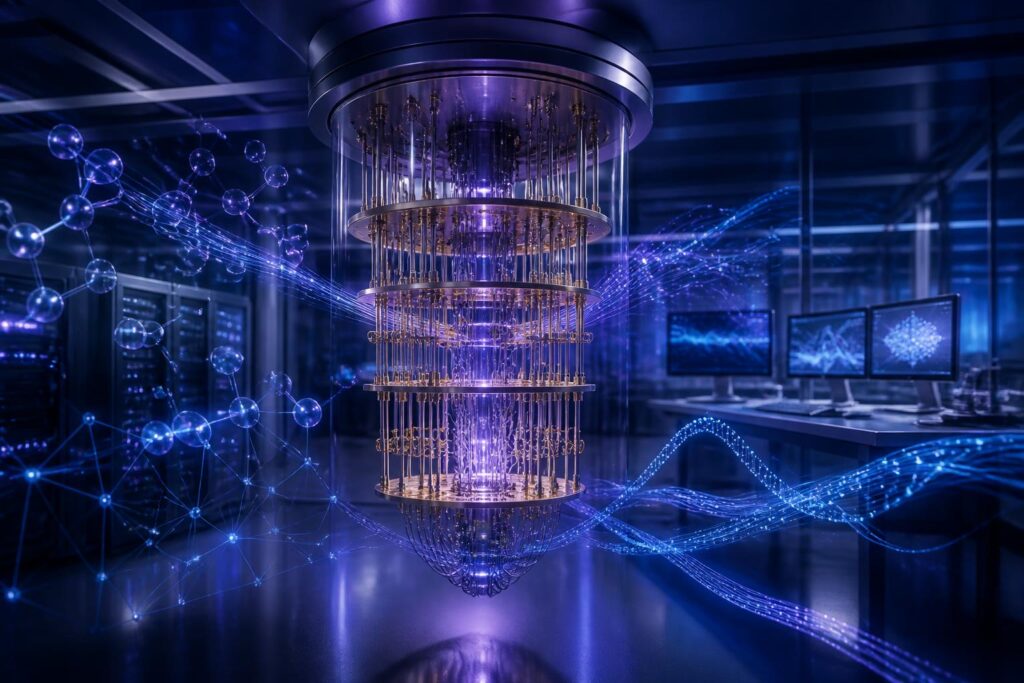
Quantum computers are often described using impressive concepts such as qubits, superposition, and quantum entanglement. However, the more important question is not how many qubits a system has, but what kinds of problems it can solve better than conventional computers. If this question is overlooked, readers may easily imagine a quantum computer as a machine capable of accelerating every type of software, from word processing to web searches. The reality is much more complex.
Quantum computers are designed to exploit the laws of quantum mechanics in the process of representing and transforming information. Any advantage, if it exists, generally appears only when an algorithm is built to take advantage of that structure. Many everyday tasks remain better suited to classical processors because they are inexpensive, easy to program, and do not require special operating conditions. Understanding the proper scope of applications helps distinguish the scientific potential of quantum computing from overly broad expectations.
Not Every Problem Benefits from Qubits
In conventional computers, information is processed using bits with a value of 0 or 1. A qubit can exist in a superposition state before it is measured, but this does not mean that a quantum computer can read all possible results simultaneously and then select the correct answer for free. When measured, the system returns only one specific result. The power of quantum algorithms lies in how states are transformed and made to interfere, so that unwanted possibilities are canceled out while suitable possibilities are amplified.
This imposes a strict requirement: the problem must have a structure that a quantum algorithm can exploit. An ordinary program does not automatically run faster simply because it is transferred to quantum hardware. Developers need to remodel the problem, build a quantum circuit, prepare the data, and process the measurement results. If the preparation or post-processing stages consume substantial resources, the benefit from the quantum-computation step may be significantly reduced.
Familiar tasks such as word processing, video streaming, managing small databases, or running most business applications are not natural targets for quantum computers. Conventional computers already have stable architectures, large memories, rich development tools, and the ability to operate under ordinary conditions. Therefore, the prospects for quantum computing do not lie in replacing all existing computers, but in supplementing them with a specialized tool for difficult problems.
Molecular and Materials Simulation Is a Prominent Application Area
One reason quantum computers attract interest is that nature at the atomic level itself follows the laws of quantum mechanics. Accurately simulating the behavior of many particles with classical computers can become difficult as the number of states that must be considered increases. Quantum computers may represent certain quantum systems in a way that more closely reflects their nature, thereby supporting research into molecular structures, chemical reactions, and materials.
In this field, the goal is not necessarily to produce a complete result after a single run. Researchers may be interested in the energy of a state, the properties of a molecule, or how a system changes under certain conditions. Such information can support the search for new materials, research into catalysts and batteries, and the development of chemical processes. However, practical applicability still depends on system size, qubit accuracy, measurement quality, and the effectiveness of the algorithm.
Quantum computers also do not automatically replace experiments in the laboratory. Simulation results need to be verified through theory, classical calculations, or experiments. Their value may lie in narrowing the search space, suggesting noteworthy structures, or helping scientists better understand a mechanism that is difficult to observe directly.
Cryptography and Problems Involving Number Structures
Another commonly mentioned application area is cryptography. Some public-key cryptographic systems rely on the difficulty of certain mathematical problems for conventional computers. Shor’s algorithm shows that a sufficiently large, stable, and error-corrected quantum computer could, in principle, efficiently solve certain problems related to integer factorization and discrete logarithms. This is why organizations are concerned not only with current capabilities, but also with preparing for future risks.
It is important to distinguish theoretical possibility from practical capability. Presenting an algorithm does not mean that current hardware can already break the cryptographic systems in use. To run large-scale algorithms, quantum computers need more physical qubits than the logical qubits used in the computation, along with extremely strong error-control capabilities. The gap between an algorithmic model and a practical operating system remains a major engineering challenge.
Conversely, quantum computers also point toward new methods of protection. Quantum key distribution protocols rely on the properties of quantum measurement to detect certain types of interference, while post-quantum cryptography focuses on algorithms that can be deployed on conventional computer infrastructure but are designed to withstand threats from future quantum computers. Therefore, the impact of quantum computing on information security is not only a story about code-breaking, but also a process of changing standards and managing the life cycle of data.
Search and Optimization: Great Potential, but Requiring Careful Evaluation
Grover’s algorithm is often used to illustrate the potential quantum speedup for searching an unstructured space. Compared with trying possibilities one by one on a classical computer, this algorithm can reduce the number of queries according to a certain rule in an appropriate model. Even so, the result does not make every search task instantaneous. The algorithm requires a way to represent the data and a method for checking answers that can be performed in a quantum circuit. The costs of loading data, constructing the checking operation, and reading the result must still be taken into account.
Optimization is another field often expected to benefit from quantum computers. Many problems in transportation, scheduling, network design, and resource allocation have a number of possible solutions that increases very rapidly as the number of variables grows. Some quantum methods attempt to find good solutions to such problems by mapping them onto an energy model or a variational circuit.
However, “can be represented using a quantum model” does not mean “is certain to be faster.” Optimization problems often have to be converted from real-world data into a mathematical form, after which the quality of the solution must be evaluated and compared with classical algorithms that have been optimized over many years. In many cases, a simple classical method or an approximate algorithm still produces sufficiently good results at a lower cost. Therefore, the practical question is not simply whether a quantum computer can find a solution, but whether that solution is better, faster, or more economical than the current process.
The Obstacles Lie in the Data, Hardware, and How Benefits Are Measured
For a quantum application to be meaningful, the entire process must be considered rather than just the circuit’s execution time. Data may need to be encoded into a quantum state, a step that is not always straightforward. The system must also control noise, limit errors, and perform measurements many times to estimate the result. If each run produces varying results, obtaining reliable information may require many additional executions.
Current hardware is also affected by environmental noise and operational errors. Different platforms use different qubit technologies, giving them distinct characteristics in terms of state-retention time, connections between qubits, and controllability. An algorithm that looks good on paper may need to be adjusted substantially to suit a specific architecture. This is why evaluating an application must include its hardware, software, data, and operating-cost requirements.
Consequently, the criterion of “quantum advantage” must be used carefully. A fast result on an artificial problem does not automatically prove that a quantum computer is useful in production. A reliable evaluation requires comparison with the best suitable classical method, using meaningful data and including the time required for preparation, data transfer, error correction, measurement, and post-processing.
Businesses Should Start with the Problem, Not the Glamour of the Technology
For businesses, the first step should not be to purchase or deploy a quantum computer simply because the technology is receiving considerable attention. A more reasonable approach is to make a list of problems with high computational costs, complex simulation requirements, or structures that fit the quantum algorithms currently being researched. Businesses can then build a small-scale version, compare it with a classical method, and identify the actual bottlenecks.
This process also requires personnel capable of connecting multiple fields: business knowledge, mathematics, computer science, and the characteristics of quantum hardware. In the early stages, learning how to model a problem and evaluate the results may be no less important than running a program on a quantum device. Businesses should avoid vague claims about speed while also considering data security, integration capabilities, and plans for cryptographic migration if they are storing information for the long term.
Quantum Computers Will Be Specialized Tools Within the Computing Ecosystem
The most realistic outlook is not for quantum computers to replace classical computers, but for the two types of systems to coexist and handle different tasks. Classical computers will continue to manage interfaces, storage, data management, process coordination, and most application logic. When appropriate, a quantum processor may be called upon to perform a specialized task and then return the result to the main system.
The value of quantum computers will be determined by the cases in which they deliver measurable benefits, not by the number of new concepts appearing in introductory presentations. Quantum simulation, certain cryptographic problems, structured search, and optimization are areas worth watching, but each has its own conditions and limitations. Understanding those conditions helps users avoid both absolute skepticism and unrealistic expectations.
Ultimately, the right question is not whether quantum computers are faster than conventional computers at everything. The right questions are: Which problems have a suitable structure? Do the potential benefits outweigh the costs of implementation? And how can the results be verified? Approached in this way, quantum computing becomes an engineering field that requires serious evaluation, rather than a vague promise about the future of all computational activity.
