


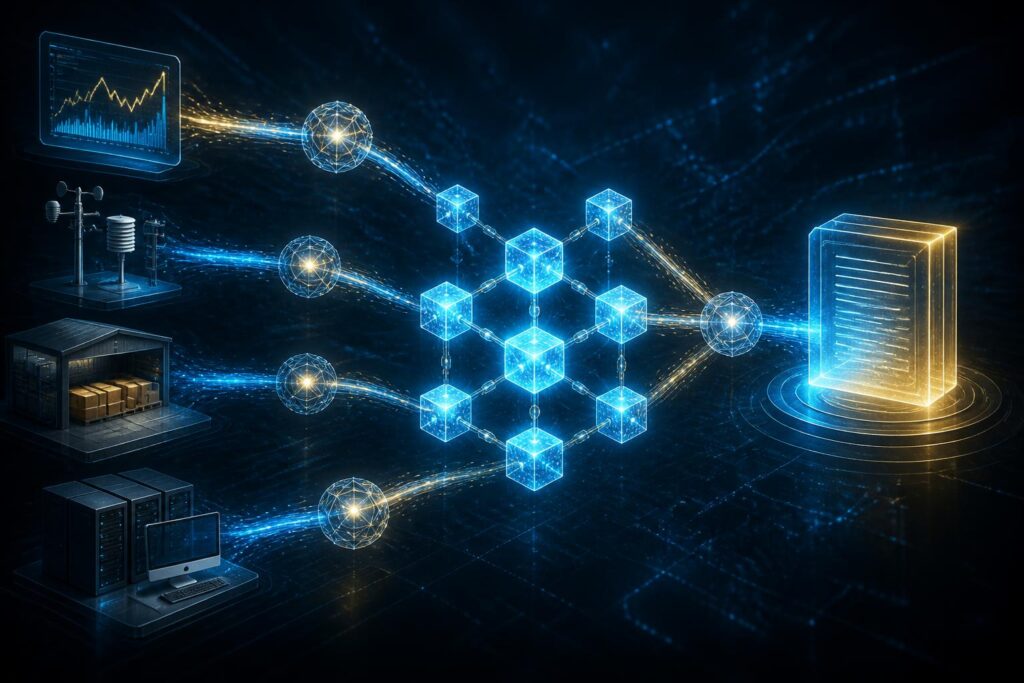
Blockchain is often described as a system capable of recording and verifying data without a single central coordinator. However, this capability primarily applies to information that is already inside the network. A blockchain can check token balances, transaction statuses, or the result of a calculation according to programmed rules. It does not automatically know the price of Bitcoin on an exchange, the temperature in a city, the result of a match, or whether a shipment has arrived at a warehouse.
For smart contracts to use such external data, the blockchain ecosystem needs a connection layer commonly called an oracle. An oracle is not simply a pipeline that brings data onto the chain. It also involves how data is collected, compared, transmitted, and protected against manipulation. When a decentralized application depends on an oracle, the application’s quality lies not only in the contract’s source code but also in the reliability of the data source and the update mechanism.
What problem does a blockchain oracle solve?
Smart contracts can automatically execute conditions, but they generally cannot directly access the internet, enterprise databases, or traditional payment systems. This limitation has a technical rationale. If every node verifying a transaction independently called a different website or API, the nodes could receive different results. In that case, it would be difficult for the network to reach consensus on the state that should be recorded.
An oracle addresses this problem by collecting external data, processing it according to a specific mechanism, and then sending the result to the blockchain. A smart contract uses only data that has been brought into the network through a transaction. This approach makes it possible to build a wider range of real-world applications, from decentralized finance platforms, parametric insurance, and prediction markets to asset-tracking systems.
For example, a lending contract may need a reference price for collateral to assess the safety of a loan. A weather insurance product may need rainfall or temperature data. A payment contract in a supply chain may need delivery status from a logistics management system. In all these cases, the blockchain provides the execution and storage environment, while the oracle provides information that the blockchain cannot observe on its own.
Common types of oracle data
Oracles provide data from many different sources. The most common category is price data, such as the prices of cryptocurrencies, financial assets, or commodities. This data is often used in lending protocols, derivatives trading, and applications that need to determine the value of an asset at a specific point in time.
Another category is real-world event data. A contract may need to know whether a shipment has been delivered, whether a flight has been delayed, or whether an insured event has occurred. There is also data related to time, sports results, weather indicators, exchange rates, or information from enterprise systems. The broader the scope of the application, the more complex the requirements for data-verification processes become.
In terms of operation, centralized and decentralized oracles can be distinguished. A centralized oracle obtains data from a single source or is controlled by one entity. This approach has the advantages of being easy to implement, generally less expensive, and potentially faster to update. In return, the entire system may depend on the accuracy, continuity, and good faith of one party.
A decentralized oracle uses multiple data providers or independent actors. The final result may be determined by comparing sources, taking the median value, or applying a consensus rule. This model does not eliminate risk entirely, but it helps reduce dependence on a single point of failure. In return, it can increase costs, latency, and operational complexity.
Why is oracle data an important risk point?
A blockchain can protect the integrity of data after that data has been recorded on-chain, but this does not automatically prove that the original data was correct. If an oracle feeds an incorrect price into the blockchain, the smart contract can still execute correctly according to its code based on that price. In other words, the blockchain’s immutability cannot compensate for an unreliable input.
The first risk lies in the data source. A single source may be disrupted, attacked, or provide incomplete information. Even when data comes from multiple sources, those sources may all depend on the same original provider. Therefore, the number of sources is not the only criterion for assessing the degree of decentralization.
The second risk is the timing of updates. Asset prices can move faster than an oracle’s update cycle. If on-chain data is delayed, a protocol may make decisions based on outdated information. This issue is particularly significant in applications involving collateral, where a major fluctuation can substantially change the safety level of a loan.
The third risk concerns how abnormal data is handled. One source may deviate sharply from the others, data may be missing, or an API may temporarily stop working. An oracle system needs rules for such situations, such as excluding abnormal values, using the most recent data, or temporarily suspending updates. Each choice has limitations and can create different impacts for users.
How should an oracle mechanism be evaluated?
Users should not look only at an oracle’s name or at claims that the system is decentralized. The first question to ask is where the data comes from. How many independent sources are there, can the sources be checked, and how does the system respond when one source fails to respond? This information helps distinguish genuine diversity from simply connecting multiple points that still depend on the same origin.
Next is the data-aggregation mechanism. Does the system use a median value, a deviation threshold, or additional confirmation conditions? Is the data updated at fixed intervals, according to the level of volatility, or at the contract’s request? If the answers are unclear, it is difficult for users to assess the risk of delayed or manipulated data.
Governance and upgrade rights should also be considered. Who can change the list of data providers, adjust alert thresholds, or suspend the service? Are those rights held by one individual, a multisignature group, or a broader governance mechanism? A system may use multiple data sources while remaining centralized in its governance. This is a point that is often overlooked when evaluating decentralized applications.
Finally, attention should be paid to the system’s operating history, technical documentation, and how the project discloses incidents. The fact that a system has never encountered a problem should not be considered conclusive evidence that it is safe. More important is whether the project has mechanisms to detect and respond to abnormal data and limit the damage when such data appears.
An oracle is not a solution to every data problem
An oracle can transmit data to the blockchain, but it cannot turn subjective data into absolute truth. If a data source concerning a real-world asset is already wrong, the oracle merely transfers that error into the contract. For events that are difficult to verify, the system may need multiple layers of checks, additional evidence, or the involvement of parties with legal responsibility.
This also demonstrates the limitations of decentralized applications. The more a protocol depends on off-chain information, the more it must consider the trade-offs among automation, speed, cost, and verifiability. No model can be completely decentralized, immune to incorrect data, and updated instantly under all circumstances.
Implications for users and businesses
For users, understanding oracles helps avoid confusing “a transaction has been confirmed on the blockchain” with “the information underlying the transaction is accurate.” Before using an application involving prices, collateral, or event outcomes, users should learn about the data sources and the situations in which the system may be temporarily paused.
For businesses, oracle integration should begin with specific data requirements. A business must determine which data is important, what level of latency is acceptable, who is responsible when the data is incorrect, and how to respond when the connection is interrupted. A good design not only selects data sources but also establishes procedures for checking data, recording incidents, and limiting the authority to execute automatically in abnormal situations.
An oracle is less prominent than an application interface or a token, but it can determine how a smart contract responds to the outside world. As blockchain is introduced into financial, commercial, and asset-management activities, questions about data quality will become increasingly important.
Understanding oracles correctly also means understanding the limits of blockchain. This technology can create a ledger that is difficult to alter and an automated execution environment, but ultimate reliability still depends on the entire chain, from the data source and verification mechanism to the rules for handling incidents. Therefore, instead of asking only whether an application uses blockchain, users should ask where the application’s data comes from, how it is checked, and what happens when that data is no longer reliable.
