


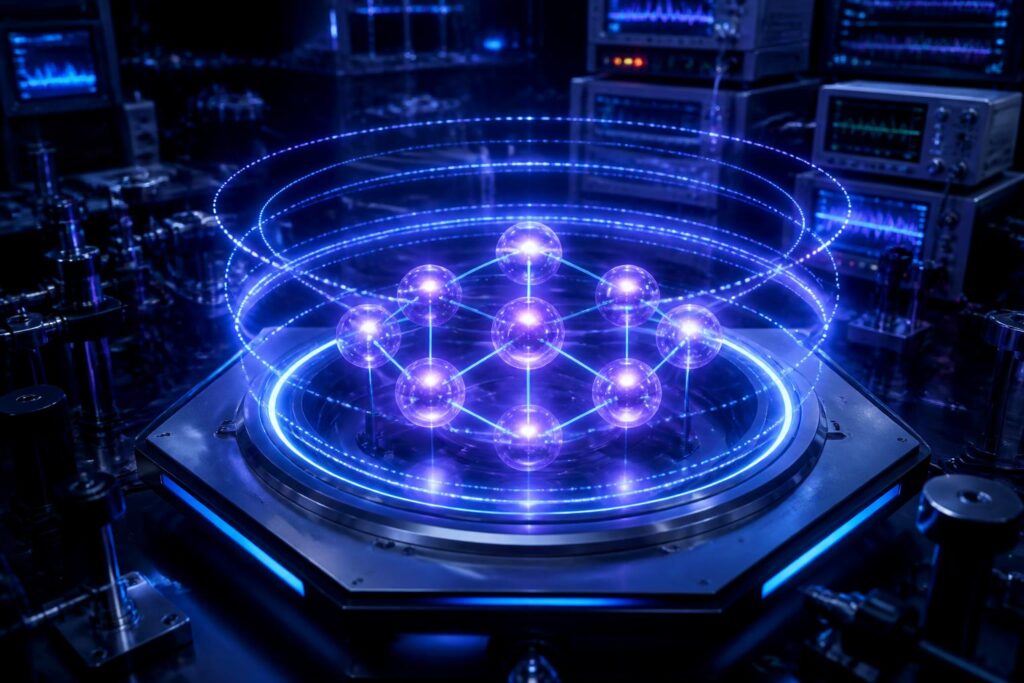
One of the important paradoxes of quantum computers is that, to perform a reliable computation, a system often has to use more qubits than the number directly involved in the algorithm. These additional qubits are not primarily used to increase the problem size in the usual way, but to detect and handle errors. This is the foundation of quantum error correction, a field that plays a decisive role in the future of quantum computing.
In classical computers, data is represented by bits with a value of 0 or 1. If a bit is flipped because of noise, a circuit can use check bits, copying operations, or other redundancy mechanisms to detect and restore the original value. Qubits do not allow this approach to be applied directly. A quantum state can be a superposition of 0 and 1, and it can also be linked to other qubits through entanglement. Measuring a qubit usually changes the state that one wants to protect, while completely copying an arbitrary quantum state is impossible under the basic principles of quantum mechanics.
Why are qubits prone to losing information?
A qubit is a physical system, not merely an abstract symbol on a screen. Depending on the technological platform, a qubit may be created from superconducting circuits, trapped ions, neutral atoms, photons, or other physical systems. Every platform must isolate the qubit from its environment well enough to preserve its quantum state, while still allowing researchers to control and measure it. These two requirements often conflict with each other: stronger interaction makes control easier, but it can also open more paths for noise to enter.
Quantum noise takes many forms. An inaccurate control pulse can cause a qubit to rotate away from the desired state. Thermal fluctuations, electromagnetic radiation, material defects, or unintended interactions can alter the amplitude and phase of the state. A qubit can also lose energy over time or lose its phase relationship with other qubits. These two processes are often described by energy-relaxation time and coherence time. When a computation lasts longer or has to pass through more quantum gates, the cumulative probability of error increases.
Not every error appears as changing a 0 into a 1. In quantum space, one can envision a basic group of errors that includes errors changing a component similar to a bit flip and errors changing the phase. Real-world errors are often combinations of several different forms. Therefore, an error-correction system must not only know the final measurement result, but must also collect enough indirect information to infer which error may have occurred without destroying the quantum data.
Physical qubits and logical qubits
The central idea of quantum error correction is to distinguish between physical qubits and logical qubits. A physical qubit is an element created directly in hardware and exposed to the environment. A logical qubit is quantum information encoded across a group of physical qubits. Through this encoding, the system can check for signs of errors and correct them while maintaining the information being processed by the algorithm.
Checking does not mean directly measuring the value of 0 or 1 of the logical qubit. Instead, the quantum computer measures ancillary qubits and check quantities, commonly called error syndromes. The syndrome indicates whether the current state is consistent with the code space. If a syndrome changes according to a particular pattern, the controller can infer the location or type of error that is likely to have occurred. The primary data does not necessarily have to be read out, so the superposition needed for the algorithm can be preserved.
There are many different encoding methods. Some codes use small groups of qubits to protect one logical qubit from simple errors. Others, including lattice-based codes, distribute information across a larger structure so that errors can be checked continuously. The larger the code, the better its error resistance may be, but in return the system requires more physical qubits, more measurements, and more complex control circuits.
Error thresholds and the conditions for meaningful error correction
Quantum error correction does not automatically make all hardware reliable. One important principle is that the error rate of physical operations must be below a certain threshold determined by the code and the system architecture. When this condition is met, increasing the code size can reduce the error rate of the logical qubit. In other words, adding physical qubits then does not merely create additional costs; it genuinely helps make the information more stable.
If hardware errors remain too high, adding qubits may provide no benefit. Errors in measurement, errors when creating quantum gates, errors in connecting qubits, and errors in the control circuitry can accumulate. The system must also take correlated errors into account, meaning that multiple qubits are affected by the same cause, because simple error-correction models are usually most effective when errors are relatively independent.
The concept of a threshold therefore should not be understood as one common number for every quantum computer. The threshold depends on the type of code, how the hardware is connected, the measurement process, the error-correction cycle time, and the noise model. A device with a low average error rate but a few serious correlated errors may still face difficulties. Conversely, a suitably designed architecture may make better use of the same level of component quality.
Where do the major costs lie?
The first challenge is the number of qubits. One logical qubit may require many physical qubits, especially when a high level of protection is needed for long computations. The specific number varies according to the error-correction code, hardware quality, and application requirements, so no fixed ratio can serve as a standard for every system. The gap between physical and logical qubits is one reason claims about the number of qubits needed should be considered together with quality and error-correction capabilities.
The second challenge is the speed and accuracy of measurement. To detect errors, the system must regularly measure ancillary qubits. If measurement is too slow, the state may continue to deteriorate before the controller can respond. If measurement is too noisy, the resulting syndrome will cause the decoder to make the wrong decision. The control hardware, wiring, cooling equipment, or laser systems, depending on the platform, must also operate in sync with a high degree of stability.
The third challenge is the decoder. After each checking cycle, the computer must analyze the syndrome sequence to estimate which errors have occurred. As the number of qubits increases, the amount of checking data also increases. The decoder must be fast enough not to become a bottleneck, while also adapting to the device’s actual noise characteristics. This creates an intersection between quantum hardware, algorithms, control electronics, and classical data processing.
From experimental results to fault-tolerant computers
During development, research teams often evaluate error correction on several levels. The first is the ability to generate and measure syndromes stably. The next is checking whether the logical-qubit error rate decreases as the code size increases. This is more important than merely demonstrating a short quantum circuit, because a fault-tolerant system must show an improvement trend that can be scaled.
Even when a logical qubit is protected, the computer still needs to perform logic gates between different logical qubits. Some gates can be implemented relatively directly within the code, while others require more complex procedures, along with many ancillary qubits and measurements. Special operations can become the most expensive part of the entire architecture. Therefore, the design of an error-correction code must go hand in hand with algorithm design, rather than being viewed merely as a technical layer behind the hardware.
This also explains why today’s quantum computers are often described as being in the early stages of development. Experimental devices may perform useful computations for hardware research, but to run large algorithms for long periods, a system needs stable logical qubits, reliable controllers, and an architecture that can scale. The number of qubits alone does not fully reflect the distance to that goal.
Implications for users and the technology industry
Quantum error correction may sound like an issue intended only for laboratories, but it directly affects how every future application is evaluated. Problems such as materials simulation, chemical research, optimization, or cryptography will require circuits that are sufficiently long and accurate. If errors accumulate faster than they can be controlled, the results may be unreliable even when the algorithm is highly promising in theory.
For businesses, this creates a need to look beyond marketing figures about qubit counts. Practical questions to ask include: how many qubits can operate simultaneously, under what conditions was the error rate measured, does the system already support logical qubits, how do measurement and decoding work, and does performance improve as the system scales? This approach helps distinguish a demonstrational prototype from a platform with the potential to support sustainable computation.
In the long term, quantum error correction is not an auxiliary feature but a condition for quantum computers to become reliable computational tools. The road ahead may require simultaneous improvements in materials, circuit design, encoding methods, decoding algorithms, and control systems. Success will not be determined solely by creating more qubits, but by the ability to transform fragile physical qubits into logical qubits capable of preserving information through a long sequence of computations.
Quantum computers promise to exploit laws different from those used by classical computers, but that advantage matters only when the results are accurate enough to be verified and used. Quantum error correction is precisely the bridge between a quantum state easily disrupted in the laboratory and a system capable of performing practical work. This bridge still has many gaps to overcome, but it also reveals an important truth: progress in quantum computing lies not only in creating quantum states, but also in the ability to protect those states long enough to turn an idea into a result.
