


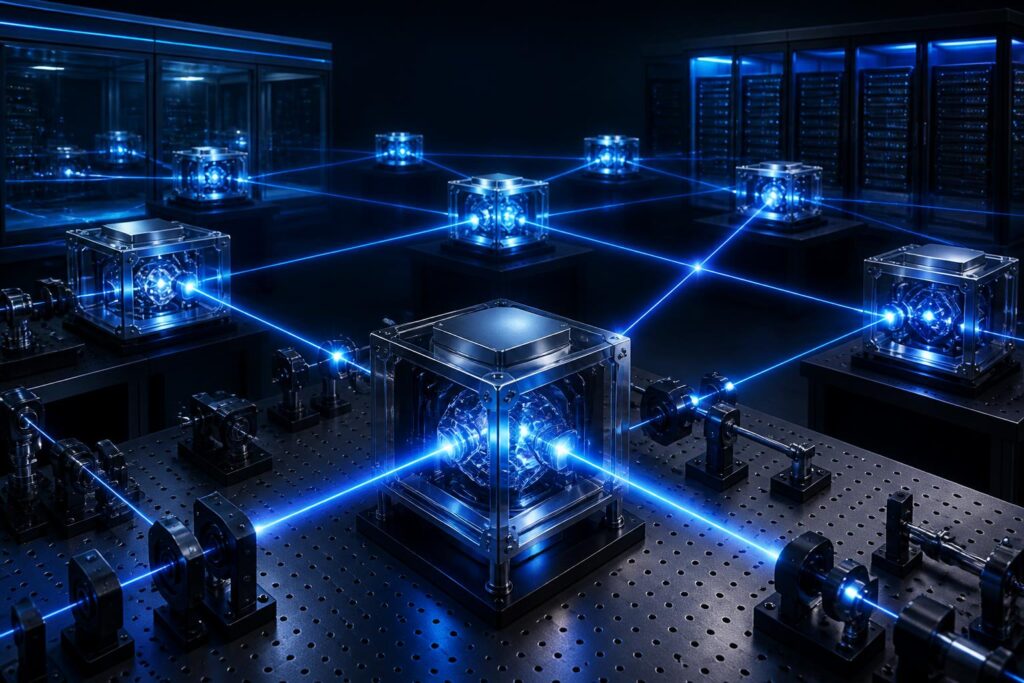
When people talk about quantum computers, most attention usually focuses on the processor, the number of qubits, or error-correction capabilities. However, a single quantum computer is not the whole picture. If quantum processors can be connected to one another, they could potentially share quantum states, coordinate to perform tasks, and expand their capabilities beyond the limits of each individual system. That idea lies at the heart of quantum networks.
A quantum network is not simply a higher-speed version of the Internet. Today’s Internet transmits classical bits, which can be copied and amplified to counter signal loss along the transmission path. Quantum information follows different rules. An arbitrary quantum state cannot be copied perfectly, while measuring it can alter the very state being transmitted. Therefore, building a quantum network requires a new architecture in which photon sources, quantum memories, intermediate nodes, and classical control systems must work closely together.
What Does a Quantum Network Transmit?
The unit of information in a quantum network can be encoded in the properties of photons, such as polarization or path states. Photons are often chosen as information carriers because they can travel through optical fibers and, in some cases, through free space. At the receiving end, the photon’s state is measured to obtain information, but this process is not the same as reading an ordinary bit. The measurement result is probabilistic and depends on how the measurement is performed.
Another important concept is quantum entanglement. Two entangled particles can exhibit a special correlation even when they are far apart. When one particle is measured, the result for the other is related to that result in a way that cannot be fully explained by simple classical variables. Entanglement does not allow messages to be sent faster than light, but it can serve as a resource for carrying out quantum communication and computing protocols.
In many network designs, the initial goal is not to send an intact qubit directly from one point to another. Instead, network nodes try to create pairs of entangled particles between locations. Once an entangled pair and a classical communication channel are available, a quantum state can be transferred from one place to another through a process commonly called quantum teleportation. This name can be misleading, because matter does not disappear and then appear elsewhere. The state is recreated at the receiving end, while the original state is altered during the measurement process.
Why Are Quantum Networks More Difficult Than Traditional Networks?
The first challenge is loss. Photons traveling through optical fibers can be absorbed or scattered. With classical signals, amplifiers can receive a weak signal, regenerate it, and transmit it onward. That approach cannot be directly applied to an unknown quantum state, because copying an arbitrary quantum state is impossible. If an intermediate node measures a photon to create a copy, the original quantum information will be destroyed.
The solution being studied is the quantum repeater. Rather than amplifying a qubit, a quantum repeater divides the route into multiple shorter segments. Nodes at both ends of each segment create and store entanglement, then use operations such as entanglement swapping to extend the connection over longer distances. In theory, this method can overcome the limitations of direct transmission. In practice, it requires quantum memories with sufficiently long storage times, precise synchronization mechanisms, and the ability to generate entangled pairs with stable quality.
The second challenge is the fragility of quantum states. Interactions with the environment, thermal fluctuations, mechanical vibrations, or electromagnetic noise can all cause decoherence. When that happens, quantum information gradually loses the properties required by the protocol. A quantum network therefore has to control its environment much more strictly than many conventional communication systems, while also being able to detect failed transmissions and try again.
The third challenge concerns speed. Entanglement-generation processes are often probabilistic. Not every attempt produces a pair of particles that meets the required quality. A network node must also wait for confirmation from other nodes, store the state for an appropriate period, and only then perform the next step. This creates latency and makes the design of control protocols just as important as the fabrication of quantum hardware.
The Architecture of a Quantum Network
A complete quantum network may consist of multiple layers. At the physical layer are photon sources, single-photon detectors, frequency converters, optical fibers, or wireless links. The quantum-memory layer stores states for the amount of time needed to wait for other processes to finish. Above that are protocols for creating, distributing, and confirming entanglement. Finally, the classical control layer is responsible for routing, synchronization, error management, and the exchange of auxiliary information.
This layered structure shows that quantum networks do not completely replace existing Internet infrastructure. In many scenarios, the two systems will operate in parallel. The classical channel remains necessary for sending measurement results, reporting node status, and confirming data. The quantum network provides a new resource—quantum states or entangled pairs—while the classical network handles most of the coordination work.
Network nodes may also have different roles. An end node may be a quantum processor located in a laboratory or data center. An intermediate node may only be responsible for storing and extending entanglement. In a more complex architecture, a node may perform special measurements to support distributed computing. Distinguishing between roles means that designers do not have to equip every location with every function.
Expected Applications
One commonly mentioned application is quantum key distribution. In some protocols, interference by a third party during the exchange process can alter the measured statistics and leave signs of unusual activity. This creates a method for detecting eavesdropping based on the physical properties of a quantum system, rather than relying solely on the assumption that a mathematical problem is difficult to solve.
However, quantum key distribution does not mean that every cybersecurity risk disappears. Systems can still be attacked through transmitting devices, receiving devices, control software, or key-management procedures. The security of such a network depends on both the theoretical protocol and its practical implementation. Therefore, a quantum network should not be viewed as an absolute shield that replaces existing security measures.
A more long-term application is connecting quantum processors. If small machines in multiple locations can share entanglement and coordinate with one another, a problem could be divided among the systems rather than being forced to run on a single machine. This could be useful when processors are built using different technologies, placed in different operating conditions, or designed for specialized tasks.
Quantum networks could also support distributed measurement. Multiple sensors located in different places could coordinate to compare signals or improve measurement sensitivity. Nevertheless, the specific benefits still depend on sensor quality, the ability to maintain entanglement, and the processing of data after measurement. Not every measurement problem requires a quantum network, so determining the practical advantage must be done on a case-by-case basis.
Development Will Not Happen in a Single Step
The common vision of a global quantum Internet often overlooks the gap between laboratory experiments and real-world operation. A practical roadmap could begin with short links between two devices, where researchers test the ability to generate photons, transmit photons, and confirm correlations. After that, test networks consisting of several nodes could be used to evaluate routing protocols, memories, and recovery mechanisms.
The next stage could involve regional networks connecting laboratories, universities, or data centers within the same city. At this scale, issues such as sharing optical fibers with classical traffic, maintaining device stability over time, and carrying out maintenance outside a controlled environment would become more apparent. Only when these components operate reliably will expansion across distant geographic regions have a convincing foundation.
Intercontinental routes may need to combine optical fiber with free-space or satellite links, but this is a separate engineering problem with demanding requirements for alignment, weather conditions, transmission timing, and photon detection. Therefore, progress in quantum networking should not be evaluated solely by the number of devices demonstrated. More important criteria include entanglement-maintenance time, the rate of successful link generation, node reliability, and the ability to integrate with network software.
What Needs to Be Standardized?
A network becomes truly useful only when devices from different manufacturers can work together. This requires common conventions for information formats, how entanglement is requested, how errors are reported, and how quantum resources are managed. If each system uses its own protocol, network expansion will be limited by gateways and proprietary integrations.
Standardization also needs to include terminology and evaluation methods. A link can be described using photon-loss rate, state fidelity, waiting time, or entanglement-generation probability. These metrics must be measured in ways that allow comparisons across platforms. In addition, systems need mechanisms for device authentication and access control, because a compromised network node could affect the entire communication process.
Human resources are another aspect that is often underestimated. Quantum networking lies at the intersection of optics, quantum physics, telecommunications engineering, cryptography, and computer science. A team that is strong only in hardware but lacks network-operation expertise will struggle to turn a prototype into a reliable service. Organizations that want to prepare early should invest in interdisciplinary testing capabilities rather than simply purchasing a single quantum device.
Quantum networks should therefore be viewed as an emerging infrastructure, not as a finished product that is about to replace the Internet. Their value will depend on the tasks that genuinely require quantum states, operating costs, and the ability to work with classical systems. In the near future, small networks serving research, specialized security, or processor interconnection may be more practical than a universal network intended for every user.
The most noteworthy aspect of this development is that it expands how we think about quantum computing. Computing power does not reside only in a single chip or laboratory. It can be distributed among multiple nodes, provided that people can solve the problems of transmitting, storing, and controlling quantum states. That path still has many limitations, but building each reliable link today will determine whether quantum networks can become practical infrastructure or remain merely technological demonstrations.
